
Tips, Stories, and Updates on Entrepreneurial and Cofounder Journeys
Stay in the loop with 25,000+ founders

Cofounder Tips
How to Interview for Mindset For An Early Hire Startup Role
September 27, 2025
In the fast-paced world of startups, a resume is a historical document, but a great early hire is a forward-looking asset. When a founder is building a team from scratch, they are not just looking for a list of skills and past jobs; they are looking for resilience, ownership, and a mindset that can adapt to a chaotic, ever-changing environment. This article will go beyond the bullet points and explain how to interview for the qualities that truly matter, ensuring you find a startup employee who can build a company, not just perform a job.
A resume is often a misleading guide. It tells you where a person has been, but not how they think, what motivates them, or how they handle failure. A candidate from a large, established company might have an impressive resume but could be completely unequipped for a startup role where resources are scarce and roles are fluid. The true value of an early hire is not in their past achievements, but in their ability to solve problems that haven't even been defined yet.
1. The Three Pillars of a Great Startup Employee
When you look beyond the resume, you are searching for a specific type of person. A great startup employee is a combination of three key traits: ownership, resourcefulness, and cultural alignment.
Pillar 1: Ownership and Initiative
In a startup, there’s no one to tell you what to do. The best employees are those who see a problem and proactively solve it without being asked.
- Questions to Ask:
- "Tell me about a time you had to solve a problem that wasn't in your job description."
- "What do you do when you don't know the answer to a problem?"
- What to Listen For: A great answer will show a candidate who takes initiative, looks for solutions on their own, and is not afraid to step outside of their designated responsibilities. They should describe a situation where they saw a gap and filled it, even if it meant learning a new skill. An example might be an engineer who notices a bug on the front end and takes it upon themselves to fix it, even if they are a backend developer. A founder looking for a technical cofounder knows this initiative is non-negotiable.
Pillar 2: Resourcefulness and Resilience
Startups operate with limited resources and face constant setbacks. Resilience is a must-have quality for any startup role.
- Questions to Ask:
- "Tell me about a time you failed and what you learned from it."
- "Describe a work environment in which you’ve thrived."
- What to Listen For: A strong candidate won't shy away from talking about failure. Instead, they will own it, articulate what went wrong, and explain the lessons they took away. Their stories of success will often be tied to overcoming significant obstacles with limited tools. When a business partner finder is vetting a potential teammate, they are looking for someone who sees a lack of resources not as a roadblock, but as a creative challenge. The same applies to every single startup employee.
Pillar 3: Cultural Fit and Values Alignment
A startup’s culture is its operating system. A bad cultural fit can be as damaging as a lack of skills, creating tension and eroding morale.
- Questions to Ask:
- "What are you looking for in your next team and what kind of work environment do you thrive in?"
- "What is your relationship to failure?"
- What to Listen For: Look for answers that align with your company's values. If your culture is fast-paced and experimental, a candidate who talks about loving stability and a clear process might not be the right fit. A legendary example of hiring for culture comes from Airbnb, who in their early days would ask interview questions that were not related to skills at all, but rather to a candidate’s beliefs and values. This extreme focus on a specific kind of early hire ensured their first team was a perfect match for their mission.
2. The Power of the Practical Interview
While behavioral questions are great, the best way to evaluate a candidate’s true potential is to see them in action. A practical, hands-on interview can reveal more about a candidate’s skills and mindset than a dozen bullet points on a resume.
- For Engineers: Give them a real-world problem to solve, not a coding puzzle. Ask them to design a small system that relates to your product. Stripe, for instance, is famous for its rigorous and practical interviews, where candidates are asked to solve complex system design problems. This process is a testament to the idea that you don’t just hire a person who can code; you hire a person who can solve a problem, which is what a technical cofounder is truly looking for.
- For Marketers: Give them a realistic task, like drafting a social media campaign for a new feature or outlining a content strategy for your blog. This shows you how they think creatively and strategically under a time constraint.
- For Designers: Give them a real product challenge and ask them to walk you through their design process from ideation to wireframing.
This approach is invaluable for an early hire because it reveals a candidate’s problem-solving process, their communication style, and their ability to think on their feet—all of which are far more valuable than a list of past achievements.
3. The Test-Drive: A Paid Project
If possible, a great way to ensure a good fit is to hire a candidate for a short-term, paid project. This is a low-risk way to see how they work with the team, how they communicate, and how they handle a real-world problem. This approach is particularly useful when you have found a potential startup employee but want to see them in action before committing to a full-time offer.
This kind of "test-drive" can provide invaluable data. Does the candidate communicate proactively? Do they meet their deadlines? Do they take initiative? The answers to these questions are worth far more than any reference check or resume bullet point. The right startup role for both parties is one that has been carefully vetted.
Conclusion
Your startup’s success depends on the quality of your first team. By looking beyond the resume and focusing on a candidate’s mindset, resilience, and sense of ownership, you can build a team that is not only skilled but also deeply committed to your mission. A resume can tell you what a person has done, but it’s your job to find out what they are capable of doing. The most valuable early hire is one who can help you solve the problems of tomorrow, not just repeat the successes of yesterday.
Ready to find a cofounder or your next great team member who shares your vision and dedication? At CoffeeSpace, we connect ambitious founders with partners who have the expertise you need and a partnership built on trust. Whether you're a founder seeking a technical cofounder or a talented individual looking for your next startup opportunity, our platform is designed to help you find the right fit where you can thrive.
Cofounder Tips
Questions to Ask (And Expect) to Show You're the Right Fit In An Early Hire Interview
September 25, 2025
For anyone considering a move into the startup world, the interview is more than just a formality—it's your chance to assess the company and show that you’re not just a passive candidate, but a potential partner. The questions you ask are as telling as the answers you give. A smart startup employee knows this and uses the interview as a two-way street to vet their potential future and demonstrate their strategic value. This guide will walk you through the key questions to ask (and expect) to prove you’re the right fit for an early hire role.
The goal is to go beyond surface-level questions about benefits and vacation policy. You want to show you're thinking like a founder, that you understand the stakes, and that you're ready to embrace the unique challenges of a startup role.
Questions to Ask That Show You’re a Strategic Thinker
The questions you ask reveal your priorities, your depth of understanding, and your mindset. Don't be afraid to dig deep. Founders respect candidates who do their homework and are genuinely curious about the business's fundamentals.
On Vision & Strategy:
- "What is the single biggest problem you're trying to solve right now, and how will my role contribute to that?" This question shows you are focused on impact and the company's core mission. It forces the founder to be specific about their priorities and how your work will directly move the needle.
- "What's your unique insight about the market that others are missing?" This gets to the heart of the company's competitive advantage. A strong founder will have a compelling, well-articulated answer. A weak one will give a vague response or a generic platitude. This is the same type of question a venture capitalist or a prospective technical cofounder would ask.
- "How do you plan to balance short-term goals with your long-term vision?" This reveals their strategic thinking. Startups are a constant balancing act between putting out fires and building for the future. The answer will tell you if they have a clear roadmap or if they are operating in a state of perpetual chaos.
On the Business & Traction:
- "What are the key metrics you're most focused on right now, and what are the biggest challenges in reaching them?" A founder who can transparently share their key metrics (e.g., user growth, churn rate, LTV) is a sign of a healthy, data-driven culture. This shows you're not just interested in the product but in the business's health.
- "What does a 'good' quarter look like? What about a 'bad' one?" This question provides insight into their expectations and their definition of success. A founder should be able to candidly discuss both their wins and their failures. This level of honesty is critical for an early hire.
- "How do you manage conflict or disagreements within the founding team?" The relationship between the founders is the most critical dynamic in any startup. This question subtly probes the health of that relationship. A founder who can answer this openly demonstrates self-awareness and maturity. The harmony between a non-technical founder and a technical cofounder is key to a startup's longevity, and a good business partner finder will always evaluate this dynamic.
Questions to Expect and How to Ace Them
Startup interviews are less about your past experience and more about your future potential. They want to see how you think, adapt, and respond to challenges.
Why a Startup?
- Question: "Why do you want to work at a startup instead of a large, established company?"
- Answer Strategy: Be honest and specific. Don't just talk about the perks. Talk about your desire for ownership, your ability to handle ambiguity, and your passion for a specific problem. Avoid talking negatively about your current or former employer. A great answer shows you understand that a startup employee is a builder, not just a maintainer.
The "Blank Slate" Test
- Question: "If you had full autonomy over your role, what would be the first thing you would do?"
- Answer Strategy: This is your chance to shine. It's not a trick question. They want to see how you think. Have a well-thought-out plan for the first 30, 60, and 90 days in the specific startup role you're applying for. Show that you’ve thought about their business model, their competitors, and where your skills can have the most immediate impact.
The Behavioral Test
- Question: "Tell me about a time you had to pivot a project on a tight deadline."
- Answer Strategy: This is a classic behavioral question, but it has a specific meaning in a startup context. They are testing your adaptability, resilience, and comfort with change. Use the STAR method (Situation, Task, Action, Result) and focus on your ability to quickly adjust to new information. A founder is looking for a startup employee who can handle the inherent volatility of an early-stage company.
Example: Stripe, a company known for its rigorous interviews, has always valued candidates who can think deeply about complex problems. Their interview questions for an early technical cofounder or developer often focus on system design and problem-solving scenarios that go far beyond basic coding. They want to see how you break down a complex, real-world problem—like designing a payment system—into manageable components. This shows they are not just looking for a coder, but a strategic partner who can build for the future.
Your Final Questions: Closing the Deal
At the end of the interview, you should have a final set of questions that signal your high level of interest and readiness.
- "What are the qualities you've found to be most critical for success for an early hire on your team?" This question shows you are focused on being a good team member and are trying to understand the DNA of a successful startup employee.
- "What would you be doing if you weren't building this company?" This question is more personal and can reveal a lot about the founder’s passion and drive. A compelling answer can solidify your confidence in their long-term commitment. A great business partner finder will always try to understand the founder’s personal "why."
Ultimately, the best way to land a startup role is to show that you're not just looking for a job—you're looking for a mission. The questions you ask are your most powerful tool for proving that you are a valuable asset who is ready to take ownership and contribute to the company's long-term success.
Ready to find a cofounder who shares your values and vision? At CoffeeSpace, we connect ambitious founders with partners who have the expertise you need and a partnership built on trust. Whether you're a founder seeking a technical cofounder or a talented individual looking for your next startup opportunity, our platform is designed to help you find the right fit where you can thrive.
Cofounder Tips
How to Find the Right Startup Role for Your Career
September 23, 2025
Joining a startup is one of the most exciting and potentially rewarding career moves you can make. It offers the chance to build something from the ground up, have a direct impact on a company’s trajectory, and work alongside passionate people. But for every success story like Airbnb or Stripe, there are countless ventures that fizzle out, taking with them the time, energy, and equity of their employees. As a prospective early hire, your job isn’t just to impress them; it's to vet them. The right startup role can be a springboard to an incredible career, but the wrong one can be a costly, frustrating detour.
So, how do you find the right startup for you? The answer lies in shifting your mindset from a candidate on trial to a strategic investor. You are investing your most valuable assets—your time, skills, and energy—and you must conduct the same level of due diligence as a venture capitalist. Here’s a playbook to help you navigate the process.
1. The Team: The Ultimate Litmus Test
The most important factor in a startup’s success isn't its product or market; it's the people behind it. The founding team's chemistry, expertise, and shared vision will determine whether the company survives the inevitable turbulence. A healthy team dynamic is your number one indicator that a startup role is a solid bet.
- The Cofounder Dynamic: Look closely at the relationship between the founders. Do they have complementary skills? Is there a clear division of responsibility between the technical cofounder and the non-technical lead? Do they show mutual respect and trust? A cofounder feud is a common reason for a startup's demise. The early days of Airbnb are a great example of a healthy cofounder dynamic. Brian Chesky (CEO), Joe Gebbia (Chief Product Officer), and Nathan Blecharczyk (CTO) had clearly defined roles and a high level of trust. This allowed them to focus on what mattered—building the business—instead of internal power struggles. A business partner finder knows this is the most critical element of a successful venture.
- Employee-Founder Relationship: Pay attention to how the founders interact with their existing team. Is there open communication, or does information flow only one way? A great startup employee is a partner in the business, not just a cog in the machine. Ask to speak to other employees without the founders present. Their honest feedback on culture, expectations, and leadership is invaluable.
2. The Business: Go Beyond the Hype
Every founder will tell you their idea is revolutionary. Your job is to find out if it's actually viable. This is where you put your detective hat on and look for hard data and a sound business model.
- Is It a Real Problem? The startup should be solving a genuine, painful problem for a clearly defined customer. A good indicator is if the founders are "the patient." This means they've experienced the problem firsthand. Airbnb’s founders, for instance, created the service out of their own necessity to pay rent. They were the first users and the best product testers. This firsthand experience is a powerful signal that the product is solving a real problem. A company that has already achieved product-market fit—where a product satisfies a strong market demand—is a far safer bet for an early hire than one still searching for a viable idea.
- Is There a Revenue Model? A high-growth startup doesn’t have to be profitable on day one, but it must have a clear and plausible path to making money. A startup employee must understand how the company plans to monetize. WeWork's business model, for example, was built on a very simple premise: a master lease and a sublease. However, the company was locking itself into long-term leases while renting on a short-term basis, creating a massive mismatch in risk. This fundamental flaw, coupled with a toxic, unsustainable culture, was a major red flag that was visible to many who looked closely. For anyone considering a startup role, understanding the revenue model is non-negotiable.
- Traction and Metrics: Don't just take the founders' word for it. Ask for specific metrics on user growth, retention, and revenue. A founder who can share this data transparently and with enthusiasm is a good sign. It shows they are data-driven and have a realistic view of the business. This is the same type of scrutiny a founder would face from a business partner finder and investors.
3. The Role: Clarity vs. Chaos
The nature of your role is a key determinant of your happiness and success as a startup employee. While a startup role requires flexibility, it should not be a chaotic, aimless endeavor.
- Is the Role Clear? While an early hire will wear many hats, your core responsibilities should be clearly defined. Ask the founders what success looks like for your role in the first 30, 60, and 90 days. If their answer is vague or changes during the conversation, it’s a warning sign. A great startup employee is empowered to take ownership, not just handed a list of random tasks.
- Are You the Right Fit for the Stage? Startups change rapidly, and the kind of person they need evolves. An early-stage startup might need a generalist who can do a bit of everything, while a Series A company needs a specialist to scale a specific function. For a technical cofounder, the challenge is often to find a partner who understands this evolution and is prepared to pivot their own role as the company grows. You need to assess if you are the right person for the company's current stage and if you will still be a good fit when it grows.
- What is the Path? Even in a small company, it’s important to understand how your career might progress. While there may not be a formal career ladder, a good startup will have a plan for your growth. They should be able to articulate how your skills will develop and what the next logical steps for you are, even if that means creating a new role for you in the future.
Conclusion
Finding the right startup for you is a challenging but deeply rewarding process. It requires more than just a great resume and a compelling story; it requires a critical, analytical eye and a willingness to walk away from a bad opportunity. By focusing on the team dynamic, the business fundamentals, and the clarity of your potential role, you can significantly de-risk your leap into the startup world. A successful startup role is not just about the product you build but the people you build it with. Ultimately, the best early hire is one who has carefully chosen their company and is confident in its ability to succeed.
Ready to find a partner who shares your vision and dedication? At CoffeeSpace, we connect ambitious founders with partners who have the expertise you need and a partnership built on trust. Whether you're a founder seeking a technical cofounder or a talented individual looking for your next startup opportunity, our platform is designed to help you find the right fit where you can thrive.
Cofounder Tips
5 Signs That A Startup Job Isn't the Right Fit For You
September 22, 2025
It's easy to be drawn in by the promise of a startup job. The allure of making a tangible impact, the chance to work on a groundbreaking product, and the relaxed, non-corporate atmosphere can seem like a perfect escape from a traditional career path. However, for every success story, there are countless others that end in burnout, frustration, or outright failure. Knowing the signs that a startup role isn't the right fit for you is crucial for protecting your career, your well-being, and your financial security.
While every startup employee takes on a certain amount of risk, there's a difference between a healthy risk and a predictable catastrophe. By recognizing these red flags early in the interview process, you can make an informed decision and avoid a costly mistake. For a founder looking for a technical cofounder or an initial team, these are the very same issues that can sink their venture.
1. The "Hustle Culture" Is All Talk, No Strategy
Startup culture is known for its "work hard, play hard" ethos, but there's a fine line between dedication and dysfunction. A healthy startup environment is one where long hours are sometimes necessary to hit a major milestone, but they are purposeful and finite. A toxic one is a constant state of chaos where "hustle" is the only metric of success, regardless of output.
What it looks like:
- Constant fire drills: The team is always reacting to new problems without a clear plan or long-term strategy.
- Glorified burnout: The founders brag about working all night, sending emails at 2 a.m., and taking no vacations.
- Vague goals: You're told to "build the business" without clear, measurable objectives or KPIs.
The story of WeWork is a powerful example of this. The company’s culture, driven by its founder Adam Neumann, glorified overwork and an alcohol-fueled "frat-boy" atmosphere. Employees were expected to attend mandatory, alcohol-fueled events and work relentlessly, yet the business lacked a coherent, profitable model. This created a culture of burnout and a lack of focus that ultimately contributed to its spectacular fall. As an aspiring early hire, you should look for a team with a strong work ethic but also a defined strategy, not just endless, aimless hustle.
2. A Lack of Transparency
In a startup, information is currency. The small size of the team means everyone needs to be on the same page for the business to move forward. A lack of transparency from the founders is a massive red flag. It suggests a lack of trust and can hide serious problems.
What it looks like:
- Secretive founders: They avoid answering direct questions about the business model, financials, or investor relations.
- Misleading metrics: They talk in vague terms about "huge traction" without providing any specific data or user numbers.
- Key decisions are made in a black box: The team is only told about major pivots after the fact, with no explanation or opportunity for input.
When a founder is vetting a technical cofounder or any key hire, they are looking for someone who can handle the good, the bad, and the ugly. If a founder isn't willing to be transparent with you during the interview, they won't be transparent once you're a startup employee. This lack of honesty can signal deeper issues, from a broken business model to unethical practices.
3. The Role is Undefined and Constantly Shifting
In a startup, a startup role is rarely as rigid as a corporate job. You're expected to be a generalist and wear many hats. However, there's a big difference between a flexible role and a chaotic, undefined one. A good role should have a clear purpose and a measurable impact, even if the daily tasks vary.
What it looks like:
- Conflicting job descriptions: The founder gives you one set of responsibilities, but other team members describe the role completely differently.
- "Do whatever needs to be done" is the only answer: When you ask about your responsibilities, this is the only answer you get.
- No clear reporting structure: You don't know who your manager is or how your performance will be evaluated.
This kind of environment can lead to a lot of wasted effort and frustration. An early hire thrives when they know what they are trying to achieve. A founder looking for a great business partner finder should have a very clear vision for what that partner will contribute. If they can't articulate that vision for you, it's a major cause for concern.
4. High Employee Turnover
High turnover is one of the most visible and concerning red flags. It's a clear signal that there's a problem with the culture, the leadership, or the business model. People don't leave great jobs en masse.
What it looks like:
- The company is "hiring aggressively" but has a small team: This suggests they are constantly replacing people.
- The founder speaks negatively about former employees: Instead of taking responsibility for the turnover, they blame the former employees.
- Multiple people have held the same role in a short period: When you ask about the previous person in the role, you get a vague or negative response.
The startup Zenefits provides a cautionary tale. The company's rapid growth was accompanied by a culture of burnout and a shocking disregard for compliance and ethical standards. This led to high turnover and multiple firings, including a major layoff. This created a chaotic environment that ultimately led to the departure of its CEO and a company restructuring. A smart startup employee will ask about team size and turnover during the interview process. If the company is unable or unwilling to answer, it’s a bad sign.
5. Dysfunctional Startup Relationships
The relationship between the founders is the engine of the company. If it's broken, everything else will eventually break too. A dysfunctional founder relationship is an immediate red flag that a startup role isn't the right fit.
What it looks like:
- Public disagreements: The founders bicker or contradict each other in front of you during the interview.
- One founder is a clear micromanager: One cofounder appears to dominate the other, or they are constantly on top of their every move.
- Vague equity discussions: The founders are vague about their own equity split, which suggests internal conflict or a lack of trust.
A healthy cofounder dynamic is built on trust, clear communication, and mutual respect. A business partner finder knows that this alignment is non-negotiable. If you're a technical cofounder yourself, you would be looking for a partner who has a clear vision and with whom you can have a transparent, honest relationship. A chaotic or resentful cofounder dynamic will inevitably trickle down and poison the rest of the company culture.
Conclusion
A startup job can be the most rewarding experience of your career, but it’s crucial to enter with your eyes wide open. Doing your due diligence, asking tough questions, and paying attention to the signals—both explicit and implicit—will help you spot the red flags that indicate a startup role isn't the right fit. Don't be swayed by the promise of free food and flashy titles if the core of the business and its culture is rotten. The right startup employee for a great company is one who values substance over style. By taking the time to vet the company and its founders, you can increase your chances of finding a truly rewarding opportunity where you can make a real, lasting impact.
Ready to find a cofounder who shares your values and vision? At CoffeeSpace, we connect ambitious founders with partners who have the expertise you need and a partnership built on trust. Whether you're a founder seeking a technical cofounder or a talented individual looking for your next startup opportunity, our platform is designed to help you find the right fit.
Cofounder Tips
A Comprehensive Comparison of What Makes Startup Roles Different from a Corporate Job
September 20, 2025
You’ve probably heard the buzzwords: "agile," "disruptive," "fast-paced," "ping-pong tables and free snacks." Startup culture is often romanticized, but it's also profoundly different from the established corporate world. For anyone considering a career leap, especially those looking for an early hire role, understanding these distinctions isn't just about choosing a vibe; it's about choosing an environment where you can thrive. This article will dissect the core differences between startup and corporate cultures, providing clarity on what to expect and how to determine if a startup role is truly the right fit for you.
The allure of a startup often lies in its promise of impact, rapid growth, and a less bureaucratic environment. However, this freedom comes with its own set of demands and expectations. What works for a Fortune 500 company would often suffocate a nascent venture, and vice-versa. When a founder is looking for a technical cofounder or any key startup employee, they're not just looking for skills; they're looking for someone who inherently understands and embraces this unique cultural DNA.
1. Structure: Flat vs. Hierarchical
The most immediate difference between a startup and a corporate job is organizational structure.
Corporate Job: Think pyramids. Large corporations operate with rigid, multi-layered hierarchies. There are clear chains of command, defined departments, and established protocols for everything. Decisions typically flow from the top down, often requiring multiple approvals. Roles are highly specialized, and career progression often involves climbing a predefined ladder.
Startup Role: Imagine a flat, dynamic network. Startups are often characterized by their lean, agile, and fluid structures. Everyone is typically closer to the founders, sometimes even directly reporting to them. The lines between roles can be blurred, and titles are often less important than impact. Decision-making is usually faster, with power distributed more horizontally. An early hire might wear multiple hats, contributing to areas far beyond their primary job description. This environment thrives on individual initiative rather than strict adherence to protocol.
Example: Consider the difference between working at a major bank versus an early fintech startup. In the bank, a developer might work on a very specific module within a larger system, with clear oversight from multiple layers of management. In a fintech startup, that same developer, possibly a technical cofounder themselves, might be responsible for the entire backend architecture, directly influencing product strategy and interacting daily with marketing and sales. They are expected to innovate and take ownership in a way that wouldn't be possible in a large corporation.
2. Pace & Adaptability: Sprint vs. Marathon
The speed at which work is done and decisions are made is dramatically different.
Corporate Job: The pace is typically more measured and predictable. Processes are often optimized for consistency, risk mitigation, and stability. Change is generally slow, deliberate, and requires significant buy-in from various stakeholders. The focus is on executing established strategies efficiently.
Startup Role: It's a constant sprint, punctuated by moments of intense focus and rapid pivots. The environment is inherently unstable, and adaptability is paramount. Strategies can change weekly, sometimes daily, based on market feedback, new data, or unexpected challenges. An early hire must be comfortable with ambiguity and possess a high tolerance for uncertainty. The mantra is "fail fast, learn faster." This means constantly experimenting and adapting. Finding a business partner finder for a startup requires someone who thrives in this environment.
Example: Think of a marketing manager at a global consumer goods company vs. one at an e-commerce startup. The corporate manager might spend months planning a nationwide campaign, with extensive market research and multiple layers of approval. The startup employee in marketing might launch five small A/B tests in a week, analyze the results immediately, and completely change their ad spend strategy by Friday. The speed of execution and iteration is key to survival for a startup role.
3. Resources & Budget: Abundance vs. Scarcity
The availability of resources profoundly shapes the work experience.
Corporate Job: Large corporations typically have established budgets, dedicated departments for everything from IT support to legal, and access to a wide array of tools and amenities. Resources are generally abundant, and the focus is on optimizing their use.
Startup Role: Scarcity is the default. Budgets are tight, teams are small, and every dollar spent is scrutinized. An early hire will likely find themselves making do with fewer resources, wearing multiple hats, and getting creative with solutions. They might be setting up their own tech, sourcing their own office supplies, or even building tools from scratch because a dedicated department doesn't exist yet. This forces ingenuity and resourcefulness. For a founder looking for a technical cofounder, finding someone who can innovate under constraint is crucial. They need someone who views limitations as challenges to overcome, not roadblocks.
Example: Consider an HR specialist at a large enterprise vs. an early hire responsible for People Operations at a new tech startup. The enterprise HR might have access to extensive software suites, a large recruiting budget, and dedicated teams for payroll, benefits, and employee relations. The startup employee, on the other hand, might be manually processing payroll, researching affordable benefits packages, and personally interviewing every candidate, including potentially their future technical cofounder. This hands-on, resourceful approach defines many early startup roles.
4. Impact & Ownership: Specialized vs. Direct
How your work translates to the company's overall success.
Corporate Job: In a large organization, your individual contribution, while important, might be a small piece of a very large puzzle. It can sometimes feel distant from the company's ultimate goals or customer impact. Recognition often comes through formal performance reviews and promotions.
Startup Role: Your impact is direct, immediate, and highly visible. Every task, every decision, can have a tangible effect on the company's trajectory. This offers a profound sense of ownership and purpose. The successes and failures are acutely felt, providing a rapid feedback loop on your contributions. For many, this direct impact is the most compelling reason to pursue a startup role. It attracts individuals who want to see their efforts directly shape the future of a product or company. A savvy business partner finder knows that showcasing this potential for impact is key to attracting top talent.
Example: A junior developer at a global software company might spend months on a minor feature update, with their code integrated into a massive system. A startup employee in a similar role might launch a critical new feature that directly leads to a significant increase in user acquisition or revenue. The direct correlation between effort and outcome is a powerful motivator in a startup environment.
Conclusion
Startup culture is not for everyone. It demands adaptability, resilience, a high tolerance for ambiguity, and a willingness to operate with limited resources. But for those who thrive in this environment, it offers unparalleled opportunities for impact, learning, and personal growth. Understanding these fundamental differences is key to making an informed career decision and ensuring that your skills and personality align with the demands of an early-stage venture. It's about finding where you can not only contribute but genuinely flourish.
Ready to find a cofounder or your next startup role? At CoffeeSpace, we connect ambitious founders with partners who share their vision and dedication. Whether you're a founder seeking a technical cofounder or a talented individual looking for your next startup employee opportunity, our platform is designed to help you find the right fit where you can thrive in a truly dynamic culture.
Cofounder Tips
From Nokia to GPT-5: How the Cycle of Disruption Paves the Way for What's Next
September 17, 2025
So, GPT-5 is here. The palpable tension that filled the air of the tech world has given way to a new kind of silence, one not of disappointment, but of profound contemplation. We’ve all been holding our breath for this moment, the next iteration of a technology that promised a new dawn of artificial general intelligence (AGI). The whispers of its capabilities, from enhanced reasoning to true multimodal understanding, fueled a frenzy of speculation. It was meant to be the next big bang, a moment that would fundamentally alter our relationship with technology. But as the hype reaches its fever pitch and the reality of its release settles in, a question hangs in the air: is GPT-5 truly a revolutionary leap, or is it merely the best version of an old idea, signaling a new kind of plateau for the AI revolution?
The tech world operates on a predictable, and often deceptive, cycle of breathtaking innovation followed by a period of diminishing returns. This is the fundamental Hype vs. Reality contrast that defines our industry. We ride a wave of hype as a new technology emerges, promising to change everything and create a new future. It reaches its "Peak of Inflated Expectations," where the possibilities seem limitless, before inevitably crashing into the "Trough of Disillusionment." Eventually, it climbs the "Slope of Enlightenment" and settles into a Plateau of predictable productivity. It is precisely on this plateau that things become standardized, safe, and, most importantly, ripe for radical disruption.
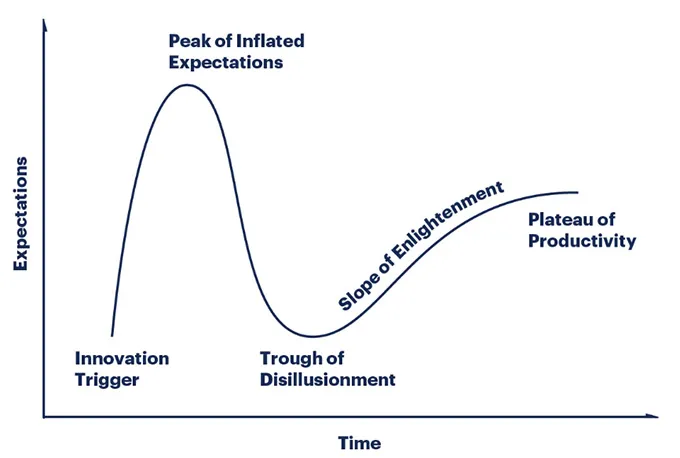
For years, we've been living on the plateau of a few dominant tech giants, a world where the future seemed to be an incremental improvement of the present. But the feeling of a shift is in the air. We are entering a crucial moment where the next revolutionary innovation isn’t just a slightly better version of what we have, but a true paradigm shift created by a new generation of bold entrepreneurs. The question is no longer "what's next?" but rather, "when do we break the plateau, and who will do it?"
The GPT-5 Conundrum: A Case of Hype vs. Reality
To understand the current state of the tech industry, we must look at the most talked-about topic of our time: AI. The initial release of ChatGPT was a watershed moment, a disruptive force that offered a fundamentally new way to interact with information. The Hype vs. Reality cycle went into overdrive. Journalists, investors, and the public alike projected a future of artificial general intelligence (AGI) and a world transformed overnight. Now, with the release of GPT-5, the reality is beginning to set in.
GPT-5 is an undeniable technical marvel. It is smarter, faster, and more capable than its predecessors on key metrics. Its reasoning abilities have improved, it can handle more complex tasks, and its hallucinations have been reduced. But, for many, the grand promise of a paradigm shift has not been realized. The user experience remains largely the same: a conversational interface in which you type a prompt and receive a text-based answer. This is the essence of the plateau effect. We are now in a phase of optimizing the existing model, not reinventing it.
The incremental gains, while impressive to a computer scientist, are not the revolutionary leap the public was sold. The improvements are in accuracy, efficiency, and scale, not in a fundamentally new way of interacting with the technology. This is the same game Nokia and BlackBerry were playing with their incremental improvements. They were making better versions of what they already had, while the next big thing was brewing in a completely different lab. The current LLM market is an increasingly crowded field, with companies vying for marginal gains in benchmarks and performance. Everyone is chasing a slightly better model, leading to a new plateau where innovation is measured in fractions of a percentage point.
The Mobile Phone: From Plateau to Disruption
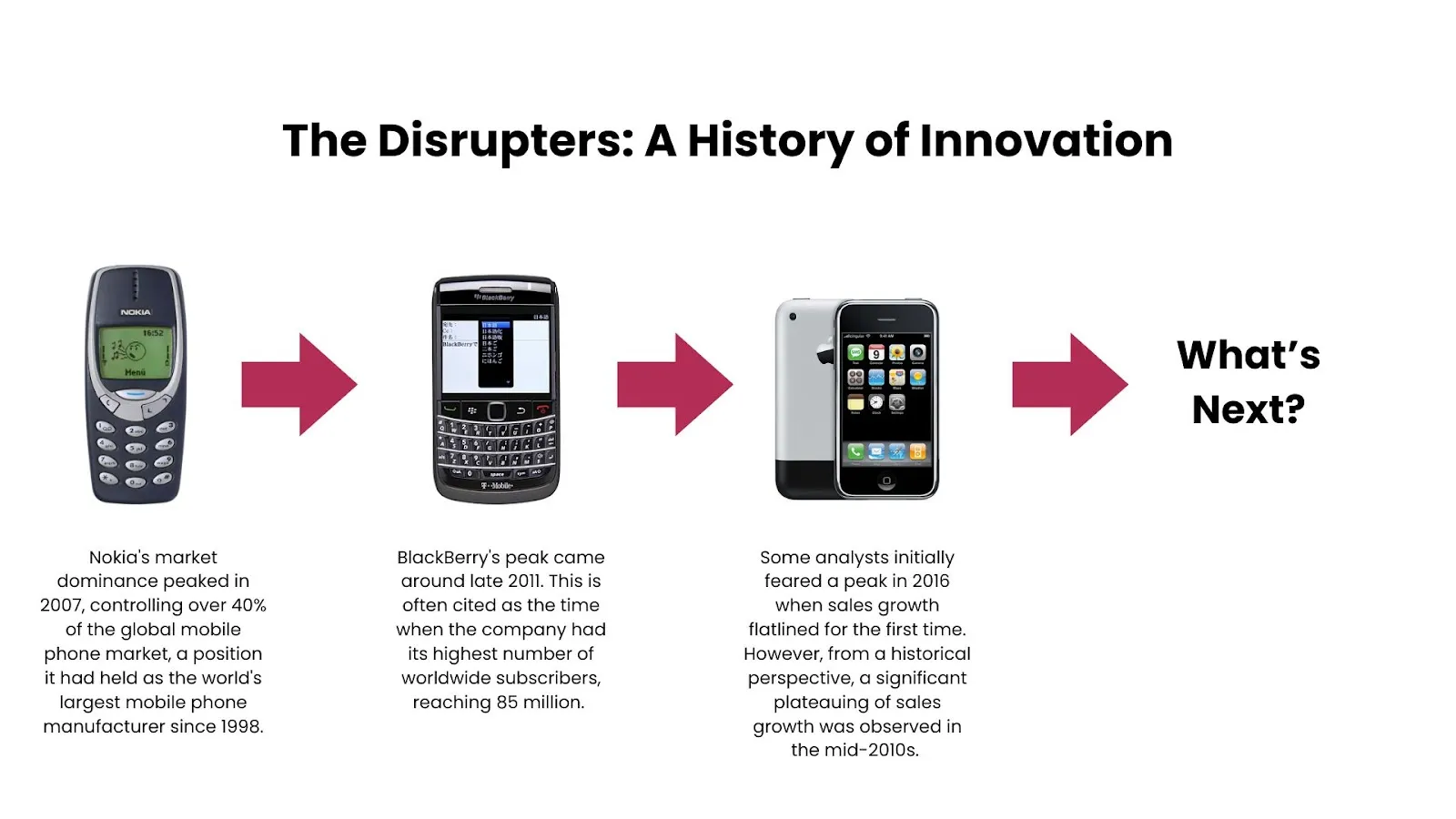
To understand this cycle, we need only look at recent history. Think back to the early 2000s. The mobile phone market was a serene plateau, a landscape dominated by corporate behemoths like Nokia and, in the enterprise space, BlackBerry. Nokia was the undisputed king, celebrated for its indestructible hardware, legendary battery life, and a user experience that, while basic by today's standards, was simple, reliable, and functional. They sold hundreds of millions of phones globally, and their brand was synonymous with mobile communication. BlackBerry, with its iconic QWERTY keyboard and secure messaging, had a near-monopoly on the corporate world.
At the time, the prevailing narrative was one of incremental improvements. Phones became smaller, their screens got a little more color, cameras had more megapixels, and you could play a slightly more complex version of "Snake." The operating systems, like Symbian, were capable but rigid. This was the point of diminishing returns. The phones were good, they were reliable, but they were not fundamentally different from one another. The industry was in a holding pattern, a comfortable space where optimization was prioritized over invention. The giants were too invested in their existing supply chains, business models, and user expectations to even consider a radical departure.
Then came the disruptive force that nobody saw coming, or at least, nobody with a vested interest in the current system. In 2007, Apple introduced the iPhone. It wasn't just a phone; it was a completely new way to interact with information and the world. It ditched the physical keyboard for a multi-touch glass screen and, crucially, introduced a full-fledged App Store. This wasn't an incremental improvement—it was a paradigm shift. Nokia and BlackBerry, so comfortable on their plateau, dismissed it as a novelty or a "toy." They were too wedded to their existing business models and supply chains to see the change coming. The rest, as they say, is history. The mobile industry was completely reset, paving the way for a new set of giants and countless startups built on the App Store ecosystem.
The Search Engine: From Plateau to New Frontier
A similar pattern has defined the information age. For over two decades, Google Search has been the unchallenged king. It has become an essential part of our lives, the first place we turn for any question, big or small. The core mechanism—typing in a query and getting a list of blue links—has remained largely unchanged. Over the years, Google has made incremental improvements: a better algorithm, richer snippets, featured answers, and personalized results based on our search history. But the fundamental user experience has plateaued. It's a highly optimized and incredibly effective system, but it's not a new one.
This is where the Hype vs. Reality cycle re-emerged with a vengeance. The introduction of ChatGPT and the broader class of large language models (LLMs) was a shock to the system. It offered a fundamentally different way to retrieve information: through a conversational interface. Instead of a list of links, you got a single, synthesized answer. The initial hype was off the charts, but now, a year or so after its launch, we are beginning to see the symptoms of the plateau effect. As we await the next iteration, GPT-5, we must ask: will it be a paradigm shift, or just an incremental improvement?
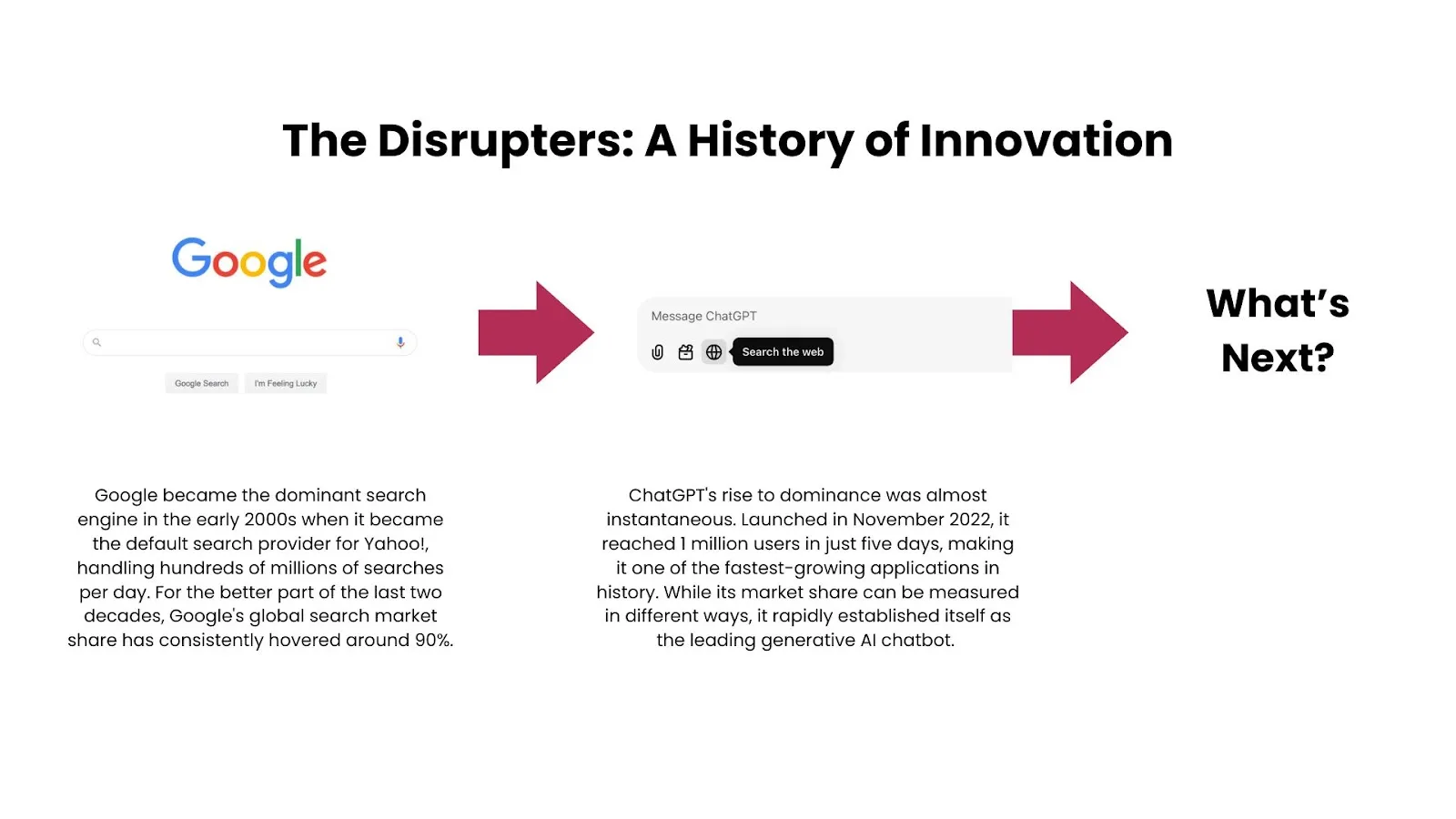
There is a growing consensus that GPT-5, while undoubtedly more powerful, will not fundamentally change the user experience in the way ChatGPT did. It will be faster, more accurate, perhaps more multimodal, and will be able to process larger amounts of data. But the core interaction, a text-based conversational answer, will likely remain the same. We are heading for a new plateau, one where dozens of companies are building similar models and applications, all vying for dominance in the same conversational space. This is the point of diminishing returns for the current LLM model. Everyone is playing the same game, just with slightly better pieces.
Where Startups Come In: The Opportunity to Disrupt
The Plateau is not a sign of failure; it is a signal. It tells us that a certain technology has matured and is now being optimized by the incumbents. It is at this precise moment that the greatest opportunities for disruption emerge. The big companies like Nokia, Google, and now the OpenAI/Google duopoly, are too committed to their existing business models, their revenue streams, and their corporate cultures to make the radical pivot necessary for the next revolutionary innovation. They will be focused on defending their existing territory, not exploring a new one.
This is where you, the entrepreneur, come in. The next disruptive force won’t be a slightly better version of ChatGPT, just as the iPhone wasn't a slightly better BlackBerry. The next big thing will be an entirely new way to interact with information, technology, or a physical product that we haven't even conceived of yet. Perhaps it will be an AI that doesn't rely on text, but on something else entirely, or an operating system for a new category of device we don't know exists yet. The potential is limitless, but it requires a fundamental break from the current model.
The current Plateau of LLMs is the starting gun for the next generation of founders. The core innovation of LLMs—the ability to generate human-like text—is now a commodity, and the real value will be created by those who can build entirely new products and experiences on top of, or even completely independent of, them. The next iPhone or the next Google will not be born out of a mega-corporation, but from a small, agile team that has the courage to see beyond the current hype and redefine what's possible.
So, what's next? The question marks around GPT-5 are not a sign of stagnation, but a beacon of opportunity. The time for startups to innovate is now. The giants have laid the groundwork; your job is to build the future on a new, un-hyped foundation.
Ready to Build the Next Big Thing?
You have the vision to see beyond the plateau. Now, you need the right co-founder to turn that vision into reality. At CoffeeSpace, we connect ambitious founders with partners who share their passion for disruptive innovation. Don't build an incremental improvement; build a paradigm shift. Download our list of 50 resources here to start building.
Cofounder Tips
Why Technical & Non-Technical Cofounders Clash (and How to Prevent It)
September 14, 2025
The founding duo of a technical genius and a savvy business strategist is a startup cliché for a reason—it’s a powerful combination. One builds the product, while the other builds the company. This synergistic relationship is often the blueprint for billion-dollar companies. However, this dynamic is also a breeding ground for conflict. The inherent differences in priorities, language, and perception of value can create a "cofounder chasm" that, if left unaddressed, can derail even the most promising start up ideas. This article will explore the root causes of these clashes and provide a clear, actionable guide on how to prevent them, ensuring your partnership is a source of strength, not a point of failure.
The dream is to find the perfect technical cofounder who complements your business acumen. The reality is that this collaboration, while essential, requires a profound understanding of each other's worlds. The conflict often stems from a simple misunderstanding: both parties believe their work is the most critical to the success of the business.
The Three Core Clashes
1. The Priority Mismatch
The most common clash is a fundamental disagreement over priorities. A technical cofounder is often singularly focused on the product. Their world is defined by clean code, scalability, and bug-free releases. Their instinct is to perfect the product before pushing it to market. The non-technical founder, on the other hand, is driven by the market. Their world is sales, marketing, and user feedback. They see the product as a tool to acquire customers and generate revenue, and they often push for an immediate launch to start testing assumptions and iterating.
This clash played a key role in the early days of Twitter. While the story is complex, a central theme was the power struggle between the technical vision (championed by Jack Dorsey) and the product/business vision (advocated by Noah Glass). While Dorsey was deeply involved in the technical execution, Glass was the one who saw the bigger picture and named the service "Twttr." This difference in focus and perception of value contributed to a bitter feud that ultimately led to Glass being pushed out. The lesson is clear: a failure to align on what truly matters to the business—the product or the market—is a recipe for disaster. Both are crucial, and a healthy partnership acknowledges this balance. The best start up ideas require both a great product and a great market strategy.
2. The Communication Breakdown
A founder team is, at its core, a relationship. Like any relationship, it lives or dies by communication. The problem is that a technical cofounder and a non-technical one often speak different languages. One talks in terms of "front-end architecture," "API endpoints," and "Agile sprints," while the other speaks in "customer acquisition cost," "LTV," and "market share." This jargon gap can lead to misunderstandings, frustration, and a feeling that the other person doesn’t understand the true nature of their work.
This dynamic was a significant issue for Zenefits in its early days, though in a different form. The company’s growth-at-all-costs culture, driven by its non-technical founder, Parker Conrad, clashed with the need for technical stability and ethical compliance. While Conrad saw every shortcut as a path to growth, the engineers saw a mountain of technical debt and compliance risks. The failure of the leadership to communicate a unified vision and respect the technical and operational realities of the business ultimately led to the company’s downfall and a messy internal and external reckoning. To be a great business partner finder, you must seek a person who values open, jargon-free communication.
How to Prevent the Clash
The good news is that these conflicts are not inevitable. They are a sign of a healthy, growing company, and they can be managed with proactive strategies.
1. Formalize Everything, Early
The single most important step you can take is to create a detailed cofounder agreement before you start your business. This document should go beyond simple equity splits. It should clearly define roles and responsibilities, establish a decision-making process for key issues (e.g., fundraising, hiring, product direction), and outline a clear vesting schedule.
A detailed agreement forces founders to have difficult conversations upfront, when emotions are less charged. It prevents future disputes over equity and who is responsible for what. You can’t solve for every contingency, but having a written framework provides a neutral, objective guide when disagreements arise. The most successful teams, like the founders of Airbnb, had their roles and equity clearly defined early on, which allowed them to focus on the business rather than internal politics. A great founder network will tell you to never skip this step.
2. Foster a Culture of Mutual Respect
Each founder brings a unique, vital skillset to the table. The non-technical founder is not just a "talker"; they are a strategist, a networker, and a sales engine. The technical cofounder is not just a "coder"; they are the architect of the product, the problem-solver, and the person who ensures the business is built on a solid, scalable foundation.
To prevent clashes, make a conscious effort to respect each other's domains. Schedule weekly check-ins where each founder provides an update from their world in plain language. A non-technical founder can join a product roadmap meeting, and a technical cofounder can listen in on a customer discovery call. This cross-pollination of knowledge builds empathy and a shared understanding of the challenges each person faces. This is how you make your partnership a truly strong entrepreneur network.
3. Establish Clear, Shared Goals
To get your start up business ideas off the ground, both founders must be aligned on the "why" and the "what." This goes beyond a simple mission statement. You need to agree on what success looks like in the short term (the MVP) and the long term (the vision). By setting shared, measurable goals and key performance indicators (KPIs), you can ensure every decision is data-driven, not opinion-driven. This approach helps to prevent arguments over priorities, as everyone is working towards the same, clearly defined target.
In essence, your partnership is a start up business ideas factory, and it needs a process. A clear framework for communication and decision-making is more important than the initial idea itself. The conflicts between a technical and a non-technical founder are often a symptom of underlying issues with communication, roles, or vision. By addressing these issues head-on, you can transform a potential liability into a profound advantage.
Ready to find a partner who understands the importance of this dynamic? At CoffeeSpace, we believe that the best business partner finder process is built on shared values and complementary skills. We connect you with a cofounder who not only has the right expertise but also shares your vision for a collaborative and resilient founder network.
Cofounder Tips
Your First Idea is Probably Bad... and How to Filter and Iterate to Find the Right One
September 12, 2025
The moment you decide to build a business, the world opens up with possibilities. That initial burst of inspiration—the "aha!" moment where a brilliant idea seems to solve everything—is intoxicating. But here’s a hard truth: your first idea is probably bad. It’s not a reflection of your intelligence or creativity; it's a reflection of the reality that a truly successful business is rarely a static idea. It is a product of relentless iteration, brutal honesty, and a willingness to abandon your original vision for a better one. This article is your guide to navigating that difficult but essential process to find the right startup ideas.
The biggest mistake aspiring entrepreneurs make is falling in love with their first idea. They become so attached to it that they fail to see its flaws, ignore critical feedback, and build a solution in search of a problem. This tunnel vision is a leading cause of startup failure. The path to a successful business is not a straight line from idea to launch; it's a winding road of pivots, adjustments, and refinements. This is the crucial stage where you filter your start up business ideas and determine which ones have the potential to grow.
1. The Power of "Kill Your Darlings"
The first step in finding the right idea is to accept that your original one is merely a starting point. It’s a hypothesis, not a final product. The goal isn’t to prove your first idea is right, but to test it so rigorously that you either find a way to make it great or you prove it's wrong. You must be willing to "kill your darlings" — to let go of an idea, no matter how much you love it, when the data tells you to.
The story of Instagram is the perfect example of this. The founders, Kevin Systrom and Mike Krieger, originally created a location-based social networking app called Burbn. It was packed with features, from check-ins to making plans, but users weren't engaging with most of them. The one feature they did use obsessively, however, was photo-sharing. Instead of adding more features to save their original vision, the founders made a courageous decision. They scrapped nearly everything and focused solely on the photo-sharing feature, a brilliant technology startup idea. This radical pivot from a cluttered "check-in" app to a simple, elegant photo platform is what led to its monumental success. They were willing to kill Burbn to build Instagram.
2. Validate, Validate, Validate: The Minimalist Approach
Before you write a single line of code or spend a single dollar, you must validate your idea. This isn't just about asking friends if they like it; it's about getting real, unbiased feedback from your target market. The goal is to prove that there is a problem worth solving and that people are willing to pay for a solution. This is how you begin to find your true start up business ideas.
The founders of Dropbox executed this to perfection. Drew Houston had the initial idea for a file-syncing service after repeatedly forgetting his USB drive. The problem was clear to him, but how could he validate it without building a complex, expensive product? He created a simple three-minute video demonstrating how the software would work. He posted the video on tech forums and immediately received an overwhelming response. Within a single day, the beta waiting list went from 5,000 to 75,000 people. The video validated the idea, proving the demand for the product before a single line of code for the front end was written. This simple, low-cost approach is the most effective way to test your assumptions and begin to start your business. This is the kind of lean validation that can help you build a business that is built on solid ground.
3. The Pivot is Your Superpower
Failure to validate an idea isn't the end; it's a new beginning. The most successful founders see a failed idea not as a setback, but as a data point that reveals a new path. This ability to pivot—to change direction while keeping your ultimate vision in sight—is a core competency of any successful entrepreneur.
The story of Slack is the quintessential pivot story. Before it was a multi-billion dollar communication tool, it was a gaming company called Tiny Speck, which had created a whimsical online game called Glitch. The game failed to gain traction, but the internal communication tool the team had built to help them work together was incredibly effective. The founders realized that their real product was not the game, but the tool they had built for themselves. They were able to use their experience to create a new company around that tool, turning a failed gaming venture into the fastest-growing enterprise software company in history. Their initial idea was bad, but their ability to see the opportunity in their failure was genius. This is the kind of agility that defines a technology startup idea with real potential.
4. The Iteration Loop: Build, Measure, Learn
Once you have a validated idea, the work of filtering and refining is far from over. It's an ongoing process captured by the "Build-Measure-Learn" loop from Eric Ries's book, The Lean Startup. You build a Minimum Viable Product (MVP), you measure how users interact with it, and you learn what to do next. This continuous feedback loop is how you iterate your way to a great product.
Netflix is a master of this. It started as a DVD-by-mail service. When the internet became fast enough, they launched a streaming service, but they didn't kill the DVD business right away. They measured customer behavior and learned from the data. They saw that streaming was the future, and they began to slowly sunset the DVD business. Today, they are a dominant force in streaming, but their ability to iterate and adapt in the face of changing technology is what allowed them to survive and thrive. This demonstrates how even established companies must continuously iterate to stay relevant. Every iteration is an opportunity to improve on your initial start up ideas.
Conclusion
Your first idea is a starting point, not a destination. It’s a hypothesis you must test, a problem you must validate, and a vision you must be willing to abandon. The path to a successful business is paved with scrapped features, bold pivots, and relentless iteration. The entrepreneurs who win are not those with the most brilliant initial idea, but those with the discipline to filter their ideas and the courage to change course when necessary. The next great technology startup idea won't be found in a moment of pure genius, but in the messy, difficult, and exhilarating process of trial and error. You are ready to build a business. It's time to start your business with the right mindset: one of constant learning and adaptation.
Ready to find a cofounder who understands this process? At CoffeeSpace, we believe that the best cofounder matching is a process built on shared values and a complementary skill set. We help you find a partner who will not only help you build a business but also challenge your assumptions and help you filter through your start up ideas.
Cofounder Tips
The "Jobs-to-be-Done" Framework: A Scientific Approach to Idea Generation
September 8, 2025
You have the drive and the ambition, but you’re stuck on the first step: what business to build? Traditional approaches often tell you to brainstorm a list of problems or to find a market with no competition. While well-intentioned, these methods can lead you down a path of chasing trends and building a product no one actually needs. To truly build a business with staying power, you need a different, more scientific approach. This is where the "Jobs-to-be-Done" (JTBD) framework comes in. It’s a revolutionary way to think about innovation that shifts your focus from the product to the customer’s ultimate goal.
The core principle of JTBD is simple yet profound: people don't buy products; they "hire" them to get a "job" done. This "job" is the underlying progress a person is trying to make in a specific circumstance. For instance, a person doesn't buy a drill because they want a drill; they buy it because they want a hole in the wall. The drill is simply a tool hired for the job. By understanding the "job," you can find incredible start up ideas that competitors often miss. This framework is a powerful lens through which to find and validate start up business ideas.
The Famous Milkshake Example
The most famous illustration of the JTBD framework comes from the late Harvard Business School professor, Clayton Christensen. A fast-food restaurant was trying to increase its milkshake sales. They tried the traditional approach: asking customers what they wanted in a milkshake (more chocolate, chunkier fruit, etc.). They improved the product, but sales didn't budge.
Then, they applied the JTBD framework. They observed who was buying milkshakes and in what circumstances. They discovered that nearly half of all milkshakes were sold before 8:30 a.m. The customers were alone, in their cars, and had only bought the milkshake. Through interviews, they learned the "job" these commuters were "hiring" the milkshake for was not a beverage or a treat. It was to make their long, boring commute more interesting and to satisfy their hunger until noon. The milkshake's key selling points were that it was thick enough to last the entire ride, easy to consume with one hand, and satiating. Its true competitors weren't other milkshakes; they were bananas, bagels, or Snickers bars—any item that could do the same job. By understanding the job, the solution became obvious: make the milkshake thicker to last longer and add small chunks of fruit to make the morning more engaging. They didn’t change the product for its own sake, but to better serve the job, and sales soared. This is a crucial lesson for anyone looking to start your business.
Applying JTBD to Your Idea Generation
Applying this framework means looking beyond demographics and product features to the underlying motivations behind a purchase. Here's a three-step process to help you find your next great technology startup idea.
Step 1: Observe and Identify the "Job"
The first step is to become an observer of human behavior. Don't ask people what they want; watch what they do. Pay close attention to moments of compromise or struggle. What is a person trying to accomplish? This could be a functional job, like "I need to get from point A to point B," or an emotional job, like "I want to feel safe when I'm away from home." These struggles are the source of all great start up ideas.
Consider Airbnb. Traditional hotels were focused on providing a room for the night. Airbnb’s founders, however, observed a different "job" to be done. For travelers, the job was to "live like a local" and have a more authentic, unique experience. For homeowners, the job was to make a living from their empty spare room. By understanding these dual jobs, Airbnb didn't just create a new type of hotel; they created a two-sided marketplace that allowed a new class of customers to get a very different job done. This insight allowed them to build a business that now competes not just with hotels, but with tour guides, travel agencies, and even cruise ships. This is the essence of finding powerful technology startup ideas.
Step 2: Uncover the "Pains and Gains"
Once you've identified a job, you need to understand the customer’s pains and desired gains. What obstacles do they face when they try to get this job done with existing solutions? What are the benefits they are hoping for? The bigger the pain, the bigger the opportunity to start your business.
Take Stripe, for example. In the early 2010s, the "job" of accepting online payments was already being done by companies like PayPal. But for developers, the process was a nightmare of complex APIs, tedious paperwork, and lengthy approval processes. Stripe's founders saw this massive pain point. The job wasn't "to process payments"; it was "to accept payments online as a developer, with as little friction as possible." They focused relentlessly on this pain point and created an elegant, clean, and developer-friendly solution. This laser-like focus on a specific job-to-be-done in a highly technical market is what propelled them to become a multi-billion dollar company. This is a perfect example of how start up business ideas are born from deep user understanding.
Step 3: Find the "Struggling Moment"
The most fertile ground for a new idea is the exact moment when a person is struggling to get a job done. This is the "hiring moment." Identify what leads them to "fire" their current solution and look for a new one.
Loom, the video messaging platform, provides a perfect case study. The "job" to be done was not "to record a video." The job was to quickly and asynchronously communicate a complex idea to a colleague without having to schedule a meeting. The "struggling moment" came from the constant back-and-forth of emails, the inability to explain a bug on a screen with text alone, and the pain of finding a mutually convenient time for a meeting. Loom’s founders built a business that allowed users to instantly record their screen and voice, providing a simple, elegant solution to the struggle of asynchronous communication. This is a brilliant example of a technology startup idea that solved a specific, painful job-to-be-done.
Conclusion
To build a business that truly matters, you must move beyond the product and into the lives of your customers. The Jobs-to-be-Done framework provides a scientific and repeatable method for uncovering the deep-seated needs and frustrations that give rise to truly innovative companies. By identifying the specific "jobs" people are trying to get done, you can find start up ideas that aren't just incremental improvements but revolutionary solutions. The market is not a void; it is a canvas of unfulfilled jobs, and the right perspective is your paintbrush. Now it's time to find the job and start your business.
Ready to apply this framework and find your next breakthrough idea? At CoffeeSpace, we believe that the best cofounder matching is a process built on shared values and a complementary skill set. We connect you with a partner who understands the importance of a problem-first approach, helping you find and build a business that truly gets the job done. Download today!
Cofounder Tips
Equity, Ego, and Exit: The 3 Financial Pitfalls of a Cofounder Partnership
September 5, 2025
The excitement of a new venture can be intoxicating. You and your cofounder share a brilliant idea, a potent vision, and an unwavering commitment to start your business. You dream of building a business that changes the world, and in the early days, everything feels aligned. But while you’re busy drafting business plans and chasing your first customers, three silent killers—Equity, Ego, and Exit—are waiting in the wings to sabotage your partnership. These financial and psychological pitfalls are responsible for a significant number of startup failures, far more than a bad product or a competitive market.
The relationship between startup founders is more than just a professional arrangement; it’s a high-stakes marriage with a complex financial dimension. Rushing through critical conversations about ownership, control, and long-term goals is a recipe for disaster. The most common mistake is a handshake deal for a 50/50 split, which, while seemingly fair, often leads to an irreconcilable deadlock when the honeymoon phase ends. This highlights the vital importance of a thorough cofounder matching process that goes beyond surface-level compatibility.
1. The Equity Trap: When Fair Isn't Equal
The allure of a 50/50 equity split is strong. It feels like an equal partnership, a democratic foundation for your shared vision. However, this seemingly fair division of the pie can become the single greatest source of conflict down the road. Why? Because equal doesn't always reflect unequal contributions. One founder might have brought the initial idea and intellectual property, while the other is the technical wizard who is building the product. What happens if one founder decides to work part-time or leaves the company after six months? Without a proper vesting schedule and a clear plan, they could walk away with a massive, unearned share of the company.
This is exactly what happened with Facebook's Eduardo Saverin. As the company grew, his role and commitment were not clearly defined. When he was pushed out, his significant equity stake became a point of major contention, leading to a prolonged and public legal battle. The lesson for all startup founders is clear: don’t treat equity as a static, fixed asset. The fairest way to handle equity is to use a dynamic model that accounts for ongoing contributions over time, with a vesting schedule (typically a four-year term with a one-year cliff). This ensures that equity is earned, not just given. A thorough cofounder matching process involves having these uncomfortable, but essential, conversations about vesting and contribution upfront. This is a critical step for anyone serious about building a business.
2. The Ego Landmine: When Pride Undermines Profit
Ego is a double-edged sword for founders. The self-confidence and conviction required to build a business can easily tip over into arrogance and a resistance to feedback. When a founder's ego becomes inflated, they may start making decisions based on personal pride rather than what's best for the company. This can manifest in refusing to relinquish control, micromanaging teams, or rejecting advice from mentors and investors. This kind of behavior can kill a company faster than a cash flow crisis.
A prime example is the story of WeWork's Adam Neumann. His charismatic, larger-than-life ego was initially a driving force for the company's meteoric rise. However, that same ego led to erratic and unvetted business decisions, a sprawling and chaotic company culture, and a governance structure that granted him near-absolute power. This ultimately resulted in a failed IPO and a spectacular public downfall that serves as a cautionary tale for all startup founders. An excessive ego is a major red flag for any venture capitalist. They know that a single founder's inability to check their ego will inevitably lead to an unstable company. A strong founders network will often serve as a check on a founder's ego, offering honest feedback and holding them accountable.
3. The Exit Dilemma: A Mismatch of Endgames
Every founder dreams of a big exit, but what that "exit" looks like can be vastly different from one partner to the next. One cofounder might be aiming for a quick, small acquisition, a rapid cash-out that allows them to move on to the next project. The other might be a long-term visionary who wants to take the company public and build a business that becomes a generational legacy. These differing views on an endgame can create profound friction.
Consider the story of the Instagram acquisition by Facebook. While the acquisition was a massive financial success, it reportedly caused friction between cofounders Kevin Systrom and Mike Krieger. While the details of their specific disagreements are private, it's a well-known fact in the tech world that the pressure of a multi-billion-dollar acquisition and the integration into a larger company can be the final straw for a partnership. One partner might be ready to sell and get out, while the other wants to keep building. These conversations about exit strategy need to happen at the very beginning of your entrepreneurial journey. It's part of a robust cofounder matching process, where you align not only on a product vision but on a life vision for the business. Your founders network can provide invaluable guidance on how to navigate these conversations. Before you even start your business, you should have a clear understanding of what "winning" looks like for both of you.
In the end, the key to avoiding these pitfalls is a commitment to radical transparency and uncomfortable conversations. You need to be able to talk about money, power, and personal goals with your cofounder without fear of judgment. Your partnership is a business, and like any good business, it needs a solid foundation. Don’t let the excitement of the early days blind you to the financial and psychological realities that can break your company.
Ready to find a cofounder who not only shares your vision but also your financial values?
At CoffeeSpace, we believe that the best cofounder matching is built on a foundation of trust and transparency. Our platform helps you connect with potential partners who have a clear understanding of what it takes to build a business—and what they're truly in it for.
Cofounder Tips
The "Honeymoon Phase" of Cofounding (and the Red Flags You Missed)
September 2, 2025
You’ve found them. The one. The cofounder who gets your vision, shares your passion, and seems to be the perfect puzzle piece to complete your business startup. The excitement to start your business is a powerful bond. But beneath this initial euphoria, subtle red flags can lie dormant, waiting for the inevitable stresses of a business startup to bring them to the surface. Ignoring these signs can lead to a messy, public cofounder breakup—a scenario that, according to data from CB Insights, is a factor in nearly a quarter of all startup failures.
The decision of who you choose to build a business with is arguably the most critical choice you will make as a founder. It’s more significant than your product, your investors, or even your market. Your partnership is the foundation, and if it cracks, the entire structure is at risk. Many startup founders are so focused on getting to market that they rush the vetting process, blinded by a potential cofounder's impressive resume or charisma. This is a common pitfall in the search for a perfect cofounder matching. The entrepreneurial journey is long and arduous, and you need a partner who can withstand the pressure.
1. The "Yes-Man" or "Yes-Woman" Syndrome
In the honeymoon phase, a partner who agrees with everything you say feels like a dream come true. They validate your ideas and seem to have perfect alignment. However, this is one of the most significant red flags. Healthy partnerships thrive on constructive conflict and diverse perspectives. A cofounder who never challenges you may lack conviction, critical thinking skills, or the courage to disagree.
Consider the story of the early days of Twitter (now X). The conflicts between founders like Jack Dorsey and Noah Glass, while acrimonious, forced a discussion about the product's fundamental direction. An absence of such a discussion can mean a lack of intellectual friction—the very thing that forges a strong, well-vetted idea. Without it, you are essentially flying blind, with no one to question your assumptions or push you to think more critically. A truly effective founders network is one that includes people who will tell you what you need to hear. A savvy venture capitalist will always look for this kind of healthy tension in a founding team. A successful cofounder matching isn't about finding someone identical to you, but rather someone who complements your skills and challenges your thinking.
2. Mismatch in Motivation and Commitment
The allure of a startup is often tied to a big exit or a quick cash-out. But what truly drives your partner? The honeymoon phase masks differing motivations, as everyone is excited by the potential. A red flag to watch for is a cofounder who talks exclusively about the financial upside, without a deep passion for the problem you're solving.
A classic example of this is the story of Zipcar. Cofounders Robin Chase and Antje Danielson had a falling out that led to Danielson's departure. While both were initially passionate, their levels of commitment to the business startup and their definitions of success began to diverge. One was ready to make the startup their sole focus, while the other was not. This led to a significant conflict over equity and contribution, proving that an initial shared excitement for a concept is not enough. To build a business that lasts, you need partners who are in it for the long haul and who share your same level of grind and dedication. The right cofounder matching is about aligning not just on skills, but on a shared work ethic and vision for the future of your entrepreneurial journey. This is where effective cofounder matching can make a profound difference.
3. The Lack of Defined Roles and Responsibilities
In the early days, everyone is "doing everything." But a failure to clearly define roles and responsibilities is a major red flag. This can lead to resentment, duplicated efforts, and a power struggle down the line. A new venture needs a clear division of ownership to function efficiently.
Take the infamous Facebook founding saga. The falling out between Mark Zuckerberg and Eduardo Saverin was rooted in a lack of a clear, legal cofounder agreement. Saverin's role and commitment were not clearly defined as the company scaled, leading to a massive conflict over equity and his eventual ousting. This serves as a stark warning to all startup founders: what feels like an unnecessary legal formality in the "honeymoon phase" is actually the critical foundation for your partnership. Every founders network will tell you that it's crucial to address these topics head-on and in writing. A savvy venture capitalist will scrutinize your founders' agreement to ensure there is no ambiguity. This is often the primary reason a simple cofounder matching on paper doesn't work out in practice.
4. Poor Communication and Conflict Resolution Skills
In a new relationship, it’s easy to avoid difficult conversations. But the ability to handle conflict is the most important skill in a cofounder relationship. A red flag is a cofounder who gets defensive, avoids tough discussions, or communicates poorly under stress.
The story of Zenefits, a once-hyped cloud software company, offers a cautionary tale. Cofounders Parker Conrad and Zach Weinberg had different visions for the company culture and business practices. This misalignment and their inability to navigate the conflict effectively created a toxic environment that ultimately led to Conrad’s resignation. This example highlights that a deep understanding of your potential partner's communication style is far more valuable than their technical prowess. Before you fully commit to start your business with someone, you must test how they handle disagreement and stress. This is a vital lesson on the entrepreneurial journey.
5. The "I'll Figure it Out" Mentality
While a can-do attitude is great, a cofounder who makes grand promises without a concrete plan is a significant red flag. A lack of follow-through and a disregard for detail will sink your business. This is especially true for cofounder matching between technical and non-technical partners.
The importance of continuous, honest conversation about individual goals is a lesson for all startup founders. During the honeymoon phase, it's easy to make assumptions about a person's long-term commitment and goals. You must look for someone who not only has the skills but also the discipline to execute and a clear plan for how they will contribute to your business startup as you scale. This is a critical factor for anyone serious about build a business.
In the end, the key to avoiding these pitfalls is to move beyond the initial excitement and engage in a rigorous vetting process. Don't be afraid to ask uncomfortable questions about past failures, work ethic, and financial expectations. Run a small project together to test your working relationship before you fully commit. Your future success depends on it. A healthy and honest founders network will be filled with stories and lessons that prove this point.
Ready to find a cofounder who shares your values and commitment? At CoffeeSpace, we help you move beyond the "honeymoon phase" by connecting you with a curated list of potential partners based on what truly matters: shared vision, complementary skills, and a matching work ethic. We believe the best partnerships are built on a foundation of trust and transparency, not just a brilliant idea. Try it out here!
Cofounder Tips
Your Network is Your Net Worth: 5 Steps to Finding Your Founder Community
August 28, 2025
The adage “your network is your net worth” has never been more relevant than in the dynamic world of entrepreneurship. For anyone looking to build a business, the initial idea, while crucial, is just the starting point. The real fuel for a startup’s engine is the collective wisdom, support, and resources of a strong founder community. Going it alone is not just difficult; it’s a path littered with avoidable mistakes and missed opportunities. The most successful business and entrepreneurs understand that their journey is a collaborative effort, not a solitary sprint. A robust entrepreneur network provides the validation, mentorship, and talent necessary to turn a concept into a thriving reality.
The narrative of the lone genius toiling in a garage is a compelling one, but the truth is far more collaborative. For every groundbreaking innovation, there is a team, a mentor, or a supportive community that played a pivotal role. Think of Steve Jobs and Steve Wozniak, or Bill Gates and Paul Allen. Their partnerships were the foundation upon which their empires were built. Similarly, the founders of Airbnb, Brian Chesky and Joe Gebbia, didn't just have an idea; they leveraged their creative skills and, crucially, their early network to launch a platform that would disrupt an entire industry. They were part of a nascent startup community that provided the feedback and connections they needed to refine their business model.
1. Identify Your "Why" and Define Your Ideal Community
Before you can effectively seek out your community, you must first understand what you need from it. Are you a solo founder looking for a technical cofounder? Are you seeking mentorship from seasoned business and entrepreneurs? Do you need a peer group to share challenges and celebrate wins with? The more specific you are about your needs, the more targeted your search for a founder community can be. This isn't just about finding people; it's about finding the right people who can complement your skills, match your values, and challenge your assumptions.
For example, Melanie Perkins of Canva faced a long and difficult road to secure funding for her now multi-billion-dollar graphic design platform. She didn't just have a great idea; she had a clear vision and knew she needed a strong entrepreneur network to bring it to life. She and her cofounder Cliff Obrecht meticulously sought out and built relationships with individuals who understood their vision, from early investors to key team members. They understood that building a business required more than a pitch deck; it required a tribe of believers.
2. Go Where the Right People Are
Once you know what you're looking for, the next step is to actively position yourself in spaces where your ideal community is likely to gather. This involves both online and offline engagement.
- Accelerators and Incubators: Programs like Y Combinator (YC) in Silicon Valley are famous for creating a highly concentrated startup community. YC's value isn't just in the funding; it's in the curated peer group and the access to a vast network of successful founders and investors. The connections made in a YC batch often last a lifetime, providing an incredible support system long after the program ends.
- Coworking Spaces: From small, local hubs to global giants, coworking spaces are a melting pot of business and entrepreneurs. The serendipitous conversations over a shared coffee machine can lead to surprising collaborations.
- Industry-Specific Meetups and Events: Whether it's a a specific meetup for SaaS founders or a large-scale conference like TechCrunch Disrupt, these events are goldmines for networking. They allow you to connect with people who are navigating similar challenges in your specific niche.
3. Provide Value Before You Ask for It
Networking is not a transactional game of "what can you do for me?" The most powerful relationships are built on a foundation of mutual value. To build a business by leveraging a network, you must first give back to it. Share your knowledge, offer to help a fellow founder with a problem you've already solved, or simply make a useful introduction. Become a "connector" within your entrepreneur network.
This principle is at the heart of many online communities like Indie Hackers. Founders openly share their revenue numbers, growth strategies, and failures, creating a transparent and supportive environment. This culture of giving leads to a highly engaged startup community where members are eager to help each other succeed, knowing the favor will be returned. The more you contribute, the more you will get back in return.
4. Cultivate Your "Inner Circle"
Your network can be vast, but your inner circle—your true founder community—should be small, trusted, and deeply engaged. This is the group you turn to for honest feedback, emotional support, and tough love. This inner circle might include your cofounder, a key mentor, or a few other founders at a similar stage in their journey.
Look at the story of the Collison brothers, founders of Stripe. Their success wasn't just about building a revolutionary payment platform; it was about being deeply integrated into the developer and startup community from the very beginning. They listened to feedback, iterated on their product based on community input, and became a trusted resource for other business and entrepreneurs. Their engagement with this community was a fundamental part of how they were able to build a business that scaled globally.
5. Be Intentional and Persistent
Finding and cultivating your founder community is not a one-time event; it's a continuous process. It requires persistence and intentionality. Follow up with people you meet. Schedule regular check-ins with your mentors. Participate actively in online forums and offline events. The goal is to consistently nurture your entrepreneur network so that it's there for you when you need it most.
For a powerful example, consider Sara Blakely of Spanx. She started with only $5,000 and no connections in the fashion industry. Yet, she was incredibly intentional about building her network. She relentlessly cold-called manufacturers, sought advice from anyone she could, and hustled to get her product in front of key buyers. Her persistence in building these relationships was a key factor in her ability to build a business from a simple idea into a global brand.
Your journey as a founder is a team sport, even if you’re a solo founder. The people you meet and the relationships you forge will be the most valuable assets on your balance sheet. To build a business that not only survives but thrives, you need to actively seek out and contribute to your founder community.
Ready to find the missing pieces of your entrepreneurial puzzle?
At CoffeeSpace, we believe that the right connection can turn a good idea into a great business. Join our platform to connect with like-minded business and entrepreneurs, mentors, and potential cofounders who not only understand your vision but also share your core values. Because when it comes to building something truly impactful, your best ideas are always better with the right people.
Sorry - there were no result for your search - try again :)