
Tips, Stories, and Updates on Entrepreneurial and Cofounder Journeys
Stay in the loop with 25,000+ founders

Cofounder Tips
Founder Networking Vs Cofounder Platforms: Which Is Better For Finding A Startup Cofounder in 2026?
February 24, 2026
One of the most common questions aspiring entrepreneurs ask is simple: How do I find a cofounder?
For many startup founders, the search for the right partner can feel overwhelming. A strong cofounder relationship can accelerate growth, bring complementary skills, and strengthen investor confidence. But finding that person is often harder than building the product itself.
Traditionally, founders relied on networking events, startup communities, and personal connections to meet potential collaborators. Today, however, the rise of cofounder platforms has changed how entrepreneurs connect.
This raises an important question: Should founders rely on networking or use cofounder matching platforms to find the right partner?
Both approaches offer advantages, and understanding their differences can help founders make smarter decisions when building their founding team.
In this guide, we explore founder networking vs cofounder platforms, the pros and cons of each, and how startup founders can find the right cofounder or early hires.
Why Finding The Right Cofounder Is So Important
Before comparing founder networking and cofounder platforms, it is important to understand why the cofounder relationship matters so much.
Many successful startups are built by teams rather than solo founders. Cofounders bring complementary skills, emotional support, and strategic perspective.
The right cofounder can:
- Share decision-making responsibilities
- Provide technical or operational expertise
- Increase startup credibility with investors
- Help manage the intense pressure of building a company
For early-stage startups, the founding team is often the strongest predictor of success.
However, choosing a cofounder is also risky. A misaligned partnership can lead to conflict, stalled progress, or even startup failure.
This is why founders must approach the cofounder search process carefully and intentionally.
What Is Founder Networking?
Founder networking refers to meeting potential collaborators through communities, events, and personal connections.
Historically, this has been the most common way startup founders meet their cofounders.
Founder networking typically happens in places like:
- Startup meetups
- hackathons
- entrepreneur conferences
- accelerators and incubators
- university startup clubs
- founder communities
Networking creates opportunities for founders to connect organically and build relationships over time.
Many well-known startup partnerships formed through informal networking environments where founders naturally met through shared interests.
What Are Cofounder Platforms?
Cofounder platforms are digital tools designed to connect founders who are actively looking for startup partners.
Instead of relying on chance meetings, these platforms allow founders to create profiles, describe their startup ideas, and discover potential collaborators.
Cofounder platforms help founders:
- Search for people with complementary skills
- Connect with individuals interested in startups
- Evaluate potential partners more efficiently
- Meet founders outside their immediate network
Platforms such as CoffeeSpace allow founders to meet cofounders and early startup talent who are actively exploring startup opportunities.
For many aspiring entrepreneurs, these platforms reduce the friction involved in finding potential collaborators.
Advantages Of Founder Networking
Founder networking offers several benefits, particularly when building trust and long-term relationships.
One key advantage is organic interaction. Meeting someone through a community or event often provides more context about their personality and work style.
Networking also allows founders to observe how potential collaborators behave in real environments. For example, hackathons and startup events reveal how individuals think, build, and collaborate under pressure.
Another advantage is stronger relationship development. Cofounder relationships built through repeated interactions often develop deeper trust.
Many early startup employees and cofounders meet through mutual friends or shared professional circles.
However, while networking can lead to strong relationships, it also has limitations.
Limitations Of Founder Networking
Despite its benefits, founder networking can be inefficient for many entrepreneurs.
One major limitation is network size. Many aspiring founders simply do not have access to large startup communities.
Geography can also be a constraint. In regions without strong startup ecosystems, networking opportunities may be limited.
Founder networking also relies heavily on chance. Even in active startup environments, meeting someone with the right skills and aligned ambitions is not guaranteed.
Additionally, networking events often attract people who are exploring ideas rather than actively committing to building a startup.
For founders who want to accelerate their cofounder search, relying solely on networking may slow progress.
Advantages Of Cofounder Platforms
Cofounder platforms address many of the challenges associated with traditional networking.
One major advantage is intent alignment. People using cofounder platforms are typically already interested in building startups.
This increases the likelihood of meeting individuals who are serious about becoming cofounders or early startup employees.
Cofounder platforms also expand the founder’s reach beyond local networks. Entrepreneurs can connect with talent across different regions, industries, and backgrounds.
Another benefit is structured discovery. Instead of waiting for chance encounters, founders can proactively search for people with specific skills such as engineering, product design, or growth marketing.
For startup founders building early teams, this efficiency can significantly accelerate progress.
Challenges Of Cofounder Platforms
While cofounder platforms offer convenience, they also require thoughtful evaluation.
Connecting online does not automatically guarantee compatibility. Founders still need to evaluate potential partners carefully.
Important considerations include:
- Work style alignment
- Long-term commitment
- complementary skills
- shared vision for the startup
Founders should treat cofounder discovery similarly to hiring early employees — through conversations, collaboration, and small projects before committing fully.
Building a startup together is a long-term partnership that requires mutual trust and respect.
How Early Hires View Founder Partnerships
Early startup employees often evaluate the founding team before joining a company.
Strong cofounder partnerships signal stability and credibility.
From the perspective of early hires, founders who have complementary strengths and clear communication tend to build more confident teams.
Early employees often look for founders who demonstrate:
- aligned vision
- strong collaboration
- transparent communication
- clear leadership roles
A well-balanced founding team makes it easier to attract early startup talent and build momentum.
When Founders Should Use Both Approaches
In reality, the most effective strategy is not choosing between founder networking or cofounder platforms.
The strongest founders often combine both.
Networking builds relationships and exposes founders to the startup ecosystem. Cofounder platforms expand reach and increase discovery opportunities.
For example, founders might:
- meet collaborators through startup communities
- explore cofounder platforms to find complementary skills
- test partnerships through small projects or side builds
This hybrid approach increases the probability of finding the right cofounder while maintaining intentionality.
How Platforms Like CoffeeSpace Help Founders Connect
As the startup ecosystem evolves, new tools are emerging to make cofounder discovery easier.
CoffeeSpace is designed to help founders connect with cofounders and early startup talent who are actively interested in building startups.
Instead of relying entirely on chance networking encounters, founders can meet people who already share similar ambitions.
CoffeeSpace helps entrepreneurs:
- discover potential cofounders
- connect with early startup employees
- build founding teams more efficiently
For many founders, platforms like CoffeeSpace complement traditional networking and accelerate team formation.
Final Thoughts: Founder Networking Vs Cofounder Platforms
When it comes to finding a startup cofounder, both founder networking and cofounder platforms offer valuable advantages.
Networking provides organic relationship-building and trust development, while cofounder platforms offer efficiency and broader reach.
Rather than choosing one over the other, founders should leverage both strategies to increase their chances of finding the right partner.
Building a startup is one of the most challenging journeys an entrepreneur can undertake. The right cofounder can provide not only complementary skills but also resilience and perspective during difficult moments.
If you are looking to find a cofounder or connect with early startup talent, CoffeeSpace helps founders meet ambitious builders who are ready to start something meaningful.
Because the right partnership often begins with the right introduction.
Cofounder Tips
What Startup Founders Should Look For In Their First 10 Employees
February 20, 2026
The first 10 employees in a startup can determine the entire trajectory of the company.
Unlike large organizations where roles are clearly defined and processes are established, early startup teams operate in uncertainty. The people you hire in the earliest stages will shape your product, your culture, and your pace of execution.
For startup founders, hiring early employees is not simply filling roles. It is about selecting individuals who can operate in ambiguity, take ownership, and build alongside the founders.
Many startups fail not because of poor ideas but because the first 10 hires lack alignment, adaptability, or ownership mentality. A single misaligned hire in a small team can slow momentum and create cultural friction that is difficult to reverse.
Understanding what founders should look for in their first 10 employees is therefore one of the most important startup hiring decisions.
This guide explores the key traits founders should prioritize when recruiting early hires, how early startup talent evaluates founders, and where founders can meet the right candidates.
Why The First 10 Employees Matter So Much
The first 10 employees form the operational backbone of an early-stage startup.
These individuals are not just executing tasks — they are shaping how the company works. From how decisions are made to how problems are solved, early hires define the company’s working rhythm.
For startup founders, hiring early employees carries long-term consequences because:
- Early hires influence startup culture
- They establish performance standards
- They often mentor future hires
- They shape product development and strategy
In larger organizations, mistakes can be absorbed by scale. In startups, each hire dramatically changes team dynamics.
This is why founders must approach early startup hiring with intentionality rather than urgency.
What Traits Should Founders Look For In Early Startup Employees?
When building the first 10 employees of a startup, founders should prioritize traits over credentials.
Early startup environments reward adaptability, initiative, and resilience more than traditional job experience.
Key qualities founders should look for include:
- Ownership mindset – employees who treat problems as their responsibility
- Adaptability – the ability to operate without clear instructions
- Curiosity – constant learning and experimentation
- Execution speed – the ability to move quickly without waiting for permission
- Collaboration – willingness to work across roles and functions
These characteristics define high-impact early hires who thrive in lean startup teams.
Hiring candidates who only excel within structured environments can slow down a young company.
Why Ownership Matters More Than Experience
One of the biggest mistakes startup founders make is prioritizing experience over ownership.
In large companies, employees often operate within strict structures. In startups, structures are constantly evolving.
Early startup talent must be comfortable solving problems independently.
Employees with strong ownership mindset typically:
- Take initiative without being asked
- Proactively identify challenges
- Seek solutions rather than waiting for instructions
- Feel accountable for outcomes
When hiring early employees, founders should look for individuals who naturally take responsibility rather than those who simply complete assigned tasks.
Ownership mindset is often the difference between employees who contribute incrementally and those who move the startup forward.
Why Generalists Often Outperform Specialists Early
In the early stages of a start up business, versatility is incredibly valuable.
Startups frequently pivot, iterate, and experiment with new directions. Employees who can operate across different functions provide flexibility.
Many successful early hires are generalists who combine multiple skill sets, such as:
- Engineers with product intuition
- Marketers who understand analytics
- Designers who think about user growth
- Operators who manage both strategy and execution
Specialists become essential later as teams scale, but the first 10 employees often need to wear multiple hats.
Hiring individuals who can contribute beyond narrow job descriptions strengthens the resilience of a lean startup team.
How Early Hires Evaluate Startup Founders
Just as founders evaluate candidates, early hires also evaluate the startup carefully.
Joining an early-stage company involves significant risk. Early startup talent wants confidence that founders can execute their vision.
From conversations with early hires, several factors consistently influence their decision:
Founder Clarity
Candidates want founders who clearly understand the problem they are solving.
Vision And Mission
Early hires are motivated by purpose. A compelling mission attracts stronger talent.
Execution Ability
Candidates observe how founders communicate progress, milestones, and strategy.
Transparency
Honest conversations about risk, funding, and equity build trust.
Early employees are not simply joining a company — they are choosing to believe in the founders.
How Founders Can Identify High-Potential Early Hires
Interviewing early startup talent requires a different approach compared to corporate hiring.
Rather than focusing purely on past job titles, founders should evaluate how candidates approach problems.
During interviews, founders should explore:
- How candidates solved ambiguous challenges
- Times they worked without clear instructions
- Examples of initiative in previous roles
- Situations where they took responsibility for outcomes
Early hires often demonstrate builder mentality — the instinct to create, improve, and iterate.
Behavioral interviews that explore real experiences provide better insight than purely technical assessments.
Where Founders Can Find Early Startup Talent
Finding strong early hires is one of the hardest challenges for startup founders.
Traditional job boards often attract candidates looking for structured roles rather than startup environments.
Instead, founders frequently meet early startup talent through:
- Startup communities
- Founder networks
- Referrals
- Entrepreneur ecosystems
- Cofounder and early talent platforms
Platforms like CoffeeSpace help founders connect directly with individuals interested in joining early-stage startups.
Rather than filtering through large volumes of applicants, founders can meet candidates who already understand the realities of startup life.
For founders building the first 10 employees, access to aligned talent can dramatically accelerate hiring.
Perspectives From Early Startup Employees
Many early hires describe their startup experience as both challenging and rewarding.
Common perspectives from early startup employees include:
The Learning Curve Is Steep
Early hires gain exposure to multiple aspects of the business.
Impact Is Immediate
Employees can directly see how their work affects the product and company trajectory.
Responsibility Comes Quickly
Early employees often take on leadership roles faster than in traditional companies.
The Environment Is Fast-Paced
Startups move quickly, requiring constant adaptability.
While the experience can be demanding, early startup talent often values the opportunity to grow alongside the company.
For many professionals, joining a startup early becomes one of the most formative experiences in their careers.
Common Mistakes Founders Make When Hiring Early Employees
Even experienced founders sometimes make hiring mistakes in the earliest stages.
Common pitfalls include:
- Hiring friends without evaluating skills
- Prioritizing speed over quality
- Hiring specialists too early
- Overlooking cultural alignment
- Failing to communicate expectations clearly
Because the first 10 employees influence company culture, founders must maintain a high hiring bar.
It is often better to delay a hire than to bring in the wrong person.
Building A Strong Foundation For Startup Growth
The first 10 employees will ultimately influence how the startup evolves.
If founders build a team with strong ownership mindset, adaptability, and collaboration, the company gains momentum.
Strong early hires contribute to:
- Faster product iteration
- Better decision-making
- Healthier team culture
- Stronger investor confidence
Startup founders who invest time in thoughtful hiring often find that each new team member accelerates progress rather than creating complexity.
Final Thoughts: Hiring The Right First 10 Employees
For startup founders, few decisions matter more than selecting the first 10 employees.
These individuals become the builders, operators, and cultural architects of the company.
By prioritizing ownership mindset, adaptability, curiosity, and collaboration, founders can build a team capable of navigating the uncertainty of early-stage startups.
If you are looking to connect with cofounders or early startup talent, platforms like CoffeeSpace help founders meet people who are specifically interested in joining startups at the earliest stages.
Whether you are searching for your first hires or exploring startup opportunities as an early employee, CoffeeSpace helps ambitious builders connect.
Because in startups, the right people at the beginning can shape everything that comes after.
Cofounder Tips
How To Build A Lean Startup Team in 2026
February 18, 2026
In 2026, startups are raising millions with teams of fewer than 15 people. The era of bloated headcount is fading. Investors, founders, and early hires are increasingly aligned around one principle: efficiency.
But how do you actually build a lean startup team?
Many startup founders misunderstand “lean” as simply hiring fewer people. In reality, a lean startup team is intentionally structured around talent density, ownership, and velocity. It prioritizes impact per hire, not headcount growth.
If you are building a start up business, the ability to recruit early hires strategically — instead of reactively — determines whether your startup scales efficiently or burns runway prematurely.
This guide explains how to build a lean startup team, what roles matter first, how early startup talent evaluates founders, and how to attract high-caliber early hires without over-hiring.
What Does A Lean Startup Team Actually Mean?
A lean startup team is not just small. It is high-leverage.
A lean startup team typically:
- Focuses on core product and growth functions
- Avoids unnecessary middle management
- Prioritizes ownership over hierarchy
- Hires generalists before specialists
- Optimizes for speed of execution
For startup founders, building lean means resisting the pressure to “look big.” Early-stage startups win by staying agile.
The goal is not minimal headcount — it is maximum output per person.
When Should A Startup Make Its First Hires?
One of the most searched founder questions is: “When should I hire?”
The answer depends on leverage, not workload.
You should recruit early hires when:
- Founder bandwidth is the bottleneck
- There is validated product demand
- The hire directly accelerates growth
- You can clearly define ownership
Hiring too early creates inefficiency. Hiring too late slows growth.
In a lean startup team, every early hire must multiply output — not simply reduce founder stress.
What Roles Should You Prioritize First?
The first 5 hires shape the trajectory of your start up business.
While every startup differs, lean startup teams often prioritize:
- Technical execution – Engineers or product builders
- Product thinking – UX or product management
- Growth experimentation – Marketing or distribution
- Operations support – Process and internal coordination
However, early startup talent must be adaptable. Lean teams benefit from generalists who can operate across domains.
Over-specialization too early often increases burn without increasing impact.
How Do You Maintain Talent Density?
Talent density is a defining feature of successful lean startup teams.
Instead of hiring quickly, startup founders should focus on hiring selectively.
Ask during startup hiring:
- Does this candidate increase the overall quality bar?
- Can they operate independently?
- Do they show ownership mentality?
- Would we regret not hiring them?
Early hires significantly influence culture. One misaligned early employee in a small team can create disproportionate friction.
High talent density means every team member contributes meaningfully to product and strategy.
How Do Early Hires Evaluate Lean Startups?
Understanding early hire psychology is essential to building a lean startup team.
From conversations with early startup talent, the decision to join depends on:
- Founder credibility
- Mission clarity
- Growth potential
- Equity fairness
- Cultural alignment
Early hires often accept lower salary in exchange for impact and upside — but only if leadership demonstrates competence and transparency.
If founders appear unclear or reactive, strong early startup talent may choose more stable alternatives.
A lean startup team must be built on trust, not just ambition.
Should You Hire Specialists Or Generalists First?
Lean startup teams benefit from adaptable builders.
Early hires in lean environments typically:
- Take ownership beyond job description
- Solve ambiguous problems
- Collaborate cross-functionally
- Learn quickly
Specialists become critical later, but in the earliest stages, flexibility drives survival.
Startup founders often overestimate the need for narrow expertise and underestimate the value of versatile operators.
If your start up business is still iterating, generalists maintain momentum.
How Do You Avoid Over-Hiring?
Over-hiring is one of the most common early-stage mistakes.
Signs you may be over-hiring:
- Hiring for optics
- Hiring before validating demand
- Duplicating responsibilities
- Building management layers prematurely
A lean startup team scales responsibilities before scaling headcount.
Founders should ask:
- Can automation solve this?
- Can founders absorb this temporarily?
- Does this hire generate revenue or accelerate product?
Startup hiring should follow validated growth, not anticipation.
How Do You Structure Ownership In A Lean Startup Team?
Ownership drives performance.
Lean startup teams operate best when:
- Roles are clearly defined
- Decision authority is explicit
- Accountability is transparent
Early hires often thrive when they feel like mini-founders.
Providing meaningful equity and responsibility increases engagement.
Founders should communicate:
- How equity works
- How performance impacts growth
- How leadership decisions are made
Clarity reduces friction and strengthens retention.
Where Do Founders Find High-Quality Early Hires?
Traditional job boards often fail lean startups because they attract volume rather than alignment.
High-quality early startup talent often emerges from:
- Founder networks
- Startup communities
- Referrals
- Curated platforms
CoffeeSpace helps founders connect directly with early hires who are actively seeking startup exposure.
Instead of filtering through generic applications, founders can meet candidates who are already aligned with early-stage environments.
For lean startup teams, intentional hiring beats reactive hiring.
Perspectives From Early Hires In Lean Teams
Early employees who join lean startup teams frequently highlight similar experiences:
1. Autonomy Is Energizing
Early hires enjoy having real decision-making authority.
2. Learning Curve Is Accelerated
Lean environments expose early hires to multiple functions quickly.
3. Founder Access Matters
Direct access to leadership increases clarity and growth.
4. Impact Is Visible
Early hires can see how their contributions directly influence outcomes.
However, early startup talent also warns:
- Poor communication destroys morale
- Undefined roles create stress
- Founder misalignment spreads uncertainty
Lean startup teams succeed when clarity balances ambition.
How Does Lean Hiring Improve Long-Term Growth?
A lean startup team creates several long-term advantages:
- Lower burn rate
- Faster iteration cycles
- Stronger culture alignment
- Higher individual accountability
- Easier communication flow
Instead of scaling complexity, lean teams scale effectiveness.
Investors increasingly value capital efficiency. Building a lean startup team signals discipline.
More importantly, it protects your runway while validating your business model.
What This Means For Startup Founders In 2026
The competitive landscape has shifted.
AI tools increase productivity. Remote work expands talent pools. Early startup talent has more options than ever.
To build a lean startup team today, founders must:
- Hire deliberately
- Define ownership clearly
- Prioritize generalists early
- Maintain high talent density
- Avoid premature scaling
Startup hiring is not about speed. It is about precision.
Founders who resist unnecessary headcount build stronger foundations.
Final Thoughts: Lean Teams Win Through Clarity
Building a lean startup team is less about minimalism and more about intentionality.
The strongest start up businesses are built by:
- Aligned founding teams
- High-quality early hires
- Clear ownership structures
- Disciplined hiring decisions
If you are looking to recruit early hires or connect with potential cofounders, CoffeeSpace is designed to help founders build intentional early teams.
Instead of hiring reactively, meet ambitious early startup talent who want to build from day one.
Because in a lean startup team, every hire changes the trajectory.
Choose wisely — and build lean.
Cofounder Tips
What Early Hires Look For In A Startup in 2026
February 16, 2026
Hiring your first few employees is one of the most critical decisions you will make as a founder. Early hires do more than execute tasks — they shape culture, influence product direction, and directly impact whether your startup survives or scales.
But what do early hires actually look for in a startup?
Many startup founders assume compensation or job title drives decisions. In reality, early startup talent evaluates risk, leadership, mission clarity, and long-term upside before saying yes.
If you are building a start up business and trying to recruit early hires, understanding what motivates early employees gives you a competitive advantage — especially when competing against well-funded companies.
This guide breaks down what early hires look for in a startup, how founders can position themselves effectively, and how to attract startup talent even without brand recognition or large salaries.
Why Do Early Hires Join Startups In The First Place?
Before optimizing your startup hiring strategy, founders need to understand the psychology of early hires.
Early startup talent is typically motivated by:
- Ownership and impact
- Learning velocity
- Direct access to founders
- Equity upside
- Building something meaningful
Unlike corporate employees, early hires expect ambiguity. They are not looking for stability — they are looking for leverage.
For startup founders, this means your recruitment messaging should emphasize opportunity, not safety.
Do Early Hires Care More About Vision Or Traction?
This is one of the most common founder questions.
The answer: both, but in different ways.
Early hires evaluate:
- Vision credibility – Is the mission clear and ambitious?
- Founder conviction – Does leadership deeply believe in the problem?
- Evidence of execution – Is there product progress or early traction?
You do not need massive revenue to recruit early hires. However, you do need signals that execution is real.
From conversations with early employees across startups, one pattern emerges:
They join vision. They stay for execution.
If your start up business lacks clear direction, recruiting early startup talent becomes significantly harder.
How Important Is The Founding Team?
Extremely.
Early hires often assess founders more than the product.
They ask:
- Are the founders aligned?
- Do they communicate clearly?
- Are roles defined?
- Do they show resilience under pressure?
In many cases, startup hiring success depends on founder credibility.
Early startup talent joins people, not just ideas.
This is why platforms like CoffeeSpace — where founders and early hires can connect directly — are powerful. They allow both sides to evaluate alignment beyond resumes.
What Type Of Compensation Do Early Hires Expect?
Compensation matters, but structure matters more.
Most early hires understand that cash may be limited. What they evaluate instead:
- Equity clarity
- Fair ownership percentage
- Vesting transparency
- Long-term upside potential
Founders often lose strong candidates not because of low salary, but because they cannot clearly explain equity structure.
If you want to recruit early hires effectively:
- Be transparent about runway
- Share fundraising plans
- Explain growth milestones
- Show how equity scales
Early startup talent values honesty over inflated promises.
Do Early Hires Prefer Generalist Or Specialist Roles?
At early-stage startups, generalists tend to thrive.
Many early hires look for roles where they can:
- Wear multiple hats
- Influence product direction
- Contribute beyond a narrow scope
- Grow with the company
If your startup hiring process defines rigid corporate-style roles too early, you may deter adaptable early employees.
The most attractive startup environments offer autonomy, not micromanagement.
What Red Flags Make Early Hires Say No?
Understanding what early hires avoid is just as important as understanding what they seek.
Common red flags include:
- Founder misalignment
- Unclear product direction
- Unrealistic timelines
- No equity discussion
- High ego leadership
From early employee perspectives, founder behavior is the strongest predictor of long-term culture.
If startup founders appear defensive, unclear, or inconsistent during interviews, high-caliber early startup talent often walks away.
How Much Does Culture Matter To Early Hires?
Culture is not ping-pong tables. It is decision-making behavior.
Early hires evaluate culture through:
- How founders handle disagreement
- Communication transparency
- Speed of decision-making
- Ownership accountability
Startup hiring is ultimately culture selection.
Because early hires shape company DNA, they are extremely sensitive to early signals.
A small, aligned founding team attracts strong early employees. A chaotic one repels them.
Perspectives From Early Hires
When speaking to early startup talent across various industries, several consistent themes appear:
1. Access To Founders Matters
Early hires want proximity to decision-making. They want mentorship and visibility into strategic thinking.
2. Growth Speed Is A Major Draw
Many early employees join startups because they can compress five years of learning into one.
3. Clear Impact Visibility
Unlike corporate roles, startup early hires want to see their work directly influence product and growth.
4. Ownership Mentality
Early hires often think like co-builders, not just employees. They expect responsibility.
If your start up business does not offer real ownership, strong early startup talent may choose a different opportunity.
Where Do Early Hires Discover Startup Opportunities?
Traditional job boards are not always effective for early-stage startup hiring.
High-quality early hires often find opportunities through:
- Founder networks
- Warm introductions
- Startup communities
- Curated platforms like CoffeeSpace
CoffeeSpace helps founders connect directly with early hires looking for startup exposure, rather than traditional employment paths.
Instead of relying solely on resumes, founders can evaluate ambition, alignment, and long-term intent.
For early hires, this also reduces information asymmetry — they can understand founders’ vision before committing.
How Can Founders Position Themselves To Attract Early Startup Talent?
If you want to recruit early hires successfully, focus on positioning.
Clarify Your Narrative
Be able to answer:
- Why now?
- Why this problem?
- Why you?
Demonstrate Progress
Even small traction signals help:
- Product prototypes
- User feedback
- Pilot customers
- Revenue milestones
Show Long-Term Thinking
Early hires want to know you are building something sustainable, not chasing trends.
Be Transparent About Risk
Ironically, transparency increases trust.
Startup hiring improves when founders communicate risk honestly rather than overselling.
What This Means For Startup Founders In 2026
The startup landscape is more competitive than ever. Early startup talent has options — from big tech to AI startups to remote global roles.
To attract early hires, founders must compete on:
- Vision clarity
- Execution discipline
- Equity fairness
- Founder credibility
- Culture quality
Hiring early employees is not about perks. It is about alignment.
Founders who invest time into thoughtful startup hiring strategy build stronger teams faster.
Final Thoughts: Early Hires Choose Founders, Not Just Startups
If you are building a start up business, remember this:
Early hires evaluate you as much as you evaluate them.
They look for:
- Conviction
- Transparency
- Complementary skills
- Structured leadership
- Real ownership
Strong early startup talent wants to build, not just work.
If you are looking to recruit early hires or meet potential cofounders, CoffeeSpace is designed for intentional connections between founders and ambitious early employees.
Instead of waiting for talent to stumble upon your opportunity, position yourself where early hires are actively looking to build.
Because in the earliest days of a startup, your first hires are not employees — they are multipliers.
Build wisely.
Cofounder Tips
What Startup Founders Can Learn From OpenAI’s Founding Team
February 13, 2026
Few organizations have shaped the modern technology landscape as dramatically as OpenAI. From launching breakthrough AI models to redefining how startups think about artificial intelligence, its rise has sparked global interest among startup founders, investors, and early hires alike.
But beyond the product headlines lies something even more important: the founding team structure.
What can startup founders actually learn from OpenAI’s founding team? Was it vision? Talent density? Cofounder alignment? Early hiring strategy? Organizational design?
For anyone building a start up business — especially in the AI era — understanding how a world-class founding team forms, aligns, and scales offers practical insights. This article breaks down key lessons startup founders can apply when building cofounder relationships, structuring early teams, and attracting exceptional early hires.
Why Does OpenAI’s Founding Team Matter To Startup Founders?
When analyzing any successful AI startup, most founders focus on product innovation. But investors consistently emphasize something else: teams.
OpenAI’s founding group included researchers, technologists, and leaders aligned around a long-term mission. That clarity created a foundation for:
- Strategic consistency
- Long-term commitment
- High talent attraction
- Clear decision frameworks
For startup founders building ambitious technology startup ideas, team structure is often more predictive of long-term success than the first product iteration.
The core lesson: strong founding teams combine complementary strengths with shared conviction.
Lesson 1: Mission Alignment Outweighs Skill Matching
One defining characteristic of OpenAI’s early structure was a clear mission around artificial intelligence development and safety. That shared purpose anchored leadership decisions.
For startup founders, this translates into a critical insight:
Skills can be hired. Mission alignment must be shared.
When forming a founding team, ask:
- Do we share the same long-term ambition?
- Are we aligned on risk tolerance?
- Do we agree on the type of company we want to build?
Early hires frequently evaluate this alignment before joining. Talented candidates prefer founders who demonstrate clarity of purpose rather than opportunistic pivots.
A start up business without a shared mission often struggles with internal friction as it grows.
Lesson 2: Complementary Cofounder Strengths Drive Leverage
One common founder mistake is choosing cofounders with identical skill sets. While chemistry matters, complementarity creates leverage.
Strong founding teams often balance:
- Technical depth
- Strategic vision
- Operational execution
- External communication
Startup founders building AI or complex technology startup ideas especially benefit from diverse expertise.
Instead of asking “Do we think the same?”, founders should ask “Do we cover different critical domains?”
Complementarity reduces bottlenecks and accelerates execution.
Lesson 3: Talent Density Matters Early
One reason OpenAI scaled quickly was early talent density. Instead of hiring broadly, the organization focused on high-caliber contributors who could operate independently.
For startup founders, this reinforces an essential hiring principle:
Your first 5 hires matter more than your next 20.
Early hires shape:
- Culture
- Communication standards
- Work intensity
- Decision-making speed
Founders building a start up business should prioritize:
- Ownership mindset
- Curiosity
- Long-term commitment
- Execution discipline
Platforms like CoffeeSpace help startup founders connect intentionally with early hires who want high-impact roles rather than traditional corporate paths.
Lesson 4: Founding Teams Must Balance Idealism With Execution
OpenAI’s narrative is often associated with long-term vision. However, long-term ambition must be paired with practical execution.
For startup founders, this means:
- Big vision + small measurable milestones
- Long-term mission + short-term product traction
- Strategic clarity + tactical iteration
Founding teams that lean only into vision risk drifting. Teams that focus only on execution risk losing direction.
Early hires are particularly sensitive to this balance. They want ambition, but also evidence of disciplined progress.
Lesson 5: Structured Leadership Reduces Chaos
As startups scale, ambiguity increases. Clear role definition becomes essential.
Founding teams should explicitly define:
- Who owns product direction?
- Who manages fundraising?
- Who leads hiring decisions?
- Who resolves internal disagreements?
Ambiguity can damage even strong cofounder relationships.
Early hires frequently report that unclear leadership boundaries create internal confusion. A structured founding team signals maturity and stability.
Lesson 6: Reputation Attracts Talent — But Culture Retains It
OpenAI’s global visibility attracts world-class talent. However, reputation alone does not sustain growth. Culture does.
For startup founders building early-stage ventures, culture begins with founding team behavior:
- How do founders handle conflict?
- Do they communicate transparently?
- Are expectations realistic?
- Do they empower early hires?
Talented early employees join for opportunity but stay for leadership quality.
A strong founding team becomes a magnet for aligned contributors.
Perspectives From Early Hires In High-Ambition Startups
Early hires in ambitious startups consistently highlight similar decision factors:
- Clear mission direction
- Cohesive cofounder relationships
- Transparent equity structure
- Access to leadership
- High talent density
In environments where founders are aligned and roles are defined, early hires report higher engagement and stronger ownership.
Startup founders who prioritize founding team health often find early hiring easier because credibility precedes recruitment.
What This Means For Today’s Startup Founders
If you are exploring start up ideas or building a start up business in the AI era, the lessons are practical:
- Align deeply on mission before splitting equity.
- Choose complementary cofounders, not identical thinkers.
- Hire for ownership early.
- Define leadership roles clearly.
- Balance ambition with measurable execution.
The rise of AI has increased competition, but it has also raised standards. Founding teams must operate with clarity and intentionality.
How Founder Networks Accelerate Team Formation
Unlike a decade ago, startup founders no longer rely solely on physical networking.
Modern platforms like CoffeeSpace allow founders to:
- Meet potential cofounders aligned on intent
- Connect with early hires seeking startup exposure
- Build relationships before committing
- Reduce misalignment risk
For founders building in competitive sectors, structured networking increases the odds of assembling a strong founding team.
Instead of leaving cofounder discovery to chance, founders can evaluate compatibility intentionally.
Final Thoughts: Build Teams That Outlast Trends
Technological waves come and go. What sustains companies is team quality.
OpenAI’s trajectory highlights a timeless principle: strong founding teams combine mission clarity, complementary strengths, disciplined hiring, and structured leadership.
Startup founders should focus less on copying surface strategies and more on designing resilient team foundations.
If you are building a startup and looking for aligned cofounders or ambitious early hires, CoffeeSpace helps you meet people who want to build seriously. Whether you are forming your founding team or expanding your early workforce, intentional alignment increases your probability of long-term success.
In the end, startups are not just built on code or capital — they are built on people. Choose them carefully.
Cofounder Tips
Is It Better To Build Your Startup Alone Or With A Cofounder?
February 11, 2026
One of the most debated questions among startup founders is simple but critical: is it better to start alone or with a cofounder? The decision affects equity structure, decision-making speed, fundraising potential, emotional resilience, and long-term scalability. Some of the most iconic startups were built by solo founders. Others were powered by deeply aligned cofounder teams. So which path is actually better?
The truth is not ideological — it is contextual.
Whether you are validating start up ideas, preparing to build a start up business, or actively assembling a founding team, this guide will help you evaluate both paths clearly. We will break down advantages, risks, personality fit, investor perception, early hire perspectives, and how modern founder networks like CoffeeSpace make the decision more flexible than ever.
Why Do So Many Founders Ask This Question?
The reason this topic ranks high in Google searches and GPT queries is because it directly impacts:
- Equity ownership
- Leadership structure
- Long-term control
- Execution speed
- Emotional sustainability
For a startup founder, choosing the wrong structure early can create unnecessary friction. Choosing the right structure compounds leverage.
Before deciding, founders should first understand what each path optimizes for.
What Are The Advantages Of Starting Alone?
Solo founders benefit from clarity and autonomy.
Key advantages include:
- Full decision-making authority
- Faster iteration without alignment delays
- No equity dilution at the founding stage
- Clear leadership structure
When validating technology startup ideas, speed can matter more than collaboration. Solo founders can pivot instantly without negotiation.
For some start up business models, especially narrow early experiments, solo founding works extremely well.
However, autonomy comes with tradeoffs.
What Are The Challenges Of Being A Solo Founder?
While independence is powerful, it also concentrates pressure.
Common solo founder challenges include:
- Emotional isolation
- Decision fatigue
- Skill gaps
- Limited bandwidth
- Higher burnout risk
Early hires often evaluate whether a solo startup founder can handle growth alone. If everything depends on one person, scaling may feel fragile.
From an early hire perspective, solo founders must demonstrate clarity and structured delegation to build trust.
What Are The Advantages Of Having A Cofounder?
A strong cofounder relationship introduces leverage.
Benefits include:
- Complementary skills (technical + business, product + sales)
- Shared responsibility under stress
- Emotional resilience
- Broader strategic thinking
- Stronger signal to investors
Many investors favor balanced cofounder teams because shared leadership reduces single-point failure risk.
For founders building ambitious start up business models, cofounders can double execution capacity without doubling cost.
What Are The Risks Of Cofounder Partnerships?
While cofounders create leverage, they also introduce complexity.
Common risks include:
- Misaligned long-term vision
- Equity disputes
- Unequal contribution
- Communication breakdown
- Founder conflict
Cofounder breakups are one of the leading causes of early startup failure.
Early hires frequently observe that tension between cofounders trickles down into company culture. Alignment at the top directly affects team morale.
Does Investor Preference Matter?
Many startup founders worry about how investors perceive solo founders versus teams.
While there is no universal rule, investors often look for:
- Complementary skill sets
- Balanced leadership
- Reduced key-person risk
That said, strong solo founders with proven execution also attract funding.
The key question is not investor preference. It is whether your start up ideas require distributed expertise.
How Should You Decide Which Path Fits You?
Rather than asking what is “better,” ask what aligns with:
- Your skill breadth
- Your stress tolerance
- Your desire for control
- Your communication style
- Your long-term ambition
If you thrive in autonomy and can execute across domains, solo founding may work.
If you value collaboration and complementary thinking, a cofounder may accelerate your growth.
A startup founder must optimize for sustainable execution, not ego.
Perspectives From Early Hires: What Do They Prefer?
Early hires offer valuable insight because they evaluate founder structure before joining.
Common observations include:
- “Aligned cofounders feel more stable.”
- “Solo founders move fast but can feel stretched.”
- “Clear leadership matters more than number of founders.”
- “Conflict between cofounders is a major red flag.”
Early employees care about leadership clarity, not founder count.
Whether solo or partnered, founders must communicate transparently and define ownership areas clearly.
Can You Start Alone And Add A Cofounder Later?
Yes — and many founders do.
A common pattern:
- Validate the idea solo
- Build early traction
- Identify capability gaps
- Bring in a complementary cofounder
This reduces early misalignment risk and clarifies roles.
Founder networking platforms like CoffeeSpace allow solo founders to meet potential cofounders intentionally rather than rushing decisions. Instead of committing early, founders can build relationships and test compatibility first.
How Do Early Hires Fit Into This Decision?
Sometimes the better question is not cofounder vs solo — but cofounder vs early hire.
Hiring early employees can provide skill leverage without equity-level control sharing.
Differences:
Cofounder
- Long-term ownership
- Strategic authority
- Equity-heavy compensation
Early Hire
- Defined role
- Vesting equity
- Operational focus
Platforms like CoffeeSpace support both paths. Founders can meet potential cofounders and early hires within the same ecosystem, allowing flexibility in team structure.
When Is Starting Alone Better?
Starting alone may be better when:
- The product scope is small
- You need rapid experimentation
- You have broad capability
- You want full control initially
Solo founding works well for focused MVP development and early validation.
When Is Having A Cofounder Better?
A cofounder may be better when:
- The problem is complex
- You lack key skills
- The market demands rapid scaling
- Emotional resilience is important
Ambitious technology startup ideas often benefit from distributed leadership.
Final Thoughts: Structure Should Serve Execution
Is it better to start alone or with a cofounder?
The answer depends on what enables you to execute consistently over time.
Solo founders gain speed and control. Cofounder teams gain leverage and resilience. Both paths succeed when built intentionally.
If you are evaluating your next move, CoffeeSpace helps you explore both options. Meet aligned cofounders. Connect with early hires who believe in your mission. Test compatibility before committing.
Your startup structure should empower your execution — not constrain it. Build intentionally. Choose alignment. Scale wisely.
Cofounder Tips
How To Build A Strong Founding Team
February 9, 2026
Every successful startup begins with more than just an idea — it begins with a strong founding team. Investors often say they invest in teams, not products. Early hires say they join founders, not companies. And startup founders quickly learn that execution speed, resilience, and long-term survival depend heavily on who is building alongside them.
But how do you actually build a strong founding team?
Is it about complementary skills? Shared values? Equity splits? Timing? Or simply chemistry?
This guide breaks down how startup founders can intentionally build a founding team that lasts — from choosing a cofounder to hiring early employees, structuring roles, and avoiding common mistakes. Whether you are exploring start up ideas or actively building a start up business, this framework will help you design a team structure that increases your odds of long-term success.
What Is A Founding Team And Why Does It Matter So Much?
A founding team typically includes:
- The startup founder (or founders)
- Cofounders with shared ownership
- Often the first 1–3 early hires
This group sets the tone for:
- Culture
- Decision-making style
- Risk tolerance
- Product direction
- Hiring standards
In early-stage startups, there are no buffers. Every decision compounds. A weak founding team slows execution. A strong founding team accelerates learning and resilience.
For founders exploring technology startup ideas, team strength often matters more than initial product perfection.
Should You Start Alone Or With Cofounders?
One of the most common startup founder questions is whether to build solo or with a cofounder.
Building alone offers:
- Full autonomy
- Faster early decisions
- Simpler equity structure
Building with a cofounder offers:
- Complementary skills
- Emotional resilience
- Shared leadership bandwidth
- Broader strategic thinking
If your start up business requires multiple disciplines (e.g., product + sales + engineering), a cofounder can dramatically increase speed.
However, alignment is critical. A misaligned cofounder can damage momentum faster than a slow solo founder.
What Makes A Strong Cofounder Relationship?
Strong founding teams are built on more than skill matching.
Key alignment areas include:
Vision alignment
- Do you want the same outcome (lifestyle business vs high growth venture)?
Risk tolerance
- Are you equally comfortable with uncertainty?
Work ethic expectations
- Do you share similar intensity levels?
Decision-making style
- Data-driven vs intuition-led?
Early hires often say they evaluate cofounder dynamics before joining. If cofounders appear misaligned or frequently conflicted, talented early employees hesitate.
For startup founders building long-term ventures, compatibility often outweighs raw talent.
How Do You Define Roles Inside A Founding Team?
Clarity reduces conflict.
Even in small teams, define:
- Who owns product?
- Who owns growth?
- Who owns fundraising?
- Who makes final calls in disagreement?
Ambiguity causes friction. Strong founding teams separate ownership areas while maintaining collaboration.
Early hires frequently report that unclear founder roles create confusion inside the organization. If leadership boundaries are blurred, accountability weakens.
For any start up business, defined authority improves execution speed.
How Should You Think About Equity In A Founding Team?
Equity conversations are uncomfortable — but necessary.
Strong principles include:
- Discuss equity before traction builds
- Use vesting schedules
- Align equity with responsibility and commitment
- Document agreements formally
Startup founders often delay these conversations to preserve harmony. This creates future tension.
From an early hire perspective, transparent equity structure signals maturity. It reassures candidates that the leadership team thinks long-term.
When Should You Bring In Early Hires?
A founding team is not just cofounders. The first early hires heavily shape company culture.
You should hire early when:
- Execution bottlenecks appear
- Founders are stretched across too many domains
- Growth requires specialization
The first 3–5 hires in a start up business often define operational standards for years.
Early hires want:
- Clear vision
- Ownership opportunities
- Direct access to founders
- Transparent communication
Platforms like CoffeeSpace help founders meet early hires who intentionally seek startup environments rather than corporate roles. This reduces mismatch risk and increases alignment.
What Do Early Hires Look For In A Founding Team?
From conversations with early employees, consistent themes emerge:
- Are the founders aligned?
- Is communication transparent?
- Is the vision realistic?
- Do founders listen?
- Is equity meaningful?
Talented early hires do not just evaluate salary. They evaluate leadership stability.
A strong founding team attracts strong early hires. A chaotic founding team repels them.
How Do You Test Team Compatibility Before Committing?
Avoid rushing permanent commitments.
Best practices include:
- Work on a short trial project
- Build a prototype together
- Test communication cadence
- Discuss worst-case scenarios
Founders exploring start up ideas should simulate stress conditions early. How does your potential cofounder react under pressure? How do disagreements get resolved?
Strong founding teams are not conflict-free. They resolve conflict constructively.
Where Do You Find Cofounders And Early Hires Today?
Traditional networking is slow and geographically limited.
Modern startup founders increasingly use:
- Founder communities
- Curated startup networks
- Online matching platforms
CoffeeSpace allows founders to connect intentionally with both potential cofounders and early hires. Instead of relying on accidental meetings, founders can evaluate alignment, intent, and goals early.
For founders building a start up business, this structured approach accelerates team formation while reducing randomness.
Common Mistakes When Building A Founding Team
Avoid these common errors:
- Choosing a cofounder based only on friendship
- Delaying equity discussions
- Ignoring red flags
- Hiring too fast without culture clarity
- Avoiding difficult conversations
A strong founding team requires intentional design, not emotional impulse.
Early hires consistently say that founders who avoid hard conversations early often struggle with larger conflicts later.
How Does A Strong Founding Team Impact Long-Term Success?
A strong founding team creates:
- Faster iteration cycles
- Better strategic debates
- Higher morale during downturns
- Stronger hiring magnetism
- Investor confidence
Investors often evaluate founding teams more than product features. Cohesion, complementary skills, and clarity signal durability.
For startup founders pursuing ambitious technology startup ideas, team strength compounds more than any early marketing tactic.
Conclusion: Build Alignment Before You Build Scale
Building a strong founding team is not about assembling impressive resumes. It is about aligning ambition, values, execution style, and long-term commitment.
Whether you start alone or with a cofounder, your early team decisions will shape your company’s trajectory. Choose deliberately. Define roles clearly. Discuss equity transparently. Test compatibility before commitment.
If you are looking to meet aligned cofounders or early hires who want to build seriously, CoffeeSpace helps founders connect with people who share long-term intent. Instead of leaving team formation to chance, use structured networking to build relationships that last.
Your founding team is the foundation of your startup. Build it intentionally.
Cofounder Tips
Founder Networking Strategies That Actually Work in 2026
February 6, 2026
Networking is often misunderstood by founders as attending events, collecting contacts, or sending cold messages. In reality, effective networking is about building trust, visibility, and meaningful relationships that compound over time. For any startup founder building a start up business, the right relationships can unlock cofounders, early hires, advisors, customers, and opportunities that dramatically accelerate growth. This article breaks down founder networking into practical, high leverage strategies that actually work in today’s ecosystem. You will learn where to focus your energy, how to approach relationship building, and how to turn connections into real collaboration. We will also explore how early hires experience founder networking from the inside, and how modern platforms like CoffeeSpace help founders intentionally build a strong founders network instead of relying on luck.
Why Is Networking So Critical For Startup Founders?
Many founders underestimate how much progress comes from relationships rather than pure execution. A startup founder rarely succeeds in isolation. Early traction often comes from conversations, referrals, and introductions.
Networking matters because it helps you:
- Discover cofounders with aligned goals
- Meet early hires who believe in your mission
- Learn from founders ahead of you
- Access investors, advisors, and partners
- Validate ideas faster
For a start up business, speed and trust are everything. A strong founders network reduces friction. Instead of starting from zero every time you need help, you tap into relationships already built.
From an early hire perspective, founders with strong networks appear more credible. They signal momentum, resourcefulness, and social proof, which makes talented candidates more confident joining early.
Where Should Founders Actually Network?
Not all networking environments are equal. Founders often spread themselves thin attending random events that produce little value.
High leverage networking environments include:
- Founder communities and curated groups
- Industry specific meetups
- Startup demo days
- Builder focused online communities
- Targeted platforms like CoffeeSpace
The key is intentionality. A startup founder should choose environments aligned with their goals rather than chasing volume.
For example:
- Looking for a cofounder → founder communities
- Hiring early talent → curated startup platforms
- Industry insight → niche meetups
Early hires often report that the best founders they join are visible in focused communities, not everywhere. They prefer founders who are deliberate about where they invest time.
How Do You Network Without Feeling Transactional?
One of the biggest fears founders have is appearing opportunistic. Real networking is relationship building, not extraction.
Effective principles include:
- Lead with curiosity, not asks
- Share insights and resources freely
- Follow up with context, not pressure
- Be consistent in communication
- Offer value before requesting help
A startup founder who approaches conversations with generosity builds long term trust. Over time, this compounds into a resilient founders network that willingly supports your growth.
Early hires notice this behavior. Founders who build relationships thoughtfully tend to build healthier teams because their communication style is collaborative, not transactional.
How Can Founders Turn Conversations Into Real Opportunities?
Networking fails when conversations never progress into action. Founders need systems to capture and activate relationships.
Practical steps include:
- Keep notes after meaningful conversations
- Schedule intentional follow ups
- Invite contacts into small collaborations
- Share progress updates periodically
- Create opportunities for mutual wins
For a start up business, small collaborations often lead to larger partnerships. A casual introduction can evolve into a cofounder relationship, advisor role, or early hire.
Early hires frequently say they joined because a founder maintained thoughtful communication over time rather than pushing immediate decisions.
What Mistakes Do Founders Make When Networking?
Common networking mistakes include:
- Prioritizing quantity over quality
- Only reaching out when they need something
- Neglecting follow up
- Talking more than listening
- Treating networking as a short term task
A startup founder who focuses purely on volume builds shallow connections. A founders network should be built slowly with intention and reciprocity.
From an early hire perspective, founders who rush relationships often display the same impatience internally. Strong networking habits often mirror strong leadership habits.
How Do Online Platforms Change Founder Networking?
Modern networking is no longer limited to physical events. Digital platforms enable founders to connect based on intent, skills, and alignment.
Platforms like CoffeeSpace allow founders to:
- Discover compatible cofounders
- Meet early hires actively seeking startup roles
- Build relationships within a curated founders network
- Reduce randomness in talent discovery
For a start up business, this shortens the time needed to meet aligned collaborators. Instead of relying on chance encounters, founders engage in structured relationship building.
Early hires appreciate platforms that clearly communicate founder intent. It reduces uncertainty and helps them evaluate opportunities faster.
Perspectives From Early Hires
Early hires often see networking as a signal of founder maturity.
Common insights include:
- “Founders who network well communicate clearly and build trust faster.”
- “Strong networks show the startup has momentum beyond just an idea.”
- “I joined because the founder maintained a thoughtful relationship before hiring.”
- “Curated communities feel safer than random outreach.”
For early hires, joining a startup founder with an active founders network suggests stability, access to advice, and long term potential.
How Should Founders Build A Sustainable Networking Habit?
Networking should be integrated into weekly workflows, not treated as an occasional activity.
Sustainable habits include:
- Scheduling one to two meaningful conversations weekly
- Participating in founder communities consistently
- Sharing learnings publicly
- Following up intentionally
- Reflecting on relationship quality
A startup founder who treats networking as relationship stewardship builds momentum naturally. Over time, their founders network becomes an ecosystem of collaborators rather than a contact list.
Early hires often gravitate toward founders who demonstrate consistency. It signals reliability, which is critical when joining a start up business at an early stage.
Conclusion: Networking As A Foundation For Cofounders And Early Hires
Founder networking is not about collecting business cards or chasing vanity metrics. It is about building trust, credibility, and aligned relationships that unlock real opportunities. For any startup founder building a start up business, the right founders network accelerates cofounder discovery, early hiring, and long term growth.
CoffeeSpace exists to make this process intentional. Instead of relying on chance encounters, founders can meet aligned cofounders and early hires in a focused environment designed for startup collaboration. Whether you are building your founding team or expanding your early workforce, structured networking dramatically increases your odds of success.
If you are serious about building the right relationships from day one, CoffeeSpace helps you connect with people who want to build, not just talk. Your next cofounder or early hire may already be one meaningful conversation away.
Cofounder Tips
Should You Build A Startup Alone Or With A Cofounder?
February 4, 2026
One of the most searched startup questions today is deceptively simple: should you start a company alone or with a cofounder? The decision shapes how you build a business, handle risk, make decisions, and grow your early team. While startup mythology often glorifies solo founders and iconic duos alike, the reality is more nuanced. Some founders thrive independently with full control, while others accelerate faster through shared ownership and complementary skills. This guide breaks down the tradeoffs, decision framework, real world dynamics, and perspectives from early hires who experience both environments. By understanding when solo founding works, when a cofounder adds leverage, and how to evaluate your own readiness, you can choose the path that maximizes execution rather than ego.
Why Do Founders Even Consider Going Solo?
Many startup founders initially lean toward building alone because independence feels efficient. There is no need to negotiate decisions, align schedules, or split equity. For founders exploring start up ideas, solo building can feel like the fastest path from concept to execution.
Common reasons founders start alone include:
- Full decision autonomy
- Faster early experimentation
- Clear ownership structure
- No partner coordination overhead
Solo founders often enjoy strong momentum in the earliest phases. When you are validating an idea or building a prototype, moving without consensus can be powerful.
However, independence comes with pressure. A solo startup founder absorbs all operational, emotional, and strategic load. That burden compounds as the company grows.
What Advantages Does Having A Cofounder Provide?
A cofounder introduces leverage, perspective, and resilience. The strongest cofounder relationships combine complementary strengths rather than duplicate skill sets.
Benefits of having a cofounder include:
- Shared decision making under pressure
- Skill complementarity
- Emotional support during uncertainty
- Expanded problem solving capacity
- Built in accountability
For founders trying to build a business in competitive environments, collaboration often accelerates execution. Many technology startup ideas require both product thinking and market strategy, which is easier when responsibilities are distributed.
Cofounders also act as mirrors. When stress rises, having someone equally invested reduces burnout risk.
When Does Starting Alone Make Sense?
Solo founding is not a compromise. It is a deliberate strategy when conditions align.
It tends to work best when:
- The founder has strong execution breadth
- Early scope is narrow and testable
- Financial runway supports experimentation
- The product does not require immediate specialization
Many founders exploring start your business journeys begin solo, validate traction, and later recruit partners once clarity improves.
The key is recognizing that solo does not mean isolated. Even independent founders rely heavily on networks, mentors, and early hires.
When Is A Cofounder Practically Necessary?
Certain situations strongly favor partnership:
- Highly technical builds requiring specialization
- Rapid scaling environments
- Fundraising heavy strategies
- Complex market entry
In these cases, a cofounder is less about preference and more about operational necessity. Startup founders pursuing ambitious start up business growth often benefit from shared leadership bandwidth.
The decision is less about ideology and more about execution reality.
How Do You Decide What Fits Your Personality?
Founding style is deeply personal. Self awareness matters more than trends.
Ask yourself:
- Do I make strong decisions independently?
- Do I value collaboration under stress?
- Can I share ownership without friction?
- Do I want full control or shared leadership?
Some founders perform best with autonomy. Others unlock creativity through partnership. Neither path is superior. The goal is alignment with how you operate.
What Risks Exist In Each Path?
Every structure carries tradeoffs.
Solo founder risks
- Burnout from decision overload
- Skill gaps slowing growth
- Isolation during setbacks
Cofounder risks
- Misaligned vision
- Equity disputes
- Communication breakdowns
Many startup failures trace back to cofounder conflict, while solo failures often stem from bandwidth limits.
Understanding these risks helps founders build safeguards early.
Perspectives From Early Hires: Solo Vs Cofounder Teams
Early hires often experience the cultural difference firsthand.
Employees joining solo founder startups frequently describe:
- Faster decision cycles
- Clear authority lines
- Heavy founder dependency
Early hires joining cofounder teams often note:
- More balanced leadership
- Diverse perspectives
- Shared accountability
Neither model guarantees success. Early hires tend to thrive when leadership alignment is visible and communication is strong.
Candidates evaluating technology startup ideas increasingly prioritize founder dynamics because leadership style affects team stability.
Can You Start Solo And Add A Cofounder Later?
Yes, but timing matters. Many founders validate early traction independently, then bring in partners once the company direction stabilizes.
This transition works best when:
- Roles are clearly defined
- Equity expectations are transparent
- Trust develops through collaboration
Rushed cofounder additions often create tension. Structured conversations and trial projects help mitigate risk.
Founder networks like CoffeeSpace support these transitions by enabling founders to meet potential partners intentionally rather than reactively.
How Do Startup Networks Influence This Decision?
Modern founder ecosystems reduce the pressure of choosing immediately. Platforms that connect founders and early hires create optionality.
CoffeeSpace allows founders to explore both solo and partnership paths by meeting collaborators aligned on values, risk tolerance, and goals. Instead of committing blindly, founders can test compatibility through real conversations.
For people exploring start up ideas or long term entrepreneurship, this ecosystem makes the decision less binary and more iterative.
What Should Founders Prioritize Above All?
Whether solo or partnered, execution discipline matters more than structure.
Strong founders prioritize:
- Clear decision frameworks
- Transparent communication
- Ownership accountability
- Continuous learning
The structure is a tool. Execution determines outcome.
Final Thoughts: Build With The Structure That Supports Execution
There is no universal answer to whether you should start alone or with a cofounder. The right choice depends on your strengths, the problem you are solving, and the scale you are pursuing.
Solo founders gain autonomy and speed. Cofounder teams gain leverage and resilience. Both paths succeed when aligned with reality, not ego.
If you are exploring partnership, hiring early collaborators, or testing startup compatibility, CoffeeSpace helps founders and early hires connect based on intent and values. Whether you are looking for a cofounder or your first team member, alignment early multiplies your chances of building something durable.
Founder Journeys
Cursor Founder’s Journey - From an MIT Experiment to the Future of Coding
February 1, 2026
In this edition, we explore the origins and evolution of Cursor, the AI-native code editor that rapidly reshaped how software is built. What began as an experimental project among four MIT graduates became one of the fastest-scaling companies in the AI tooling wave which is redefining developer workflows and setting new expectations for human–AI collaboration in software engineering.
Cursor’s journey is a story of technical conviction, sharp pivots, and disciplined execution at exactly the right moment in the AI cycle. It is also a reminder that transformative companies often emerge not from grand initial visions, but from founders obsessively solving a problem they understand deeply.
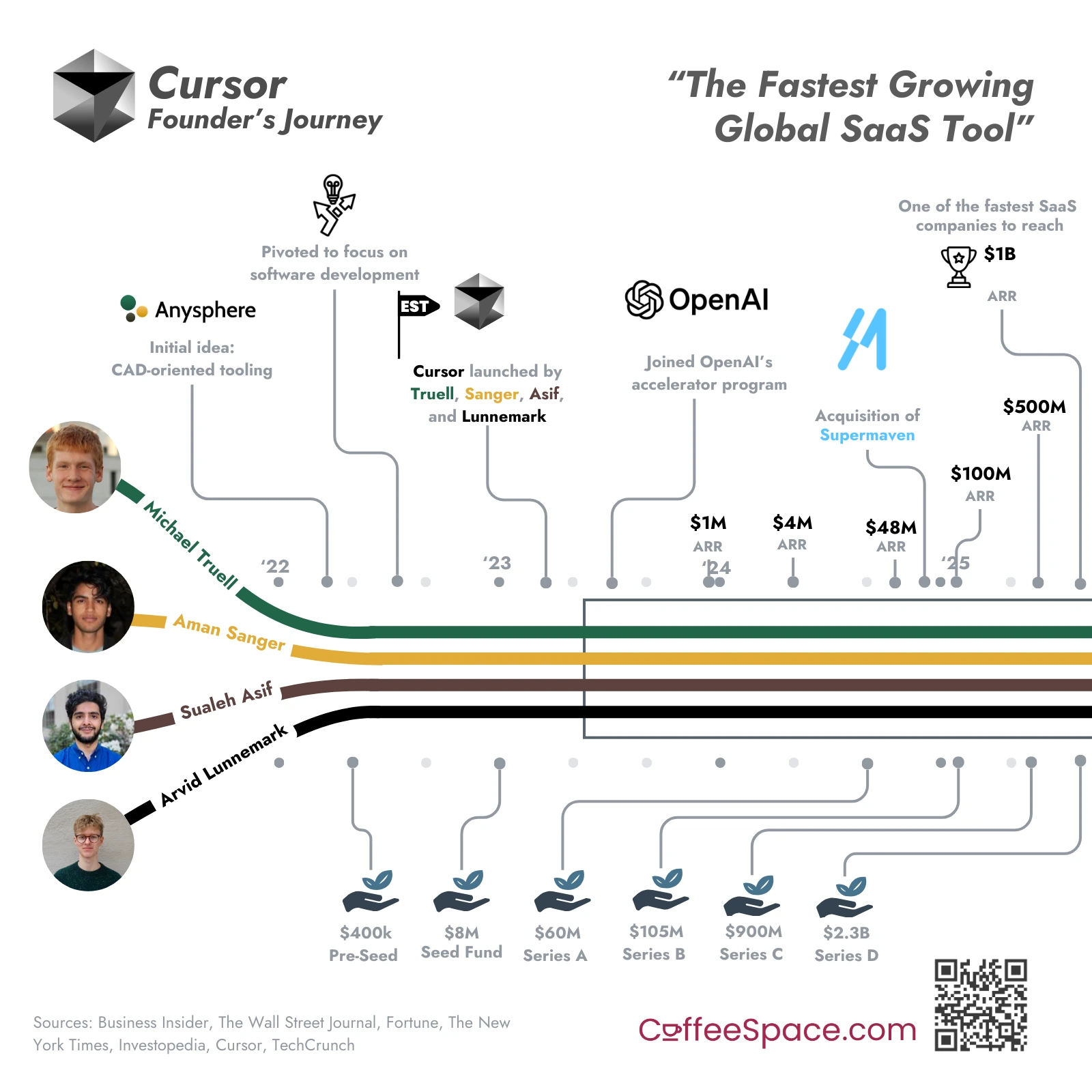
The MIT Roots: Where Cursor Began (2022)
Cursor’s story begins not in a Silicon Valley accelerator or a polished startup studio, but within the intellectually dense environment of the Massachusetts Institute of Technology. Michael Truell, Sualeh Asif, Arvid Lunnemark, and Aman Sanger met as students and collaborators, each shaped by MIT’s culture of experimentation and rigorous problem‑solving.
In 2022, the four founders incorporated Anysphere, the company that would later produce Cursor. Their early work focused on applying artificial intelligence to complex engineering problems, including mechanical design and analysis. At the time, large language models were improving quickly, but their applications remained fragmented and often superficial.
As the founders explored where AI could create the most leverage, one domain stood out clearly: software development. Despite the emergence of tools like GitHub Copilot, coding still felt fundamentally manual. Developers wrote most logic themselves, navigated sprawling codebases unaided, and spent countless hours debugging and refactoring. Existing AI tools helped with snippets, but they did not understand projects as systems.
That gap became the spark. The founders realized the opportunity was not to build another AI assistant, but to rethink the code editor itself.
Reimagining the Code Editor: The Cursor Vision
From the outset, Cursor was conceived as an AI-native editor rather than an add-on or plugin. Instead of layering AI on top of existing workflows, the team chose to fork a familiar editor and embed intelligence directly into its core. This decision was both technical and philosophical.
By operating at the editor level, Cursor could observe the full structure of a codebase — files, dependencies, symbols, and developer intent, enabling a qualitatively different form of assistance. The AI could reason across projects, not just lines. It could explain unfamiliar code, propose sweeping refactors, and execute multi-step changes with context awareness.
The founders’ roles naturally aligned with this ambition. Michael Truell stepped into the role of CEO, shaping long-term direction and external narrative. Sualeh Asif focused on AI systems and backend architecture. Arvid Lunnemark drove performance and scalability, ensuring the editor could handle real-world workloads. Aman Sanger led product and user experience, grounding advanced technology in practical developer needs.
By late 2022, the technical foundation was in place. The question was no longer whether AI could assist developers, but how far that assistance could go.
Early Acceleration and the OpenAI Relationship (2023)
Cursor’s early momentum was amplified through its engagement with OpenAI’s startup ecosystem. Access to advanced language models and feedback loops allowed the team to push beyond basic completion and into deeper reasoning, planning, and transformation of code.
This period was less about publicity and more about refinement. The founders tested Cursor internally and with early adopters, focusing on correctness, speed, and usefulness over spectacle. Every iteration aimed to answer a simple question: does this actually make developers faster and more confident?
In March 2023, Cursor officially launched. Adoption spread quickly not through aggressive marketing, but through developer word of mouth. Engineers shared it with teammates. Slack channels lit up with demos of complex refactors completed in minutes. Cursor felt less like a novelty and more like a shift in how coding itself worked.
The editor’s defining feature was not just code generation, but conversation. Developers could ask questions in natural language, reason through unfamiliar systems, and delegate mechanical work to the AI while retaining control.
Building Trust and Product‑Led Growth (Late 2023)
Throughout 2023, Cursor remained deeply product-focused. The team resisted the urge to prematurely chase enterprise contracts, instead doubling down on developer experience. Latency was reduced. Context windows expanded. Explanations improved. The AI became more predictable and more helpful.
Later that year, Cursor raised an $8 million seed round led by the OpenAI Startup Fund. The capital enabled the company to expand its engineering and research team, but the operating philosophy remained unchanged. Funding was fuel, not a pivot.
By the end of 2023, Cursor had established itself as a serious tool used in production environments. Its users included engineers at fast-growing startups and established technology companies, which was a strong signal that the product was crossing from experimentation into daily reliance.
Scaling Up: Series A and Market Validation (2024)
In 2024, Cursor entered a new phase. Usage continued to climb, revenue became meaningful, and the company raised a $60 million Series A at a valuation of roughly $400 million. The round validated a belief that had guided the founders from the beginning: AI-assisted coding was not a feature, but a platform shift.
With new capital, Cursor expanded aggressively. Engineering and research teams grew. Enterprise-grade features such as security, access controls, and collaboration tooling were prioritized. Cursor evolved from an individual productivity booster into a system capable of supporting entire engineering organizations.
At the same time, the product itself matured. Cursor’s AI could now plan multi-file changes, reason about dependencies, and handle complex refactors. Developers increasingly described their workflow as “thinking out loud” while the editor executed.
Growing Pains: Pricing, Trust, and AI Reality
Hypergrowth brought its own challenges. In mid-2024, a pricing change led to unexpected charges for some users, triggering public criticism. Cursor responded quickly, issuing refunds and acknowledging the misstep. The incident reinforced an internal principle: trust compounds more slowly than growth, but erodes much faster.
Soon after, another issue surfaced when an automated support agent provided incorrect information about account policies. The episode highlighted a fundamental tension in AI-first companies — automation scales, but errors scale too.
Rather than retreat, Cursor adjusted. Human oversight was tightened, safeguards were introduced, and the company treated reliability as a core product feature. These moments marked Cursor’s transition from an ambitious startup to a more operationally mature organization.
Breakout Year: Explosive Growth and Category Leadership (2025)
By early 2025, Cursor’s growth accelerated dramatically. Enterprise adoption surged, recurring revenue climbed rapidly, and the company raised a large Series B followed by a $900 million Series C at a $9.9 billion valuation.
The funding allowed Cursor to invest deeply in proprietary AI research, infrastructure, and long-term defensibility. The team grew to roughly 100 people, predominantly engineers and researchers. Cursor began exploring custom models optimized specifically for code — faster, cheaper, and more controllable than general-purpose systems.
At the same time, Cursor expanded beyond traditional coding. New tools blurred the boundary between development, design, and product specification, pointing toward a future where software creation feels more like describing intent than writing syntax.
In late 2025, Cursor raised a $2.3 billion Series D, valuing the company at approximately $29.3 billion. Strategic investors joined the round, signaling that Cursor was no longer viewed as a single-product startup, but as foundational infrastructure for the future of software.
By this stage, Cursor reported over $1 billion in annualized revenue. What began as an MIT experiment had become a defining force in how developers build, reason about, and maintain software.
Leadership, Culture, and Founder Evolution
Despite its scale, Cursor retained much of its early culture. Decision-making remained fast. Experimentation was encouraged. Product quality consistently outranked short-term optimization. The founders stayed closely involved in technical direction, preserving the company’s original ethos even as it matured.
As with many fast-growing companies, leadership roles evolved. Some founders pursued new research directions, while others focused on steering Cursor through its next phase. These transitions reflected growth, not instability — a natural evolution from startup to institution.
What Cursor Represents
Cursor’s journey mirrors a broader shift in software development itself. Coding is moving away from line-by-line instruction and toward high-level collaboration between humans and intelligent systems. Cursor did not invent this shift, but it executed on it faster, deeper, and more convincingly than most.
For founders, Cursor offers enduring lessons: build where workflows already exist, treat trust as a feature, and design AI as a partner rather than a gimmick. Above all, Cursor shows how a small, focused team — armed with technical clarity and conviction — can redefine an industry during moments of technological inflection.
Founder Lessons
Product-led growth only works if the product truly leads
Cursor scaled not through aggressive sales tactics, but because developers felt immediate productivity gains. When a product becomes habit-forming and meaningfully improves daily work, growth becomes a byproduct rather than a goal.
AI-native companies are built on integration, not novelty
Cursor’s edge wasn’t flashy demos — it was deep integration into real workflows. The long-term winners in AI will be those who treat AI as infrastructure, not spectacle, and design products people trust to work quietly, reliably, and every day.
Start with what almost works, then go deeper
Cursor didn’t emerge by rejecting existing AI coding tools, it emerged by noticing their limits. Instead of improving autocomplete, the founders reimagined the editor itself as an AI-native environment. Many breakout companies aren’t born from new markets, but from taking a familiar idea and finishing the job others only started.
If you’re inspired by this story and want to start exploring your own ideas or find someone to build with, join us at CoffeeSpace.
Cofounder Tips
How Risky Is Being An Early Startup Hire?
January 28, 2026
oining a startup as one of the first employees is often portrayed as a high stakes gamble: unstable income, unclear roles, and the possibility the company disappears overnight. Yet thousands of professionals still choose this path every year because the upside learning, ownership, and career acceleration can be enormous. The real question is not whether risk exists, but how to understand, evaluate, and manage it intelligently. This guide breaks down what risk actually looks like when you become an early hire, how startup founders think about early employees, what signals indicate a healthy opportunity, and how early hires themselves view the tradeoffs. By the end, you will see that risk in startups is rarely random it is structured, assessable, and often worth taking when aligned with the right team.
What Makes Being An Early Startup Hire Risky?
The risk of becoming an early hire is not just about failure rates. It comes from uncertainty across several dimensions:
- Financial uncertainty: salaries may be lower or partially equity based
- Role ambiguity: responsibilities change weekly
- Company survival: many startups pivot or shut down
- Leadership maturity: startup founders are learning in real time
Unlike established companies, early stage environments lack buffers. You are closer to decisions, mistakes, and breakthroughs.
However, risk is not inherently negative. For many early hires, proximity to decision making becomes a growth accelerator that corporate roles rarely offer. A startup founder often depends heavily on early employees, which means visibility, ownership, and rapid skill expansion.
This dynamic is one reason people who want to build a business eventually choose early startup roles: they want exposure to real execution, not theoretical strategy.
How Do Early Hires Evaluate Whether The Risk Is Worth It?
Smart early hires do not gamble blindly. They evaluate signals that indicate whether a startup founder has built a credible foundation.
Key evaluation areas include:
Founder quality
- Do they communicate vision clearly?
- Have they demonstrated resilience?
Market clarity
- Is there a real customer problem?
- Is traction measurable?
Role definition
- Does the early hire understand success metrics?
Financial runway
- Is funding or revenue sufficient for 12 to 18 months?
Many candidates exploring start up business opportunities treat this evaluation as seriously as investors do. They are not just joining a job they are deciding whether this is a place to build a business career.
What Does A Startup Founder Expect From An Early Hire?
Startup founders hire early employees because they need leverage, not maintenance. Expectations often include:
- Ownership mindset rather than task execution
- Comfort with ambiguity
- Initiative without constant direction
- Willingness to solve problems outside job scope
An early hire is not just filling a role. They are shaping how the company operates. This expectation is why many startup founders view early employees as culture carriers.
For candidates exploring technology startup ideas or future entrepreneurship, working closely with a startup founder offers direct exposure to decision frameworks rarely taught elsewhere.
What Are The Real Upsides That Offset The Risk?
Risk exists because upside exists. Early hires frequently cite the following benefits:
- Accelerated learning curve
- Direct access to founders
- Broad skill exposure
- Equity participation
- Influence on company direction
For professionals interested in start up ideas or long term entrepreneurial paths, this environment compresses years of learning into months.
Some early hires describe their experience as a live masterclass in how to build a business under pressure. Even when startups fail, the skill acquisition often leads to stronger future opportunities.
Perspectives From Early Startup Hires
Early employees who thrive tend to frame risk differently. Instead of asking “will this fail?” they ask “what will I learn if it does?”
Common reflections include:
- “I learned more in one year than five years in corporate roles.”
- “The uncertainty forced me to think like a startup founder.”
- “Even when we pivoted, my responsibility expanded.”
Many early hires later launch their own ventures or join new startups at higher leverage positions. Their risk tolerance becomes an asset rather than a liability.
This mindset often develops within strong startup networks where founders and operators exchange lessons openly.
How Can Early Hires Reduce Their Risk?
Risk management is about preparation, not avoidance. Early hires can protect themselves by:
- Negotiating equity with clear vesting terms
- Understanding runway and burn rate
- Clarifying role expectations
- Building emergency financial buffers
- Maintaining active startup networks
Networking platforms like CoffeeSpace allow candidates to evaluate founders, meet multiple teams, and compare opportunities before committing. This reduces the likelihood of joining misaligned environments.
Candidates exploring start your business ambitions often use these networks to test compatibility with startup founders long before formal offers appear.
Are Early Startup Roles Riskier Than Corporate Jobs?
Corporate roles feel safer because structures exist. But safety is contextual.
Corporate risks include:
- Slow career growth
- Limited ownership exposure
- Organizational politics
Startup risks include:
- Volatility
- Rapid responsibility changes
Professionals who aim to build a business or eventually pursue technology startup ideas often accept early stage volatility because the long term skill and ownership upside outweighs short term instability.
Risk is not universal. It depends on personal goals, financial flexibility, and appetite for uncertainty.
When Does The Risk Become A Red Flag?
Not all startup risk is healthy. Warning signs include:
- Founder evasiveness about finances
- Undefined strategy
- High employee turnover
- Equity promises without documentation
Smart early hires differentiate productive uncertainty from reckless leadership.
Why Startup Networks Matter For Risk Evaluation
The best early hires rarely join startups blindly. They rely on founder networks, peer referrals, and ecosystem platforms to vet opportunities.
CoffeeSpace helps candidates and startup founders connect based on values, intent, and working style rather than rushed hiring decisions. This reduces asymmetric risk where one party has incomplete information.
For anyone exploring start up ideas or early career exposure to startup environments, networks dramatically increase decision quality.
Final Thoughts: Risk Is A Tool, Not A Trap
Being an early startup hire is risky only when entered without awareness. When evaluated thoughtfully, it becomes one of the fastest paths to ownership thinking, real execution skills, and entrepreneurial growth.
Whether you aspire to become a startup founder, want exposure to building teams, or simply seek a career with higher leverage, early stage roles can be transformative.
If you are looking to connect with startup founders, explore early hire opportunities, or find aligned collaborators who share your long term goals, CoffeeSpace helps you meet the right people early. Whether you want a cofounder or your first startup role, alignment reduces risk and multiplies opportunity.
Cofounder Tips
Can Early Employees Become Cofounders Later In Startups?
January 25, 2026
In the early days of a startup, titles are fluid, responsibilities overlap, and ownership is often still being figured out. Many startup founders hire their first few employees before fully defining what the founding team will look like long term. This naturally raises a common question across Google and GPT searches: can early employees become cofounders later in startups?
The short answer is yes, but it depends heavily on timing, contribution, trust, and how the company evolves. This article breaks down how early employees transition into cofounder roles, when it makes sense, when it does not, and what both startup founders and early hires should realistically expect. We will also explore real startup patterns, perspectives from early hires, and how founder networks like CoffeeSpace help align people early before titles become complicated.
What Is The Difference Between An Early Employee And A Cofounder?
A cofounder is typically involved at the zero stage of a company. They help define the idea, validate the market, take on existential risk, and usually invest unpaid time before the company has traction. A startup founder or cofounder is responsible not just for execution but for long term ownership of outcomes.
An early employee, on the other hand, joins after the company has already started moving. They may still take significant risk, but the startup founder has usually made the initial bet.
Key differences include:
- Cofounders shape the company’s direction from day one
- Early employees execute within a vision that already exists
- Cofounders usually hold more equity and decision power
- Early hires often have clearer roles and compensation structures
That said, in very early startups, these lines can blur quickly.
When Does It Make Sense For Early Employees To Become Cofounders?
Early employees can become cofounders when their contribution fundamentally changes the trajectory of the company. This usually happens when an early hire moves beyond their job scope and starts operating like an owner.
Common scenarios where this transition makes sense include:
- The early hire joins before product market fit and helps discover it
- They take on founder level responsibility during a critical pivot
- They bring in customers, funding, or key partnerships
- They effectively run a core function end to end
In these cases, the startup founder may choose to formally recognize the contribution by upgrading the role to cofounder status.
Is There A Time Window For Becoming A Cofounder?
Timing matters more than most people realize. The earlier the company stage, the more realistic the cofounder transition becomes.
Typical patterns:
- Pre revenue or pre product: very possible
- Early revenue but pre scale: possible with renegotiation
- Post Series A: rare and often symbolic
Once a company has institutional investors, a board, and structured equity plans, converting an early employee into a cofounder becomes legally and culturally harder.
This is why many founders prefer to clarify cofounder relationships early through trusted founder networks rather than retroactively.
How Equity Usually Changes When An Early Employee Becomes A Cofounder
Equity is where emotions and reality often collide. Early employees rarely receive equal equity to original founders, even if their role expands.
Common equity outcomes include:
- Additional equity grants layered on top of existing ESOPs
- Title change without full cofounder equity parity
- Vesting resets tied to new responsibilities
A startup founder must balance fairness with the long term cap table. Giving away too much equity too late can harm future fundraising, while giving too little can demotivate someone operating at founder level.
Can An Early Employee Call Themselves A Cofounder?
This is one of the most searched questions online. Legally, the answer depends on shareholder agreements. Practically, it depends on internal alignment.
In healthy startups:
- Titles are agreed upon, not self assigned
- External representation matches internal reality
- Investors understand who actually founded the company
Misaligned titles often signal deeper trust issues. Clear communication early prevents awkward situations later.
Perspectives From Early Employees Who Became Cofounders
Many early hires describe the transition as gradual rather than sudden. They did not ask for the title. Instead, the responsibility found them.
Common reflections from early hires include:
- Ownership mindset mattered more than title
- Trust with the startup founder came first
- Equity discussions were harder than expected
- Recognition mattered as much as compensation
Some early employees also choose not to become cofounders, preferring defined roles and stability even in high growth environments.
Why Some Early Employees Should Not Become Cofounders
Not every strong early hire should become a cofounder. Being great at execution does not always translate to founder responsibilities.
Warning signs include:
- Avoidance of ambiguity
- Discomfort with long term risk
- Focus on role rather than outcomes
- Misalignment on vision or values
A startup founder must distinguish between loyalty and founder readiness.
How Founder Networks Influence These Transitions
Strong founder networks reduce confusion around roles. When founders meet potential collaborators early through communities rather than rushed hiring, expectations are clearer from the start.
Platforms like CoffeeSpace help founders connect with people who want ownership, not just jobs. This makes it easier to identify whether someone should be an early hire, a long term operator, or a true cofounder before formal titles are needed.
CoffeeSpace also allows early hires to assess founder quality before joining, which reduces the risk of misaligned expectations later.
How Startup Founders Can Avoid Title Confusion Early
To prevent future tension:
- Be explicit about roles from day one
- Define what cofounder means in your company
- Tie ownership to responsibility, not tenure
- Revisit agreements as the company evolves
Clarity builds trust. Ambiguity creates resentment.
What Early Employees Should Ask Before Expecting A Cofounder Role
Early hires who aspire to founder level roles should ask themselves:
- Am I willing to take founder level risk?
- Am I influencing company direction or just executing tasks?
- Have I communicated my long term intentions clearly?
Expectations that are not spoken rarely get fulfilled.
The Long Term Impact Of These Decisions
How a startup handles early employees and cofounder transitions often predicts company culture. Fairness, transparency, and mutual respect compound over time.
Startups that navigate this well tend to:
- Retain early talent longer
- Attract stronger future hires
- Build trust with investors
- Maintain founder alignment under pressure
Final Thoughts: Finding The Right People Early Matters
Whether someone starts as a cofounder or an early employee, alignment matters more than titles. The strongest startups are built by people who share risk, values, and long term vision from the beginning.
If you are a startup founder looking to meet potential cofounders or early hires who actually want ownership, or if you are an early hire searching for a team worth committing to, CoffeeSpace helps match people based on values, goals, and intent not just resumes or cold outreach.
Great startups are built by aligned people. CoffeeSpace helps you find them earlier.
Sorry - there were no result for your search - try again :)