
Tips, Stories, and Updates on Entrepreneurial and Cofounder Journeys
Stay in the loop with 25,000+ founders

Cofounder Tips
The Red Flags Every Startup Founder Should Look For When Choosing a Founding Team Member
November 16, 2025
Choosing the wrong person for your founding team can derail even the strongest ideas. While finding someone with complementary skills is essential, spotting red flags early is what truly protects a startup founder from future disasters. As you start up business operations—whether you’re launching your first product, raising capital, or building out your founders network—you need cofounders and early hires who share values, ambition, and execution speed. This article breaks down the warning signs founders often overlook, the questions people commonly ask when evaluating potential teammates, and how to make better decisions before giving someone a title that will shape your company’s future.
What are the biggest early red flags when choosing a founding team member?
One of the most common concerns among startup founder communities is simply: “How do I know if this person is truly founder material?”
Here are the red flags that consistently show up across early-stage teams:
Lack of urgency:
If someone takes too long to respond, delays decisions, or needs constant external motivation, that’s a clear sign they aren’t ready for the intensity of a start up business environment. Founding teams survive on speed.
Misaligned ambitions:
You may want to build a big company; they may want a lifestyle project. You want a global product; they want a hobby. Misalignment doesn’t always show up on day one—but it becomes obvious in long-term decisions.
Overpromising, under-delivering:
Everyone sells their best self during early conversations. But if they repeatedly set deadlines they miss, exaggerate their skill set, or talk in buzzwords without concrete action, that’s a serious warning.
Low ownership mentality:
The best early teammates think in terms of “What does the company need?” instead of “What’s my role?”
If they stick strictly to their job description or avoid ambiguity, they’re behaving more like a regular employee—not a founder-level contributor.
Poor communication under pressure:
Startups are 90% chaos at the beginning. If someone shuts down, gets defensive, or avoids hard discussions, tension will only amplify as the company grows.
What personality traits signal that someone may not be right for a founding team?
Beyond skills and output, personality alignment matters just as much—sometimes even more.
Fragile ego:
If the person cannot handle feedback, rejects alternate ideas, or needs to “be right,” they will slow momentum and damage team culture.
Victim mindset:
Founders must take extreme ownership. If someone always blames external factors—the market, investors, other teammates, the economy—they won’t help your startup survive tough cycles.
Risk aversion disguised as “pragmatism”:
A founding team member must be willing to make bold bets with imperfect information.
Someone who constantly slows decisions, over-analyzes, or avoids committing is signaling a deeper resistance to startup risk.
Transactional motivation:
If their first questions revolve around salary, titles, equity percentages, or perks—and not the problem, customers, or mission—they’re looking for a job, not a journey.
What work habits or behaviors indicate someone won’t thrive on a founding team?
Inconsistent execution:
Early-stage work is unpredictable, and things break constantly. A founding team member must be reliable when the plan collapses—and still deliver.
Needing too much structure:
If someone struggles without formal processes, reporting lines, or step-by-step instructions, they’re unlikely to thrive in the unstructured reality of building something from scratch.
Avoidance of hard tasks:
Founders must do everything—sales, customer calls, hiring, product fixes, partnerships. Red flag: someone who consistently gravitates only toward “fun” tasks.
Disappearing during critical moments:
If they ghost during sprints, fundraising periods, or product deadlines, that’s a hard no. A startup founder cannot build with someone who isn’t dependable.
Inflexibility with role shifts:
A founding team role changes every three months. If someone insists on staying inside a narrow function, they may be better suited as a specialist later—not a founding teammate.
What value misalignments cause the biggest long-term issues?
Values are harder to screen for than skill—and far more important.
Different views on work ethic:
If you’re prepared to work nights and weekends but your partner wants strict 9–5 boundaries, it will create resentment.
Different definitions of success:
Some founders want fast growth and venture funding. Others prefer bootstrapping. Some want to sell early; others want a decade-long journey.
Misalignment here is one of the top reasons founding relationships collapse.
Different moral compass:
This is a big one. If someone is comfortable bending rules, cutting corners, or “faking it until they make it,” that could jeopardize your entire start up business down the road.
Different communication styles:
If one person is direct and the other avoids confrontation, problems will fester instead of being resolved.
How do you test whether someone is truly founder-level before committing?
Before giving someone equity or a title, test for compatibility using real work—not just meetings.
1. Build something small together.
A one-week sprint tells you more than three months of calls.
2. Run a values alignment conversation.
Discuss mission, scale, ethics, ownership, conflict style, risk tolerance, and expectations.
3. Observe how they behave in ambiguous situations.
Give them a problem with no clear solution. Ask them how they would navigate uncertainty.
4. Ask why they want to build this company.
The answer reveals everything.
If it’s genuine, mission-driven, and customer-focused—that’s green.
If it’s about money, titles, or prestige—that’s red.
5. Talk to people who have worked with them.
Past behavior predicts future behavior.
Founders in your founders network can give insight on whether someone has a history of quitting early, creating conflict, or failing to deliver.
Should you walk away if you see even one red flag?
Not always—but you must understand the difference between a yellow flag and a red flag.
Yellow flags = coachable issues
Examples: inexperience, slower iteration pace, or lack of startup exposure.
Red flags = non-negotiables
Examples: low ownership, ego issues, unreliability, misaligned values, lack of urgency.
Founding team decisions shape the DNA of your start up business.
These are not hire-and-fire roles.
These are partnerships.
Walking away early is easier than repairing damage later.
Ending: CoffeeSpace for Cofounders and Early Hires
Choosing the right founding team member can make or break your startup. Skill matters, but alignment, urgency, and ownership matter even more. If you’re looking for someone who shares your values—not just someone looking for a title—CoffeeSpace helps you meet aligned cofounders and the early hire talent needed to build momentum fast. Whether you’re expanding your founding team or searching for the right technical partner, CoffeeSpace is the place to find people who match the way you build.
Cofounder Tips
How to Hire the First Employees for Your Startup
November 14, 2025
Hiring your first employees is one of the most pivotal moments in a start up business. These aren’t just hires but instead they become the foundation, the culture, and the execution engine that moves the company forward. In this guide, we break down the real questions a startup founder asks when building an early team: What roles come first? Should you hire generalists or specialists? How do you find people who thrive in chaos? What signals matter more than skills? And how do you compete against bigger companies when you have no brand yet? This article gives you the frameworks, red flags, and tactical playbook needed to hire the right first employees.
What Roles Should You Hire First? (Generalist vs Specialist)
This question splits founders all the time. The answer depends on what your start up business needs to survive the next version of itself.
Hire a Generalist First If:
- You are still iterating on the product
- You’re pre-revenue or pre-MVP
- You need someone who can do ops, customer calls, testing, research, and execution
Early generalists are often “Swiss Army knife” hires — they help you discover what roles you’ll need later. They turn chaos into motion.
Hire a Specialist First If:
- You already validated the problem
- You need engineering expertise to build the first real product
- You’re in a technical space (AI, fintech, devtools, biotech)
- You need fast execution in a clearly defined area
A startup founder should think of the first hire as a force multiplier:
A generalist multiplies your capacity.
A specialist multiplies your output.
Both can be the right answer — it depends on where you stand today.
Should Your First Hire Be Full-Time, Part-Time, or Contract?
This is one of the most commonly searched questions — and one most founders answer incorrectly by defaulting to full-time too early.
Full-Time Hire
Choose this only if:
- You have clarity in role and responsibilities
- You have funding or runway
- The skill is core to the company
Full-time is best for mission-critical roles like engineering, product, or core operations.
Part-Time or Contract
This is ideal when:
- You need to validate demand before overcommitting
- You need expertise temporarily (e.g., branding, back-end audit, GTM experiment)
- You’re pre-product and not sure what long-term roles will look like
The biggest mistake a startup founder makes is hiring full-time simply because it “feels like progress.”
Progress is validation, not headcount.
How Do You Know Someone Will Survive a Zero-to-One Environment?
Early hires are not normal employees. They operate without direction, without structure, and often without precedent. Here are the real-world signals that someone can thrive:
1. They bring solutions, not questions.
They don’t ask what to do — they tell you what they did.
2. They’ve built something outside their job.
Side projects, open-source contributions, indie hacks, small businesses — these reveal initiative and ownership.
3. Ambiguity excites them instead of scaring them.
When things break, they lean in rather than panic.
4. They don’t cling to titles.
Anyone overly concerned with titles, reporting lines, and job descriptions will not last.
5. They talk about outcomes, not responsibilities.
Founders focus on outcomes. Early hires must do the same.
6. They can operate with low ego, high accountability.
The early environment is too fragile for ego battles.
You’re looking for builders, not joiners.
Where Do the Best Early Employees Come From? (It’s Not Where You Think)
Founders often look at job boards — but the best early hires rarely come from there. People who thrive in early chaos gather in very different places.
1. People Who Already Work in Startups
They understand the pace and uncertainty.
They know what “low process, high urgency” feels like.
2. Former Founders or First-10 Employees
These are your highest upside hires.
They’ve built before. They know what matters.
3. Community Builders, Hackathon Regulars, Indie Makers
These people ship fast and enjoy creation.
4. Operators Inside Hypergrowth Companies
People leaving Stripe, Canva, Grab, or Shopify want ownership again.
5. Early-stage hiring platforms built for startup matching
Places where builders join because they want impact, not corporate ladders. Check out early hiring and cofounder matching apps such as CoffeeSpace.
6. Your extended personal network (2nd–3rd degree)
Surprisingly, your best early hire may come from someone who’s “one introduction away.”
The job isn’t finding talent, but it’s finding mission-aligned talent.
How Do You Structure Compensation for First Employees?
Founders often ask:
“How much equity should I give?”
But the better question is:
“How do I make the compensation reflect risk, ownership, and impact?”
Salary for First Hires
- Often below market
- Should scale with funding
- Must be paired with trust and transparency
Equity Expectations
Typical early-employee equity ranges:
- 0.5%–2% for early operators
- 1%–4% for technical hires
- 3%–10% for near-cofounder-level contributors
But equity alone isn’t enough. You must communicate:
- Vesting schedule
- Liquidation preferences
- Cap table expectations
- Long-term growth path
Early employees aren’t paid for the work they do today. They’re paid for the future value they help create.
How Do You Convince Great People to Join a Risky Startup?
Contrary to belief, people don’t join early startups for money. They join for meaning, momentum, and ownership.
Here’s how to sell the opportunity:
1. Articulate a future they want to be part of
People follow vision.
2. Show evidence of momentum
Even small wins matter:
- A prototype
- A waiting list
- A signed LOI
- Early revenue
3. Offer real ownership and autonomy
Not just equity — but responsibility.
4. Give clarity about the mission
People want to know why you are the startup founder building this.
5. Be honest about the risks
Transparency builds trust and sets the right expectations.
Great people don’t want stability —
They want meaningful challenge.
What Are the Red Flags When Hiring Your First Employees?
Avoid these candidates at all costs:
1. People who need process
Early startups have none.
2. People who ask about career ladders
There are none yet.
3. People who say “I’ll do anything”
Generalists must still have a superpower.
4. People who need external validation
You need internal drive, not approval seekers.
5. People who don’t ask questions about customers
Customer obsession is non-negotiable.
Culture mistakes at this phase become culture debt later.
Conclusion: Find Your Early Hire or Cofounder on CoffeeSpace
Your first hires shape everything — speed, culture, product quality, execution, and founder sanity. Whether you're looking for a mission-aligned cofounder, a high-ownership generalist, or your first specialist hire, CoffeeSpace connects you with serious builders through a global founders network. If you're ready to grow your start up business with people who think like owners, CoffeeSpace is where ambitious founders meet the partners who help them win.
Cofounder Tips
How to Find a Founding Engineer for Your Startup?
November 11, 2025
Finding a founding engineer is one of the most important early decisions a startup founder will ever make. A true founding engineer is not just someone who writes code — they help define product direction, shape technical strategy, build early culture, and co-create the DNA of your start up business. In this guide, we’ll walk through what a founding engineer actually is, where to find them, how to evaluate them, how much equity they typically get, and what questions most founders ask when searching for this critical early partner. Whether you’re hiring your very first technical teammate or looking for someone who can take your MVP to production, this article provides a practical playbook used across startup founder circles and global founders network communities.
What Is a Founding Engineer?
A founding engineer is an early technical hire — usually among the first 1–3 employees — who joins before the company has stability, revenue, or even a fully defined product. Unlike a regular engineer, a founding engineer builds both the product and the foundations of the company.
They typically:
- Ship the earliest versions of the product
- Make architectural decisions with long-term impact
- Work directly with customers
- Influence product and go-to-market strategy
- Partner with the startup founder on technical direction
- Build frameworks future engineers will rely on
- Set engineering culture and hiring standards
In some companies, founding engineers operate almost like cofounders — with similar responsibility, but without the formal title. That’s why choosing the right person is crucial. A good founding engineer accelerates a start up business; a misaligned one can slow it down for years.
Where Do Founding Engineers Usually Come From?
Many startup founders assume that finding top technical talent requires luck. But in reality, founding engineers tend to come from a few predictable places:
1. Your existing network
Most early hires come from warm introductions — ex-colleagues, referrals, and people you’ve built with before. Trust matters more than resumes at this stage.
2. Startup communities and founders network groups
Communities built for early builders are among the fastest-growing sources of high-intent candidates.
3. Hackathons, demo days, and early-tech events
These environments attract people who love fast execution and zero-to-one building.
4. Open-source contributors
People already building and shipping outside their jobs often excel in founding roles.
5. Engineer-focused hiring platforms
Especially platforms built for early-stage teams, such as CoffeeSpace, or talent platforms such as Upwork.
6. Alumni groups from high-growth companies
Companies like Stripe, Airbnb, Grab, and Notion produce early employees who later want to join a small team again.
The key is not volume — it’s finding the right kind of engineer who thinks like an owner, not an employee.
How Do You Know Someone Is a “Founding Engineer” and Not Just a Strong Developer?
A founding engineer is defined by mindset and behaviour more than technical ability. Ask yourself:
Do they think in systems or just tasks?
Founding engineers design for scale even when building scrappy MVPs.
Do they thrive in ambiguity?
Early-stage work is chaotic — there are no specs, no clear answers, and no handholding.
Do they care about users or only code?
The best ones talk to customers, test assumptions, and understand product tradeoffs.
Can they own entire problem areas?
A founding engineer should be comfortable with full responsibility.
Do they communicate clearly?
Poor communication early on is deadly. You need someone who can simplify complexity quickly.
Do they demonstrate founder-like behaviours?
Taking initiative, thinking ahead, solving problems before they appear, and treating company resources like their own.
If the answer to most of the above is “yes,” the person is more likely to succeed in this uniquely demanding role.
What Skills Should You Look for in a Founding Engineer?
Beyond core technical strength, founding engineers need a hybrid skillset:
1. Full-stack capability (or deep backend strength with range)
They must move fast and independently. Specialisation comes later.
2. Ability to build from scratch
Not all engineers know how to create architecture or product flows from nothing.
3. Strong product intuition
A founding engineer understands user experience, not just implementation.
4. Prior startup exposure
Not mandatory, but incredibly helpful — they’ve felt the chaos before.
5. Problem prioritisation
Many engineers can solve complex problems. Few know which problems actually matter.
6. Desire to own outcomes
The early team must care as much as the startup founder about quality, velocity, and outcomes.
This combination is rare — which is why founding engineers are so valuable.
How Much Equity Should a Founding Engineer Get?
Equity is one of the most common questions startup founders ask — and one of the hardest to answer.
Typical equity ranges for founding engineers:
- 1%–5% for the first engineer
- 0.5%–2% for subsequent founding engineers
- Higher if:
- they replace the need for a technical cofounder
- they bring exceptional experience
- they are taking a major pay cut
- they are assuming CTO-level responsibilities
Cash compensation is usually below market, but equity compensates for risk and early uncertainty. Remember: equity is about aligning incentives for the future of the start up business.
Where Are the Best Places to Find a Founding Engineer?
Here are the sources that consistently produce high-quality founding engineers:
1. Founder–builder communities
Places where engineers actively seek zero-to-one opportunities.
2. Niche technical groups
AI, security, infra, devtools, blockchain, and ML communities produce exceptional builders.
3. Technical Twitter / LinkedIn
Engineers who build publicly often become strong early hires.
4. Cold outreach to open-source contributors
These are builders in their purest form — motivated by creation.
5. Platforms that specialise in early-stage matching
Generic job boards rarely find people comfortable with risk. Targeted platforms focused on early technical roles perform far better.
6. University entrepreneurial clubs
Some of the best founding engineers join startups straight out of school.
Don’t wait for inbound applicants. Founders who proactively search always hire the best early talent.
What Can You Do While Searching for a Founding Engineer?
Searching for the right founding engineer often stretches across months of intros, interviews, and mutual due diligence, and product momentum can quietly stall in the gap. One way founders keep shipping in the meantime is by bringing in independent talent for scoped work, a front end build for a launch, a DevOps setup, an integration a prospect is waiting on, without pre committing equity or a full time offer.
Upwork is a common place to start: post the role, review proposals from freelancers across more than 10,000 skills, and often have someone working within days. The founding engineer search stays the priority. The roadmap just doesn’t have to wait for it.
How Do You Convince a Strong Engineer to Join as a Founding Engineer?
Early engineers have options — often many options — so attracting them requires clarity and conviction.
Here’s what matters most:
1. A compelling mission
They must believe the problem is worth solving.
2. Proof you can execute
Even if you’re non-technical, show traction, insight, or domain expertise.
3. Transparency about risks
Strong engineers respect honesty over hype.
4. Clear ownership
Define the areas they will fully lead.
5. Meaningful equity
They are taking risk — reward them properly.
6. A culture built around builders
Founding engineers want autonomy and trust.
Hiring is a sales job. You’re not convincing them to work for you — you’re inviting them to build with you.
Conclusion: Find Your Cofounder or Early Technical Hire on CoffeeSpace
The right founding engineer can change everything, from product velocity to culture to the survival of your company. Whether you’re a solo startup founder seeking a technical counterpart or a team looking for your next early hire, CoffeeSpace connects you with serious builders across a global founders network. If you want to meet high-intent cofounders, founding engineers, and early employees ready to build from day one, CoffeeSpace is the fastest way to find the partner who will help you take your start up business from idea to reality.
Cofounder Tips
What Is the Difference Between Founder and Cofounder?
November 10, 2025
People often use “founder” and “cofounder” interchangeably, but they aren’t actually the same thing — and the distinction matters more than most realise. In this article, we’ll break down the exact difference between a founder and a cofounder, clarify how each role evolves inside a start up business, and answer the most common questions people ask when deciding how to structure their early team. Whether you're a new startup founder or someone considering joining a founding team, this guide will help you understand titles, equity, expectations, and why the terminology matters. We’ll also cover misconceptions, real-world dynamics between partners, and how your position affects decision-making and ownership.
What Does “Founder” Actually Mean?
A founder is the person, or in some cases, the initial person who originates the idea for the company and takes the first steps to bring it to life. This could mean validating the market, outlining a business plan, building the first prototype, or rallying resources. A startup founder is typically the one who sets the initial direction and makes the early decisions that shape the identity of the company.
Founders usually carry a unique type of ownership: not just equity, but emotional ownership. They feel deeply responsible for why the company should exist in the world. In the earliest days of a start up business, the founder is usually wearing every hat — product, customer development, operations, sales, and sometimes even engineering or marketing.
But one key point often surprises people:
A company can have one founder or multiple founders.
If several people worked together from day one and took equal initiative in forming the company, they can all be considered founders.
What Is a Cofounder?
A cofounder is someone who contributes meaningfully to the creation and formation of the company from the beginning. They help transform the founding idea into a real business, sharing both responsibility and ownership. A cofounder is not “secondary” to a founder — the term simply indicates that more than one person was involved in founding the company.
For example:
- If you originate the idea and bring in someone to help build it, you become founder and cofounder, and so do they.
- If three people start simultaneously, all three are cofounders and founders.
In practical use, “cofounder” emphasises partnership. It signals that the company was built by a team, not by a single individual. In many cases, investors prefer companies with cofounders because complementary skills and shared leadership reduce risk.
Is a Cofounder the Same as a Founder?
Yes — and no.
Every cofounder is a founder, but not every founder is a cofounder.
Here’s the difference:
- Founder is a role defined by time and initiation. You started the company.
- Cofounder is a role defined by collaboration. You started the company with someone else.
Think of it this way:
- If one person creates the company: solo founder.
- If two people create the company: two cofounders and two founders.
- If someone joins after the company is already established (even early): they are not a cofounder, unless the original founder chooses to give them the title for strategic or symbolic reasons.
Some solo founders retroactively give “cofounder” titles to very early employees who were instrumental in shaping the start up business — but this is a strategic choice, not a requirement.
What Do Cofounders Actually Do Inside a Startup?
The short answer: everything needed to keep the company alive.
But the real answer is more nuanced.
Cofounders usually:
- Build the earliest version of the product
- Test the business model
- Talk to customers
- Hire the first team
- Set the culture
- Raise capital
- Make key decisions
- Manage crisis after crisis
In a traditional company, roles are well defined. In a startup, especially at the beginning, cofounders constantly switch between strategy and execution. A technical cofounder may spend mornings writing code and afternoons pitching investors. A business cofounder may spend evenings doing customer support and weekends mapping product requirements.
The mix of responsibilities depends on:
- Skillsets
- Strengths
- Equity split
- What the company needs right now
What matters most is not titles — it’s alignment, complementary skills, and shared conviction.
Why Do Some Startups Prefer Multiple Founders Instead of One?
A growing number of investors, accelerators, and startup communities — including mature founders network groups — believe that companies with multiple founders outperform solo founders. The logic is simple:
- More skills at the table.
It’s rare for one person to excel at product, business, operations, and fundraising. - Better decision-making.
A strong cofounder provides counterbalance, perspective, and emotional resilience. - Shared pressure.
Building a company is exhausting; having a partner keeps you from burning out. - Greater credibility.
Many venture capitalists see multiple founders as proof that people believe in the vision enough to commit at the very beginning.
None of this means solo founders can’t succeed — many have. But it’s undeniable that cofounder teams tend to move faster and distribute responsibilities more sustainably.
Do Founders and Cofounders Get the Same Equity?
Not always. And that’s one of the most misunderstood aspects of founding a company.
Equity is usually split based on:
- level of involvement
- skill contribution
- financial contribution
- risk taken
- IP ownership
- time committed
In some cases, equity is equal. In many cases, it’s not.
There is no universal rule — but there is a universal principle:
Equity should reflect contribution, both past and future.
Founders who choose poorly at this stage often face painful conflict years later.
This is why many startup founder groups and founders network circles advise extreme transparency early on. Conversations about equity should happen before incorporation, and everyone should understand the value they bring.
Can Someone Become a Cofounder Later?
Yes — but it’s uncommon and strategic.
Retrofitting someone with the “cofounder” title usually happens when:
- an early hire behaves like an owner
- they take on extraordinary responsibility
- they fill a critical skill gap
- they elevate the business far beyond their official role
In these cases, granting cofounder status helps acknowledge their contribution and retain them long-term. But the title is not automatically earned — it must be justified.
Which Role Is “Higher”? Founder or Cofounder?
Neither.
This is a misconception created by corporate hierarchy thinking.
Founders and cofounders are both originators of the company — the difference is only how many people were involved at inception.
However:
the lead founder (sometimes called the “originating founder” or “vision founder”) may naturally assume the CEO role or maintain final decision-making power. This is based on contribution and leadership — not title.
How Should You Decide Whether to Bring On a Cofounder?
Ask yourself:
- Can you build the product alone, at least at an MVP level?
- Do you need someone with a skill set you lack?
- Are you prepared to give up equity?
- Do you prefer shared decision-making or ownership independence?
- Are you looking for emotional resilience or speed?
If your answers lean toward partnership, then bringing in a cofounder may dramatically increase the odds that your start up business survives its first two years.
Finding the Right Cofounder or Early Hire With CoffeeSpace
Whether you’re a solo startup founder searching for a partner or part of a team looking for your next early hire, the right person can change the trajectory of your entire company. CoffeeSpace helps you meet aligned, high-intent builders from a global founders network, people who think like owners, move fast, and genuinely want to help you build something meaningful. If you want to find the cofounder who completes your skillset or the early hire who will grow with you from day one, CoffeeSpace is where your search starts.
Cofounder Tips
What Is a Founding Team in a Startup?
November 8, 2025
The founding team of a startup is one of the most misunderstood concepts in early-stage building. People often mix up founders, founding team members, and early hires—but these roles come with different responsibilities, risks, influence, and long-term upside. This article clarifies what a founding team actually is, how it differs from the original startup founder group, what founding team members typically do, and whether joining a founding team is the right move for your career. If you're deciding whether to start or join a company, or whether you’re meant to be a founding hire rather than a founder, understanding these distinctions will help you build a business on solid footing.
What Is a Founding Team?
A founding team is the group of people who join a startup in its earliest stage—usually between employee #1 and employee #5—when almost everything is ambiguous, nothing is stable, and the company’s direction can change overnight. This team is responsible for transforming the initial concept into a working product, a functioning operation, and a real business.
A founding team is defined less by a specific legal document and more by responsibility and impact. These are the people who:
- Shape the culture before any processes exist
- Build the first version of the product
- Set the bar for speed and execution
- Influence the DNA of the company in ways that last for years
- Solve existential problems daily
Unlike typical team members who join later, the founding team works closely with the startup founder and often operates as extensions of the founders themselves. They make decisions not just about tasks, but about strategy, identity, and direction.
A founding team member is not simply an early hire. A founding team is:
- The earliest team
- The team that builds core systems
- The team that owns mission-critical decisions
They don’t just fill a job—they define the job itself.
Is the Founding Team the Same as the Founders?
Not exactly—but they overlap.
A startup founder is someone who was there before the company legally existed. They helped shape the idea, drafted the early vision, made the earliest decisions, and took on the highest level of risk. Their names are typically on incorporation documents, and they hold significant equity.
A founding team member, however, joins after the company is incorporated or after the idea is already formed. They still join very early—often right after the founders—but they did not originate the company.
The best way to think about it is:
- Founders created the company.
- The founding team makes the company real.
Founders define “what” and “why.”
The founding team defines “how” and “when.”
They partner closely with the startup founder but are not founders themselves unless explicitly granted that title and equity role. Many people misunderstand this distinction and assume “founding team” means they can call themselves founders. They can’t—unless the founders agree and legal structures reflect it.
But the influence of the founding team is enormous, and in many cases, founding hires become as critical as the original founder group. This is why understanding the defining lines matters for equity, for expectations, and for how you build a business from scratch.
What Are the Roles and Responsibilities of a Founding Team Member?
Founding team members act like owners, even without founder status. Their responsibilities stretch beyond their job description, because in a startup’s earliest days, everyone covers everything.
Typical responsibilities include:
1. Owning Core Functions Completely
Founding engineers own architecture, not just features.
Founding designers own experience and identity.
Founding operators own workflows, not just tasks.
They are the “department of one” until the company grows.
2. Making Decisions With Limited Data
Founding team members must be comfortable making choices before the market validates anything. They help shape decisions that later hires will follow.
3. Setting the Culture Standard
Culture doesn’t come from a handbook—it comes from how the first five people behave.
Founding team members influence:
- Communication style
- Speed of execution
- Conflict resolution
- Values in practice
- Work ethic and ownership mentality
Everything they do becomes the template the next 50 hires will imitate.
4. Acting as Multipliers, Not Just Contributors
Founding team members hire their own replacements, design their own systems, and build frameworks that allow the company to scale.
A typical founding hire isn’t measured by output alone, but by how much they enable the company to grow.
5. Carrying a Higher Level of Risk
They often take below-market salary, high responsibility, and uncertainty about the future—because they believe in the mission and the people leading it.
In short, a founding team member is someone who steps into chaos willingly and brings order, clarity, and momentum.
Should You Join a Founding Team?
Joining a founding team is not the same as taking a job. It’s taking on a mission. It’s choosing a path that involves risk, ownership, and dramatic personal growth.
Here are strong reasons to consider joining one:
You want to learn how to build a business from the inside out.
Founding team roles accelerate learning at a speed traditional companies can’t match.
You want responsibility and influence.
You’ll shape product decisions, strategy, culture, and execution—not just your lane.
You’re comfortable with ambiguity.
Nothing is certain. Everything changes quickly. Some people thrive in this environment.
You want meaningful equity upside.
While not as large as a founder’s stake, a founding hire often receives more equity than almost anyone else who joins later.
You prefer building, not maintaining.
Founding teams attract people who enjoy creating tools, processes, and systems where none exist.
But it’s not for everyone.
You shouldn’t join a founding team if:
- You need structure
- You want a clear job description
- You prefer predictability
- You don’t enjoy experimentation
- You’re seeking short-term security
A founding team role is best for someone who wants to build intensely, grow rapidly, and be part of a company’s origin story—even if they aren’t a startup founder themselves.
Final Thoughts
Understanding the difference between founders, founding hires, and the founding team helps you make a smarter decision about where you belong. Whether you want to become a startup founder or join as an early hire, these roles offer completely different paths, each with unique rewards, pressures, and long-term opportunities. If your goal is to build a business and shape its earliest days, the founding team may be the place where your skills, ambition, and appetite for risk align best.
Finding the right cofounder or early hire can feel like the hardest part of building a company, but it doesn’t have to be. CoffeeSpace makes the process radically easier by connecting you with aligned builders who think like owners, not employees. Whether you’re searching for a true cofounder to build a business with you or a founding hire ready to grow into a leadership role, CoffeeSpace helps you filter for ambition, compatibility, and shared vision. If you want to build a business with the right people from day one, start your search on CoffeeSpace, where serious founders meet the partners who help them win.
Cofounder Tips
What is the Difference Between Founder and Founding Hire?
November 5, 2025
In the startup world, the line between a startup founder and a founding hire is often blurred, especially as teams form quickly and titles get thrown around loosely. Yet the difference matters—for equity, responsibility, long-term upside, career identity, and how you build a business in its earliest days. This article breaks down the distinctions clearly: what each role actually does, how equity compares, whether founding hires are considered part of the founding team, whether they can call themselves founders, and what the long-term outcomes typically look like. If you're thinking about joining a startup as an early hire, or debating whether to start your own company, understanding these differences will guide one of the most defining decisions in your career.
What Does a Founder Actually Do Compared to a Founding Hire?
A startup founder begins before anything exists—before the name, the pitch deck, or the first version of the product. The founder’s responsibility is to create something from absolute zero, not to fill a job. Their work is a messy blend of vision, execution, sales, fundraising, and team-building. They are responsible for answering questions that have no data, no precedent, and often no validation yet. They must build a business from an idea that barely has shape.
A founding hire, on the other hand, joins after there is already a direction, a hypothesis to execute on, and a version of the product or plan. Their work is still ambiguous, but it revolves around owning a function—engineering, design, operations, growth, finance—rather than defining the very existence of the company itself.
A founder asks:
What should we build? Why now? Who is this for? How do we survive long enough to test it?
A founding hire asks:
How do I make this part of the company exceptional? How do I execute the strategy we’ve aligned on?
Both jobs are critical, but the distinctions matter:
- Founders are responsible for direction; founding hires are responsible for acceleration.
- Founders take existential risk; founding hires take career risk.
- Founders create roles; founding hires fill them and shape them.
If you're deciding whether you're more naturally a startup founder or a founding hire, the core question is: Do you want to create the company, or do you want to help make it fly?
Does a Founding Hire Get Equity Like a Founder?
In short: no—but they do get meaningful equity.
A founder typically receives double-digit equity, because they take on maximum responsibility, maximum uncertainty, and maximum personal and financial risk. The equity reflects the years they will spend building before the company becomes stable.
A founding hire usually receives a smaller but still significant equity stake, often in the low single digits depending on their role, stage of joining, and contribution. Their equity is tied not to creating the company, but to helping it scale.
Why the difference?
Because equity is compensation for risk and contribution:
- The founder risks income, reputation, time, and often their savings.
- The founding hire risks job stability and career flexibility but joins a company with a foundation already laid.
Equity for founding hires is still life-changing when the company succeeds. Many of Silicon Valley’s most successful operators built generational wealth as early hires—even without being founders.
But the distinction in percentage is intentional: the founder took on the “zero-to-one” burden required to build a business from the ground up, while the founding hire takes on the challenge of making that early foundation actually work.
Is a Founding Hire Considered Part of the Founding Team?
This is where language becomes tricky.
A founding hire is typically not part of the original founding team, but they are part of the foundational team—those crucial first people who shape culture, quality, speed, and trust inside the company. Many investors use the term “founding team” to refer to the earliest 3–7 people, regardless of legal founder status.
But legally and structurally:
- A founder is listed on incorporation documents.
- A founding hire is not.
Culturally, however, a founding hire is often treated with enormous weight. They are expected to think like owners, move like owners, and care like owners. They influence everything from technical architecture to hiring philosophy to how the company talks about itself.
So are they part of the founding team?
Informally: yes.
Legally and structurally: no.
Both distinctions matter—and both give power to the title “founding hire” without blurring it with “startup founder.”
Can a Founding Hire Call Themselves a Founder?
This is one of the most common, most contentious questions.
The short answer: No—unless they were there before incorporation, defined the idea, or built the first version.
Calling yourself a founder carries implications:
- You initiated the company.
- You defined the problem and early direction.
- You shared the risks from day zero.
- You were responsible for getting the first dollar in the door.
A founding hire may do incredible, high-impact work, sometimes even more valuable than one of the original founders. But the title “founder” reflects origin, not contribution level.
There are edge cases—like when a founding hire joins during the idea stage and becomes a “late founder”—but these cases involve explicit agreement and proper equity restructuring.
If you're unsure whether you can call yourself a founder, the default answer is no, but you can say:
- Founding engineer
- Founding designer
- Founding PM
- First hire
- Early hire on the founding team
These titles reflect truth while preserving clarity.
What’s the Long-Term Upside Difference Between Founders and Founding Hires?
Over the long run, the difference comes down to:
equity × duration × role in value creation
Founders generally have higher upside because:
- Their equity is larger.
- They control the direction, partnerships, capital strategy, and major decisions that shape valuation.
- Their commitment is usually multi-year by default.
A founding hire can still achieve extremely high long-term upside, especially if:
- They join early (first 1–5 employees).
- They hold key roles like engineering, product, or growth.
- They stay long enough for equity to vest over a meaningful period.
- They contribute to major breakthroughs that increase valuation.
Some of the biggest success stories in startup history—early employees at Uber, Airbnb, Stripe, Canva, and Figma—came from founding hires whose equity turned into millions.
But the scale of upside is generally different:
- Founders capture generational upside.
- Founding hires capture life-changing upside.
Both paths are valid. Both can reward you enormously. The choice depends on your appetite for risk, ambiguity, and ownership, and whether you want to build a business from scratch or help accelerate one already in motion.
Choosing the Path That Fits Your Ambition
Whether you see yourself as a startup founder shaping a company from zero or as a founding hire building momentum from day one, the most important step is choosing the path that matches your appetite for risk, ownership, and impact. The early days of any company are defined by the people who show up—those willing to build a business before it’s obvious, stable, or guaranteed. Surrounding yourself with the right partners, collaborators, and early teammates will shape not only the trajectory of the product but the trajectory of your life.
If you’re looking for a cofounder who aligns with your values or searching for early hires ready to help you scale, CoffeeSpace gives you a smarter way to meet the right people, based on shared goals and working styles rather than chance. Start building with the people who make the journey possible.
Cofounder Tips
A Fast-Start Guide on How to Turn Any Idea Into a Live Product in 48 Hours
November 3, 2025
Every startup founder starts with an idea. Some spend months polishing it, preparing, planning, and hesitating. Others ship something in a weekend. In today’s landscape—where customers expect immediacy and investors reward velocity—the founders who win are those who can turn ideas into something tangible instantly.
You no longer need to be a technical founder to get your first version live. You don’t even need to write code. With AI-assisted building, no-code platforms, and rapid prototyping tools, anyone can turn a napkin sketch into a functioning product in 48 hours.
And if your goal is to build a business, speed is your advantage. The faster you test, the faster you learn. The faster you learn, the faster you can iterate, pivot, or scale.
This guide gives you the exact blueprint to go from idea to live product in two days—and how to use platforms like CoffeeSpace to build your startup network and find a cofounder or early collaborators who can take it further.
Step 1: Validate the Idea in 2 Hours (Yes, Two)
Before you build anything, you need proof that someone cares.
Spend your first two hours doing:
1. Problem Interviews
Message 10 people in your target audience. Ask:
- “What’s the hardest part about ____?”
- “How are you solving that today?”
- “If someone solved this for you, would you pay?”
Even a startup founder with zero experience can run this.
2. Landing Page Test
Use tools like:
- Tally → for quick forms
- Typedream / Webflow → for simple landing pages
- Notion → for no-code MVPs
Create a simple message:
“This product solves X problem. Join the waitlist if you want early access.”
If 10 people sign up within 24 hours, you're onto something.
This is how Superhuman, Levels, and dozens of YC startups validated demand—before writing a line of code.
Step 2: Build the “Fake” Version First (4 Hours)
A product doesn’t need to be real to be useful.
Many great companies started with “Wizard of Oz” prototypes:
- Zappos: The founder photographed shoes at stores and manually delivered orders to validate demand.
- Airbnb: Their first version was a simple blog with three photos.
- AngelList: Initially, a plain email newsletter.
You can simulate features using:
- Google Sheets
- Airtable
- Zapier
- Figma
- Loom
A technical founder might build infrastructure. A non-technical founder can “pretend” the product exists. Customers rarely know the difference at the prototype stage.
Step 3: Build the Real MVP in 12 Hours with No-Code + AI
This is where modern tools change the game.
You can build a functioning app in hours using:
- Bubble → custom web apps
- Glide → data-driven apps
- WeWeb → front-end builder
- Tally → forms
- Zapier or Make → automation
- Vibe coding tools → describe the app, and AI generates it
Generations of companies once required months of engineering. Today, you can build:
- Marketplaces
- CRMs
- AI agents
- Matching apps
- Dashboards
- Subscription apps
Startup hire or not, a motivated founder can assemble an end-to-end product quickly—no technical founder required.
If you are a technical founder, this speed doubles: AI can scaffold codebases, set up APIs, and generate functional components faster than ever.
Step 4: Ship Publicly and Collect Feedback (6 Hours)
You now have a prototype. Next, in 6 hours, you’ll gather real users.
Where to share:
- Twitter/X
- Reddit (niche subreddits)
- Product Hunt
- Local startup network groups
- Your mailing list
- Your friends who complain about the problem
Keep it simple:
“I built this in 48 hours. Here’s what it does. Try it and tell me what’s missing.”
Most people love supporting ambitious builders.
This step is where early customer insight forms your real direction. If you’re going to build a business, you need ongoing feedback—not stealth building.
Step 5: Add Automation to Make It “Feel Real” (6 Hours)
Users don’t need the final version. They need the illusion of completeness.
Use automation to handle:
- Onboarding
- Email notifications
- Calendar scheduling
- Matches (for marketplace-type products)
- Data syncs
- AI summaries / insights
An early product is often 60% manual, 40% automated. That’s normal.
The only thing that matters is whether users want the outcome—no one cares if there's a spreadsheet behind the curtain.
Step 6: Find Your First Users and Collaborators (8 Hours)
Your 48 hours should end with conversations—real ones.
Reach out on:
- Indie Hacker forums
- Founder communities
- Discord startup rooms
- Local accelerators
- CoffeeSpace’s startup network
If you’re a startup founder trying to scale your early user base, meeting others building in the same space is invaluable. You might find:
- your first customers
- a cofounder
- an advisor
- a startup hire
- testers for new features
CoffeeSpace is particularly helpful because it connects you with people actively building, looking for projects, or exploring new ideas—making the journey less lonely.
Why 48-Hour Builds Work (Even if You Don’t Feel Ready)
Fast builds work because:
- They force clarity.
- They remove perfectionism.
- They attract early adopters.
- They help you learn instead of guess.
- They make you visible to potential collaborators.
- They give you momentum.
The biggest accelerator for anyone wanting to build a business isn't talent—it’s momentum. When others see you ship fast, they want to support you. Investors take notice. Future cofounders get curious. Talent becomes easier to recruit. A startup network forms naturally around your speed.
Even companies like Dropbox, Figma, and Calm had tiny prototypes early on. Their founders didn’t grow because their MVPs were perfect. They grew because their MVPs existed.
Building Alone vs. Building With People
The greatest unlock for turning an idea into a real company is not tools—it’s people.
A cofounder can multiply your output. An early collaborator can push your vision forward. A startup hire can elevate execution.
But alignment matters more than skill.
You need someone whose:
- pace matches yours
- motivation aligns with your mission
- energy complements your weakness
- worldviews don’t clash
- ambition mirrors your intensity
These matches aren’t found on typical “job boards.” They’re found in intentional spaces where people build.
This is where CoffeeSpace becomes invaluable—because it lets you find your network based on values, goals, and the type of company you want to create.
Build Faster. But Build With the Right People.
If you know you're ready to bring someone into your journey—whether a cofounder or an early collaborator—the hardest part is finding someone whose risk tolerance, work style, and long-term ambition align with yours.
CoffeeSpace helps you match not just with builders, but with the right builders.
If you want to accelerate your 48-hour build, expand your startup network, or find someone who believes in your vision as much as you do, download CoffeeSpace to find a cofounder or early hires that matches your value.
Cofounder Tips
Are You a Cofounder, a First Hire, or an Early Operator? Here’s How to Know
November 1, 2025
Everyone wants to build a business, but not everyone is meant to build it from the same seat. Some people thrive as a startup founder shaping the vision from zero. Some excel as a strategic first startup hire who stabilizes chaos. Others are early operators—builders who thrive once a bit of structure exists.
Misidentifying your lane is one of the most common causes of misalignment, burnout, and cofounder conflict. Understanding who you really are makes it easier to start your business, join the right team, and succeed inside a fast-moving environment.
This article breaks down each archetype, shows real examples, and shows how tools like CoffeeSpace help you find the right role through a curated startup network that understands your personality, values, and working style.
1. The Cofounder: Vision, Risk, and Identity-Level Ownership
Some people don’t just want to build a business—they feel compelled to. A cofounder’s relationship to a company is identity-level. They don’t think in tasks; they think in inevitability.
How to Know You’re a Cofounder
- You’re comfortable with ambiguity bordering on chaos.
- The idea of owning 100 problems at once energizes you.
- You naturally attract collaborators—team members, advisors, supporters.
- You want to make the first call, not be told what the first call is.
- You feel motivated by risky paths others avoid.
Cofounders don’t wait for permission; they create the thing that gives permission.
Case Study: Figma’s Cofounder DNA
Dylan Field wasn’t just an early designer—he had to solve the browser-first design problem. Friends described him as someone who treated Figma like destiny, not a job. That’s classic cofounder energy.
When You’re Not a Fit
If you need rapid clarity, structure, and visible progress within weeks, you’re likely better suited as an early hire or operator.
Where CoffeeSpace Helps
If you know you’re a cofounder, the hardest part is finding someone whose risk tolerance, working style, and worldview align with yours. CoffeeSpace helps you find your cofounder match using shared values and goals—not just “hey, who wants to start something?”
2. The First Hire: Stabilizer, System Builder, Reality Filter
The first startup hire isn’t there to dream—they’re there to translate the dream into something real. They still take big risks, but they join once the mission exists and needs shape.
Traits of a First Hire
- You love early chaos but need a bit of direction.
- You’re good at turning vague ideas into plans.
- You influence rather than initiate vision.
- You anticipate problems before they appear.
- You often become “the adult in the room.”
First hires are force multipliers. They bring leverage, operational clarity, and a dose of practicality to the startup founder’s ambition.
Case Study: Shopify’s First Hire
Shopify’s early employee Daniel Weinand wasn’t the founder, but he shaped product sensibility, visual direction, and early customer obsession. Many cultures in tech are defined more by first hires than founders.
Signs You’re Not a Cofounder (and That’s Good)
You want to build a business, but you prefer structure, defined missions, and sanity. You want impact—just not existential pressure.
Where CoffeeSpace Helps
If you know you'd suit a great early hire role and you’re exploring startup roles, it’s just as hard to figure out which founders are genuinely aligned with how you like to work. CoffeeSpace helps bridge both sides by matching cofounders and early hires through shared values and goals—not just “who’s looking for a job” or “who wants to start something?” but real compatibility that leads to long-term team chemistry.
3. The Early Operator: Builders Who Thrive Once the Engine Starts
Early operators join when the startup has momentum but lacks process. They’re somewhere between a Swiss Army knife and a team lead.
They don’t need raw chaos, but they do need speed.
Traits of an Early Operator
- You like problem-solving with slightly clearer lanes.
- You thrive in the messy middle—between 10 and 50 people.
- You don’t want to set the vision but you want to shape execution.
- You love building workflows, systems, and repeatable processes.
Real Example: Notion’s Early Ops Team
Much of Notion’s early hypergrowth came from operators who built community programs, activation funnels, and customer playbooks long before the company hired specialists.
Why This Role Is Underrated
Many people think being a startup founder is the only path to impact. But early operators often have more direct influence on customer experience and scaling than founders do.
Cofounder vs First Hire vs Early Operator: The Core Differences
1. Risk Tolerance
- Cofounder: existential risk
- First hire: operational risk
- Operator: manageable risk
2. Identity Level
- Cofounder: the company is you
- First hire: you shape it
- Operator: you strengthen it
3. Motivation
- Cofounder: ownership
- First hire: impact
- Operator: excellence in execution
4. What They Ask Themselves
- Cofounder: “What should exist in the world?”
- First hire: “How do we make this real?”
- Operator: “How do we make this scale?”
Knowing which question feels like home is the fastest way to find your correct lane.
Why Misalignment Happens (And How to Avoid It)
Many people join a startup thinking they’re joining as a cofounder, when they’re actually better suited for structured early hires. Or they want stability while claiming they want to start your business.
Misalignment leads to resentment, burnout, and broken teams.
This is why values, expectations, and working styles matter far more than job titles—and why a curated startup network like Coffeespace makes a difference. It filters for what actually predicts compatibility, not just interest in startup founder roles.
How to Decide Your Path (A Practical Self-Test)
Ask yourself:
- Do I want to define the mission or refine it?
- Do I take responsibility naturally, or do I want a lane?
- Does being responsible for payroll excite or terrify me?
- Do I feel more energized by ideas or execution?
Your honest answers point clearly toward one of the three archetypes—cofounder, first hire, or operator.
With CoffeeSpace, the cofounder-and-early-hire app also helps you:
- join a real startup network instead of random groups
- meet people who want to build a business with aligned values
- filter for personalities, not just skills
- identify whether you fit as a cofounder, a first hire, or an operator
- match with the right early hires if you’re a budding startup founder or apply for early hire roles
Most importantly—it helps you find people you trust. And trust is the foundation of every strong early team.
You Don’t Need Every Trait, Just the Right Role
As a conclusion, startup success isn’t about being everything. It’s about knowing your lane and finding people whose lanes complement yours. Whether you're a cofounder, a stabilizing first hire, or an operator who scales systems—you have a place in the ecosystem.
And if you're ready to find the people who match your energy and values, Coffeespace helps you connect with the right cofounder who aligns with where your story begins.
Find your cofounder and early hire match on CoffeeSpace and start building with someone who works the way you do.
Cofounder Tips
The Lonely Founder’s Cure: Why Peer Communities Matter More than Mentors
October 29, 2025
Founding a startup is often romanticized — the brave individual, chasing a vision, building something from scratch. But behind every success story lies a quieter reality that most founders rarely talk about: loneliness. Many founders struggle with isolation, decision fatigue, and the feeling that no one around them truly understands the pressure of creating something new.
Recent surveys show that most founders experience some form of loneliness, which often impacts how they lead, decide, and sustain momentum. When you’re trying to build a business, isolation doesn’t just slow you down emotionally — it can affect your clarity, your ability to scale, and your willingness to keep going.
This article explores why peer communities have become the real cure for founder loneliness, how being part of a founder’s network or entrepreneur network can transform your journey, and how community tools are able to help founders connect with others who share their drive and values.
Why Mentors Alone Aren’t Enough
For years, mentorship was seen as the ultimate growth hack for new founders. The idea was simple: find someone wiser, absorb their insights, and skip the painful mistakes. But the truth is, mentorship alone rarely fills the emotional and strategic gaps that founders face daily.
A mentor might give valuable guidance, but they aren’t walking the same path you are. They’ve likely moved past your stage, and while they can warn you of pitfalls, they can’t fully empathize with the uncertainty and chaos of your present. Mentors are valuable — but they’re not the same as peers who are in the trenches with you, navigating similar struggles and milestones in real time.
Peer communities, on the other hand, offer what mentorship cannot: shared language, accountability, empathy, and the collective momentum of people who are also trying to build a business. When you connect with others who are facing the same decisions — about funding, hiring, product, or burnout — you feel less alone and far more capable of moving forward.
The Impact of a Founder’s Network
Founders who belong to active peer groups often report higher satisfaction, better decision-making, and stronger resilience. Many even credit their startup’s success not to one-on-one advice but to the power of being surrounded by others building alongside them.
Belonging to a founder’s network can dramatically improve how you start your business and evolve your startup network. Founders who regularly engage with their peers gain diverse perspectives, test assumptions faster, and discover practical insights that traditional mentorship models rarely deliver.
In fact, founders who actively maintain peer relationships are more likely to secure funding, pivot successfully, and avoid burnout. That’s because the right community doesn’t just offer advice — it becomes a living ecosystem of accountability and shared growth.
When you’re constantly exchanging ideas, reviewing progress, and supporting others who are also working to build a business, you strengthen not only your venture but your own ability to lead with clarity.
How Peer Communities Fuel Startup Growth
Connecting with other founders can transform how you approach every stage of your startup. Here’s how peer networks directly help you start your business and grow it effectively:
1. Idea Validation and Feedback
When you share your early startup business ideas with a peer community, you receive grounded, practical feedback from people who are also experimenting, iterating, and learning. This shortens your cycle from concept to product and helps you test real-world assumptions faster.
2. Emotional Resilience
Building a company is emotionally taxing. A peer group gives you a safe space to be vulnerable, share challenges, and see that others face the same obstacles. This shared understanding keeps you motivated and steady through tough moments.
3. Accountability and Momentum
Regular peer check-ins create natural accountability loops. When others expect progress, you’re less likely to stall. It helps sustain focus and keeps your momentum strong as you build a business.
4. Access to Talent and Cofounders
Many founders meet their ideal cofounder or early collaborators within their network. Inside a founder’s community, you meet people who share your mission but bring complementary skills — a combination that’s often more powerful than any mentorship connection.
5. Better Decision-Making
Peer interactions help you see blind spots faster. Instead of operating in a vacuum, you gain real-time input from founders who’ve faced similar crossroads. That clarity can save months of trial and error and help you make smarter strategic calls.
How to Use Your Community to Build a Business
Peer networks are most powerful when you use them intentionally. Here’s how to make the most of them:
Define your goals and needs.
Before joining any community, be clear on what you’re looking for. Are you exploring startup business ideas? Are you searching for someone to start your business with? Do you want tactical feedback or emotional support? Knowing this helps you find the right environment.
Choose the right platform.
Avoid large, unfocused groups. Instead, join spaces designed for genuine founder connection — communities built for collaboration, not just conversation. Platforms like CoffeeSpace are designed for founders who want to meet serious builders, exchange insights, and find potential cofounders who align in values and ambition.
Engage actively.
The best way to build a strong entrepreneur network is by showing up consistently. Share updates, ask for feedback, contribute value to others, and celebrate small wins together. The more you engage, the more opportunities you uncover.
Leverage the network for cofounder matching.
When you’re ready to start your business or expand your team, look within your community. Many founders find their ideal cofounder not through traditional recruiting but through trusted relationships in their startup network. CoffeeSpace, for example, helps filter matches based on compatibility in skills, values, and vision.
Keep learning through peer feedback.
Use your community to test new ideas, refine your technology startup ideas, and get early reactions. The right peer feedback can drastically improve your execution speed and market readiness.
From Founder Isolation to Peer-Driven Growth
One healthtech founder once described how joining a peer community completely changed their trajectory. After months of struggling alone, they found clarity and confidence through regular peer sessions. They refined their idea, met a cofounder with a complementary background, and even gained access to early pilot users — all through a single network.
This story isn’t rare. Founders who surround themselves with the right community tend to make decisions faster, stay motivated longer, and handle uncertainty with more stability. It’s not just about business strategy — it’s about shared humanity and growth.
When you realize you don’t have to build a business alone, you unlock the real strength of entrepreneurship.
The New Mindset: From Mentorship to Community
The old model of entrepreneurship idolized the solo hero guided by a wise mentor. The new model is collaborative, peer-driven, and community-powered.
Instead of relying on one expert to guide you, you draw from a network of founders who walk beside you. Instead of building in isolation, you build with shared insight. Instead of seeing yourself as the lone visionary, you become part of a movement — founders supporting founders.
That’s how modern entrepreneurs succeed today: through shared strength, not solo struggle.
Final Thoughts: Build Together, Grow Together
If you’re exploring startup business ideas or preparing to start your business, don’t underestimate the power of community. A strong founder’s network or entrepreneur network can make the difference between stalling and scaling.
The path to building something meaningful isn’t about going it alone — it’s about surrounding yourself with people who share your vision, challenge your assumptions, and celebrate your wins.
Platforms like CoffeeSpace make that easier than ever. You can meet like-minded builders, exchange insights, join vibrant communities, and even find a cofounder who aligns with your values and vision, or early hires that add to your dream team that you're looking for.
If you’re ready to build a business and connect with founders who think like you, head to CoffeeSpace today — and find the people who’ll help you grow, create, and build your next chapter together.
Cofounder Tips
Comparing the Top 9 Early Hiring Platforms for Startups
October 27, 2025
Building your first team has never been harder — or more exciting.
The early hiring landscape is transforming fast, powered by AI-driven matching, founder-focused recruiting tools, and a new generation of platforms designed to help startups make their first key hires. What once depended on referrals, job boards, or cold outreach has evolved into a smarter, faster ecosystem that blends automation, human curation, and community. These platforms don’t just post jobs — they optimize for fit, intent, and speed, helping founders build high-signal teams that define their company’s future.
For founders, recruiters, and anyone fascinated by how startups form their earliest teams, this shift marks one of the most dynamic evolutions in tech. The latest wave of early hiring platforms combines data, design, and startup know-how to connect the right people at the right moment — whether for technical, creative, or leadership roles. It’s no longer about just filling positions; it’s about shaping the DNA of what a startup will become.
Here are eight early hiring platforms leading that change, each one catering to a different audience, from founders to recruiters to ambitious candidates ready to join the next big thing.
1. Juicebox
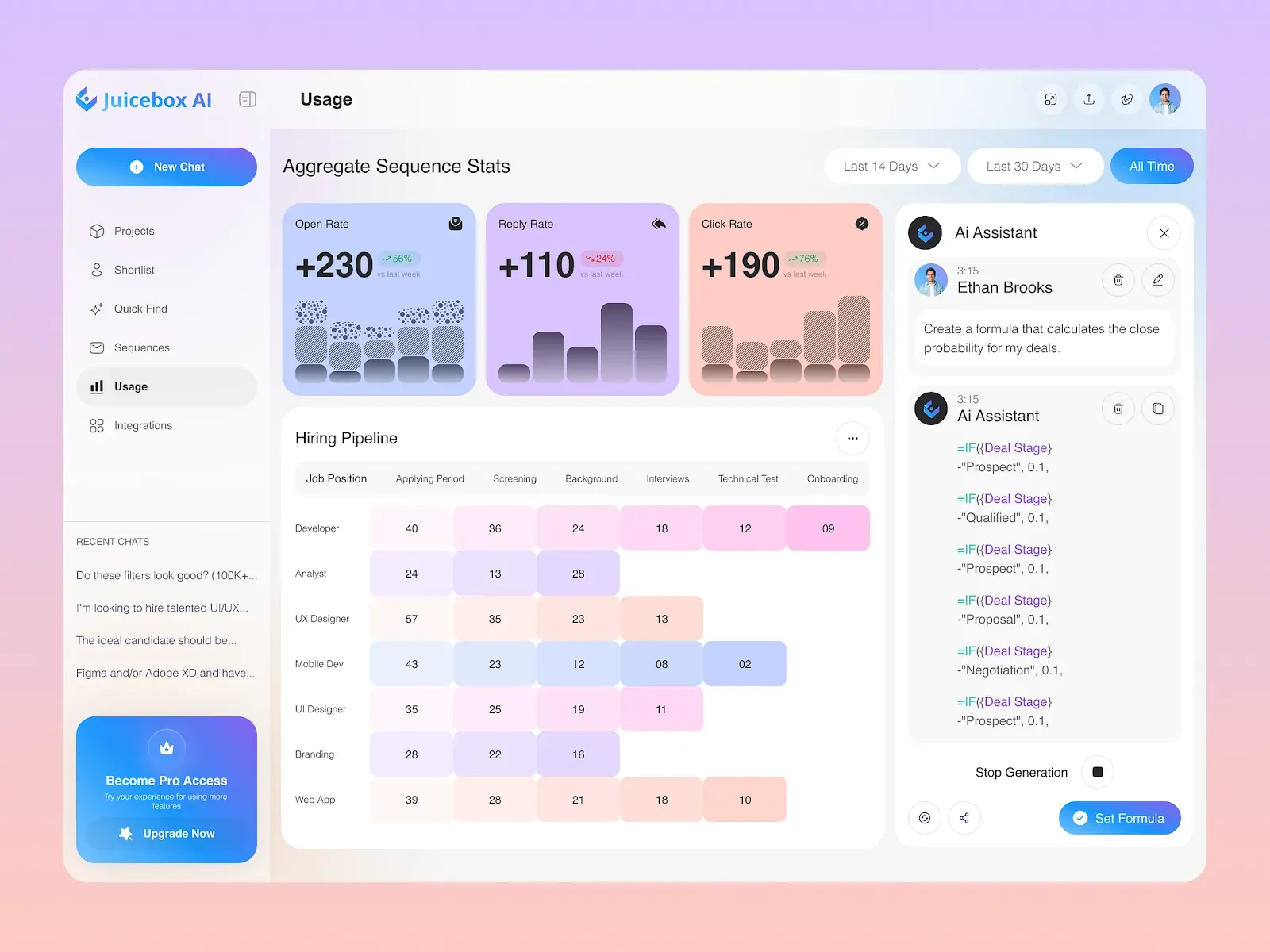
Juicebox is an AI-driven recruiting platform built around its core engine, PeopleGPT, which lets users find candidates by simply describing the role in plain language. It searches across hundreds of millions of public profiles, ranks them by relevance, and learns from your feedback to improve matches over time. Its autonomous sourcing agents keep working in the background, continuously finding and refining new candidates, while automated outreach tools handle personalized messages and follow-ups. Integrated analytics and ATS/CRM connections tie everything together, letting teams track engagement and move shortlisted candidates seamlessly into hiring pipelines. In short, Juicebox turns manual sourcing into a continuous, AI-assisted talent-discovery system designed for speed, precision, and scalability.
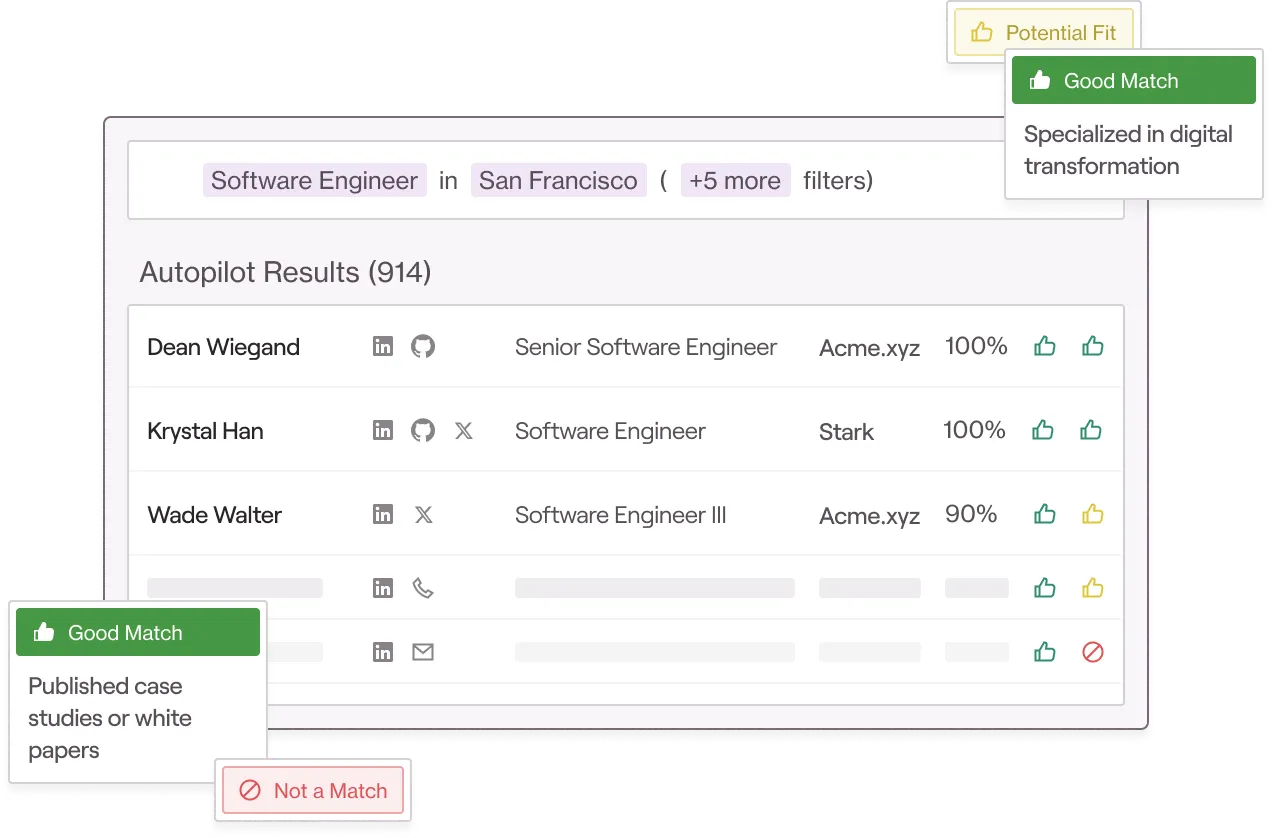
Pros of Juicebox
- Ideal for recruiters, founders, and hiring teams—built to streamline sourcing, automate outreach, and scale hiring efforts.
- A powerful AI engine searches hundreds of millions of profiles using natural language, making it easy to describe the talent you need. (PeopleGPT)
- Built-in personalized email sequences help recruiters contact candidates efficiently and track replies.
- Connects with major ATS and CRM systems—easy to plug into an existing recruiting workflow while offering strong data visibility, talent availability, engagement metrics, sourcing efficiency.
Cons of Juicebox
- Not built for job seekers—no candidate sign-up or application portal. You can’t apply for roles directly.
- Candidates can’t control how or when their data appears—visibility is passive, based on public profiles.
- Requires technical setup and a paid subscription; not a lightweight tool for casual users. Limited access to features with the free trial plan.
In essence, Juicebox reimagines recruiting as an AI-driven discovery process rather than a manual search-and-message grind. It empowers founders and hiring teams to act more like data-savvy talent scouts—automating the repetitive parts of sourcing while surfacing higher-quality candidates faster. Its strength lies in precision, scalability, and continuous learning through AI agents, making it especially useful for startups or recruiters hiring for hard-to-fill technical roles. However, it’s clearly a recruiter’s tool, not a candidate marketplace, so it shines behind the scenes—fueling better hires rather than providing a place for job seekers to apply.
2. CoffeeSpace
CoffeeSpace is a mobile-first networking and early hiring platform designed to help founders, builders, and early-stage talent find cofounders and first hires. Think of it as the “Tinder for startup builders,” but with smarter filters and a focus on meaningful professional matches. Instead of scrolling through job boards or cold-emailing potential teammates, users swipe through curated profiles of founders, engineers, designers, and operators looking to collaborate on new ventures or join early teams.
What makes CoffeeSpace stand out is its expansion to focus on the very first 5–10 hires—the people who often define a startup’s culture and direction. The platform uses a double opt-in match system (both sides must express interest), offers skill-based and mission-based filters, and integrates chat features for direct communication once a match occurs. Its UX is designed to feel natural and fast—mirroring social discovery apps—but built specifically for startup team formation, not casual networking.
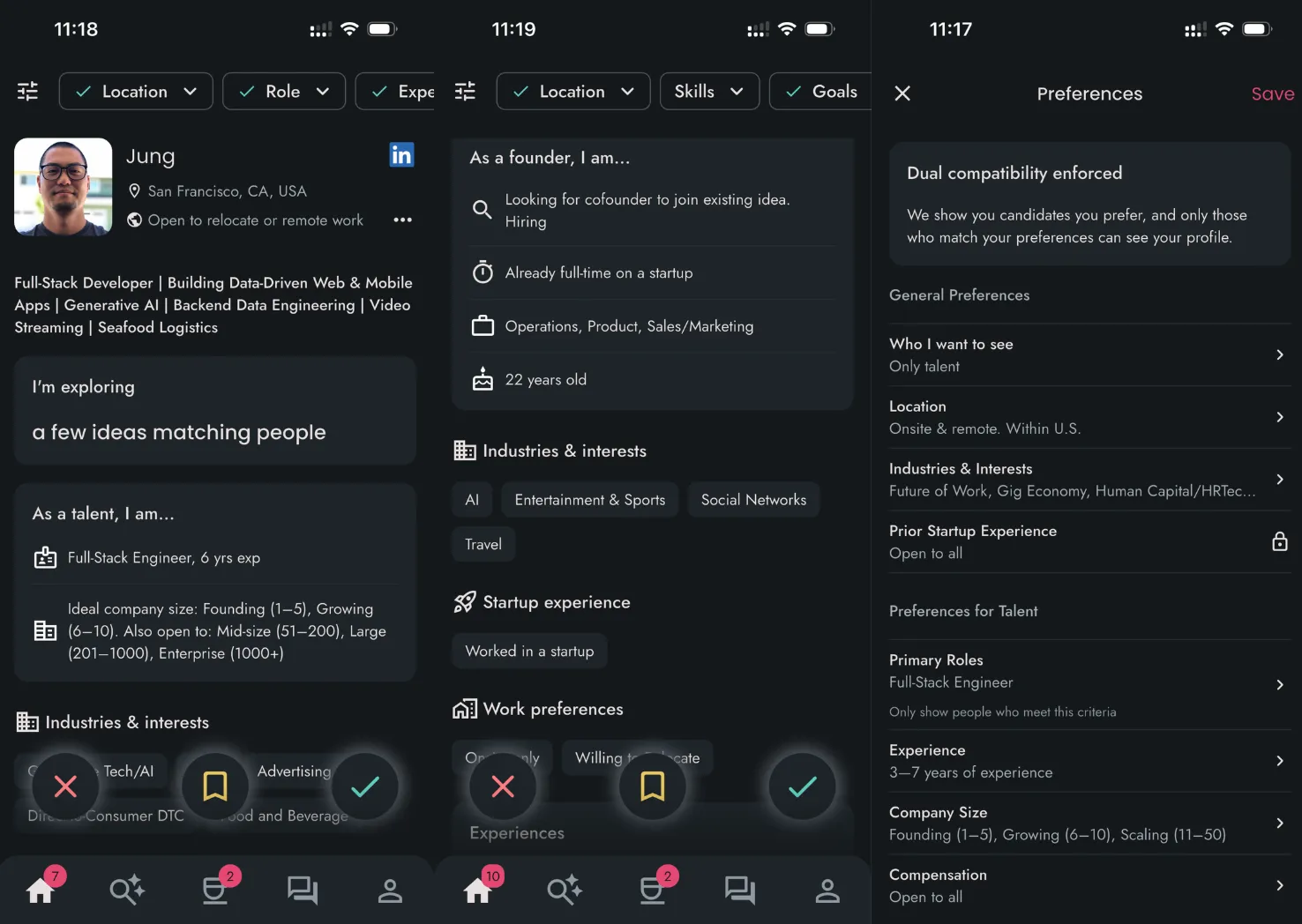
Pros of CoffeeSpace
- Tailored for early-stage founders and first hires, focusing on cofounder and early team formation rather than corporate recruiting.
- Mobile-first (iOS and Android), swipe-based interface makes discovery fun and intuitive; strong onboarding flow for clarifying goals, skills, and interests.
- Double opt-in ensures mutual interest before messaging; helps avoid spam and wasted outreach.
- Built-in chat and direct messaging make it easy to connect once matched; lightweight and immediate communication channel.
- Encourages authentic interaction around ideas and collaboration, not just jobs; integrates “coffee chat” prompts for organic networking.
Cons of CoffeeSpace
- Smaller user base compared to large job platforms; less suitable for later-stage hiring or non-startup roles.
- Matching relies on active users in your region or field—low density in some markets can limit matches.
- No advanced recruitment tools like applicant tracking, job posts, or candidate analytics—purely connection-focused.
CoffeeSpace fills a unique gap in the early hiring landscape—bridging social discovery and professional networking for founders who need to build their first team fast. Its mobile-native, swipe-based UX lowers the barrier to meeting potential cofounders or first hires, while the curated, startup-focused user base keeps the experience relevant and high-signal. It’s not designed for traditional recruiting or late-stage hiring pipelines; instead, its magic lies in those early, serendipitous connections that turn ideas into real companies. For founders seeking like-minded collaborators—or for early builders looking to join something from the ground up—CoffeeSpace delivers a modern, human way to meet the people who’ll help shape your next big venture.
3. Upwork
Upwork is a human and AI-powered work marketplace that connects businesses with independent professionals across more than 10,000 skills, from software and design to marketing, finance, and customer support. For early teams, it covers the work that sits outside permanent hires: a brand designer before a launch, a finance contractor to close the books, a mobile developer to ship one feature.
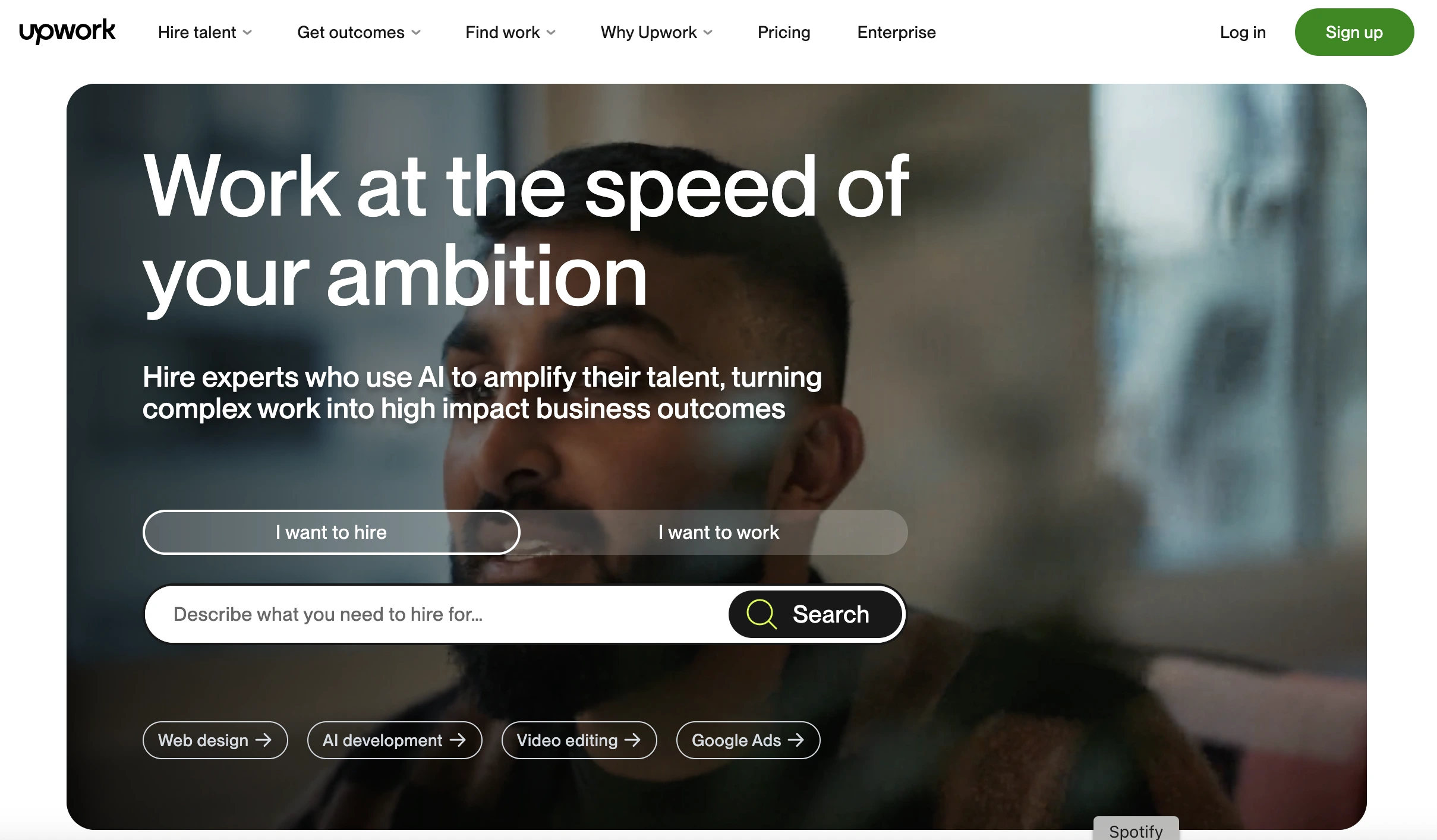
Pros of Upwork
- Access to vetted independent talent across 10,000+ skills
- Fast time to start, often within days of posting a role
- Built-in contracts, milestones, and payment protection
- Job Success Scores and client reviews to guide evaluation
Cons of Upwork
- Not built for cofounder search or full-time employee hiring specifically
- Quality varies across an open marketplace, so screening from the client's end still matters
- Project-based engagements require a clear scope to work well
Upwork is a strong choice for startups that need flexible, project based talent quickly. Its broad talent pool, built in contracts and payment tools, and access to professionals across thousands of skills make it useful for filling immediate skill gaps without committing to a full time hire. However, Upwork is ultimately built around getting specific work done, rather than building a long term team. It works best when you have a clearly defined project and know the skills you need, but is less suited to finding cofounders, early employees, or people who will take ownership and grow with the company. For early stage startups, Upwork is best viewed as a complement to permanent hiring, rather than a replacement for it.
4. Contrario
Contrario positions itself as a hybrid recruiting platform that combines the efficiency of AI with the expertise of human recruiters. Rather than being a simple job board or matchmaking app, Contrario operates as a managed talent marketplace, connecting startups and growth companies to pre-vetted recruiters who specialize in specific roles or industries. Its unique value lies in this blend of automation and human touch. Unlike self-serve platforms where founders must source candidates themselves, Contrario allows startups, especially early-stage ones without internal HR, to delegate that work to trusted recruiters who are augmented by data-driven matching algorithms. This makes it particularly useful for lean teams looking to fill critical technical or leadership roles without building a full recruiting function internally.
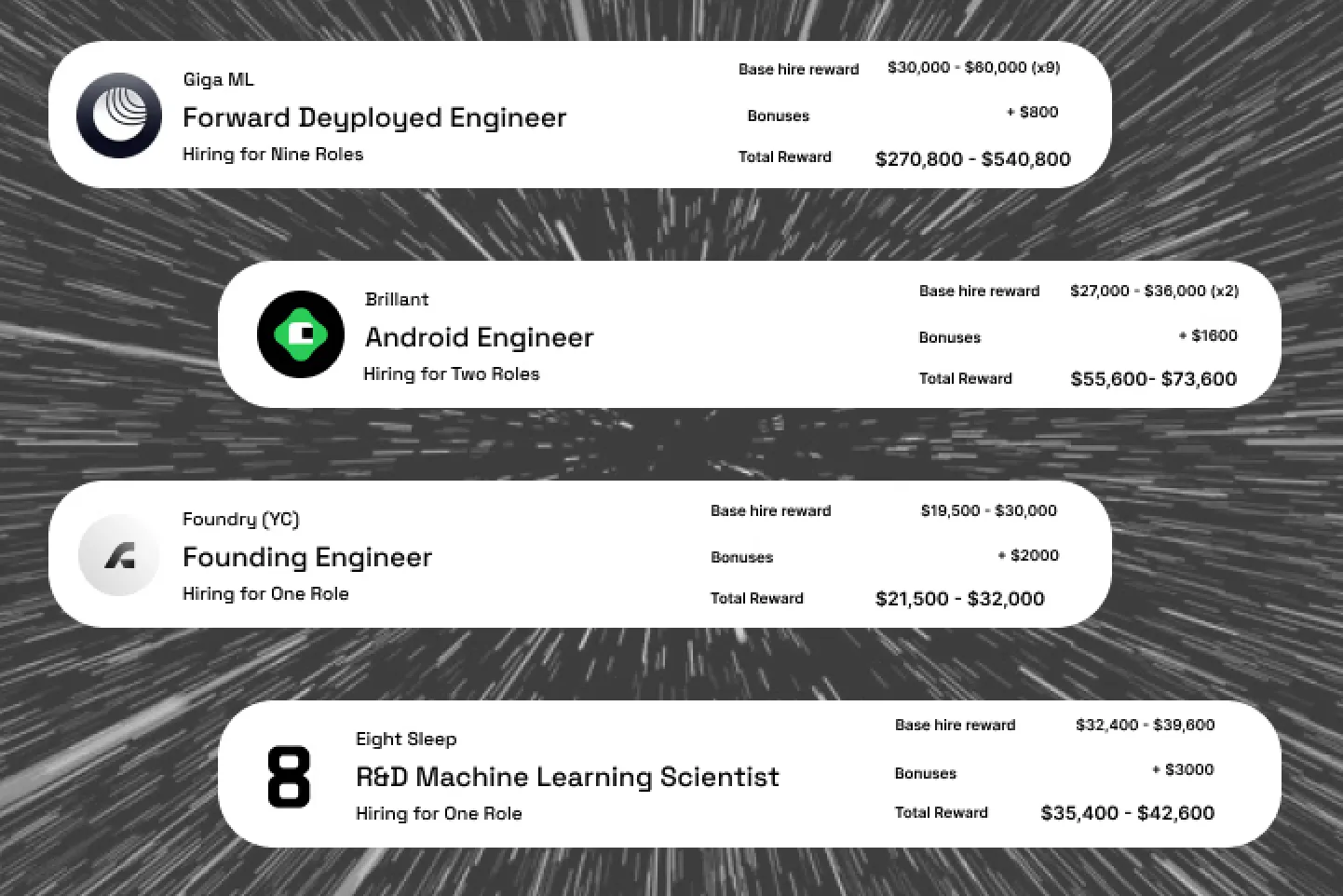
Pros of Contrario
- Ideal for startups needing expert help to fill early or niche roles; combines human recruiters with AI efficiency.
- Operates as a web platform with dashboards for clients and recruiters; supports integrated communication and tracking.
- Transparent pricing and likely lower than traditional recruiting agencies; pay for successful placements.
- Access to a vetted community of experienced recruiters who specialize in startup and tech hiring.
- AI tools that assist with candidate discovery, filtering, and matching, improving speed and reducing manual work.
Cons of Contrario
- Recruiting quality can vary slightly by individual recruiter, as it’s still a marketplace model.
- Lacks public-facing candidate discovery—everything is handled through the recruiter, not through browsing or swiping.
- No mobile app version currently; mainly web-accessible and service-driven.
- The AI is used to assist recruiters, not founders directly—so benefits are indirect unless you’re on the hiring side.
Contrario bridges the gap between traditional recruiting agencies and AI-driven hiring tools, offering startups a semi-outsourced, high-speed recruiting solution. Backed by Y Combinator, it matches founders with vetted recruiters who use AI to identify and engage top candidates efficiently. This managed approach lets lean teams fill technical or leadership roles quickly without building internal HR capacity. Best suited for founders who prefer to delegate hiring, Contrario delivers a balanced mix of automation, human expertise, and reliability—ideal for startups that need quality hires fast without sacrificing fit or precision.
5. YC’s Work at a Startup
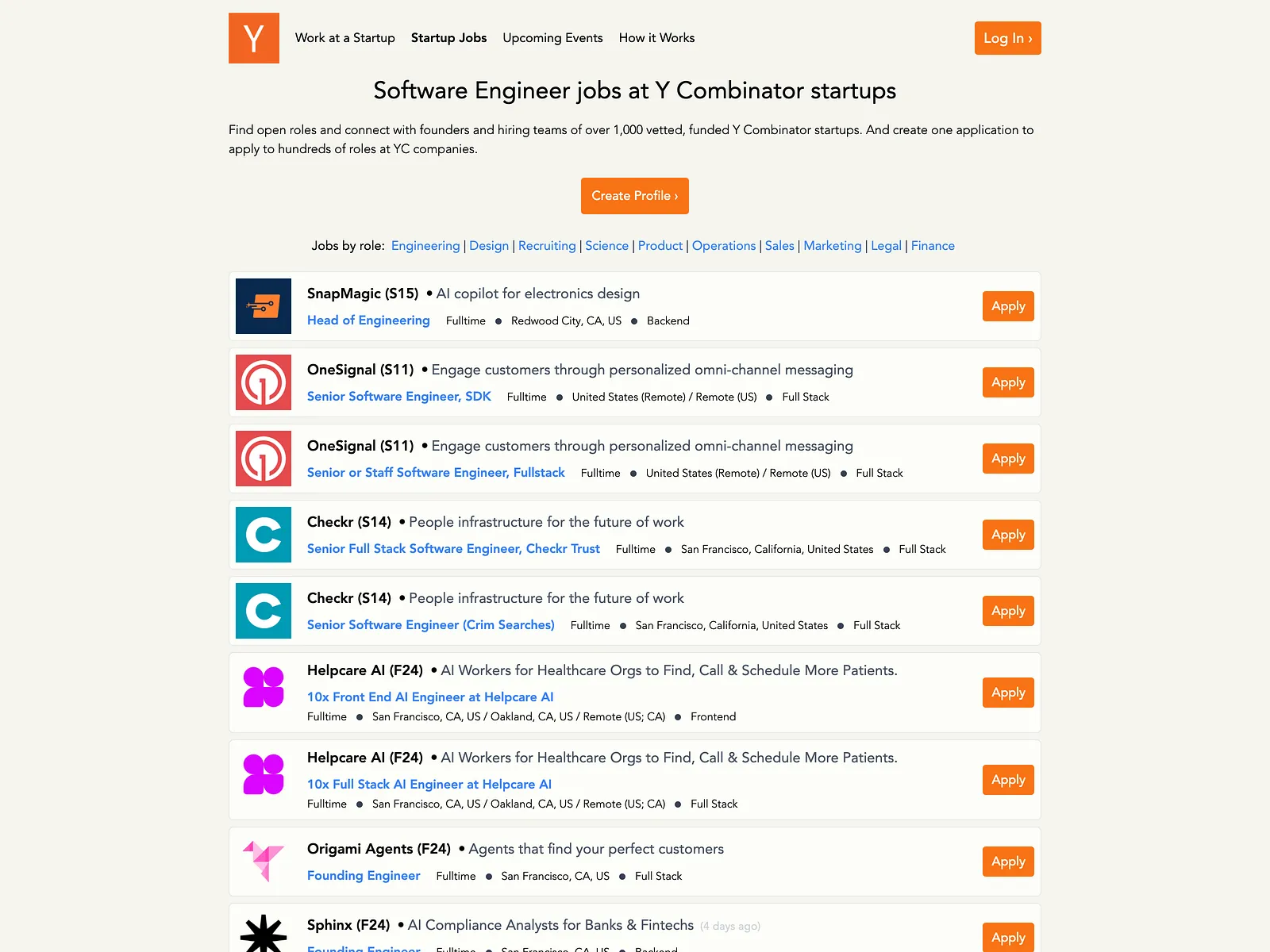
The platform Work at a Startup is a job-board and matching site run by Y Combinator that connects job-seekers with roles at YC-backed startups. Users create a single profile and apply once, and then the startup companies in the network browse those profiles and reach out to matching candidates. The idea is to reduce the friction of applying to many early-stage companies, especially for technical roles, and to give candidates access to hundreds (or thousands) of startups via one central application.
Pros of YC's Work at a Startup
- Gain exposure to many YC-backed or YC-affiliated companies (often early stage, high growth potential) via one profile.
- Ideal if you want to work in a startup environment (fast-paced, multiple hats, high growth).
- The platform is designed for startups to browse candidates, which means you may get inbound interest rather than constant outbound hunting.
- YC’s name carries credibility; working at a YC-backed company can carry professional signals.
Cons of YC's Work at a Startup
- The feedback loop is weaker for candidates: some users report minimal responses or transparency on application status.
- You may lack control over which exact role you’re applying for; some roles may not match your ideal preferences.
- The “YC brand” can draw a large applicant pool, meaning roles fill fast or get very high application volumes. Because it’s open to all YC and larger scale startups, the number of applicants is very large, competition is intense.
Work at a Startup offers a valuable gateway for job-seekers who are motivated to work at early-stage, growth-oriented startups, especially those connected to Y Combinator. It simplifies the application process and gives access to a broad network of companies. However, because of its wide reach and startup focus, users should be prepared for high competition, less control over individual role matches, and startup-specific trade-offs (pace, ambiguity, risk). If you’re looking for startup roles and are comfortable with that environment, this platform is a strong option; if you prefer very specific roles, slower growth organizations or more mature companies, it may be less ideal.
6. Sorce
Sorce is also a mobile-first, AI-powered job-search app that transforms the way job-seekers apply by combining a swipe-based UX (akin to a dating app) with automation behind the scenes: you upload your résumé once, swipe right on jobs you like, and Sorce’s AI agent handles the rest (forms, cover letters, submissions) automatically. It aims to reduce the grind of traditional job-hunting by offering “one-swipe apply” plus smart matching and tracking of applications.
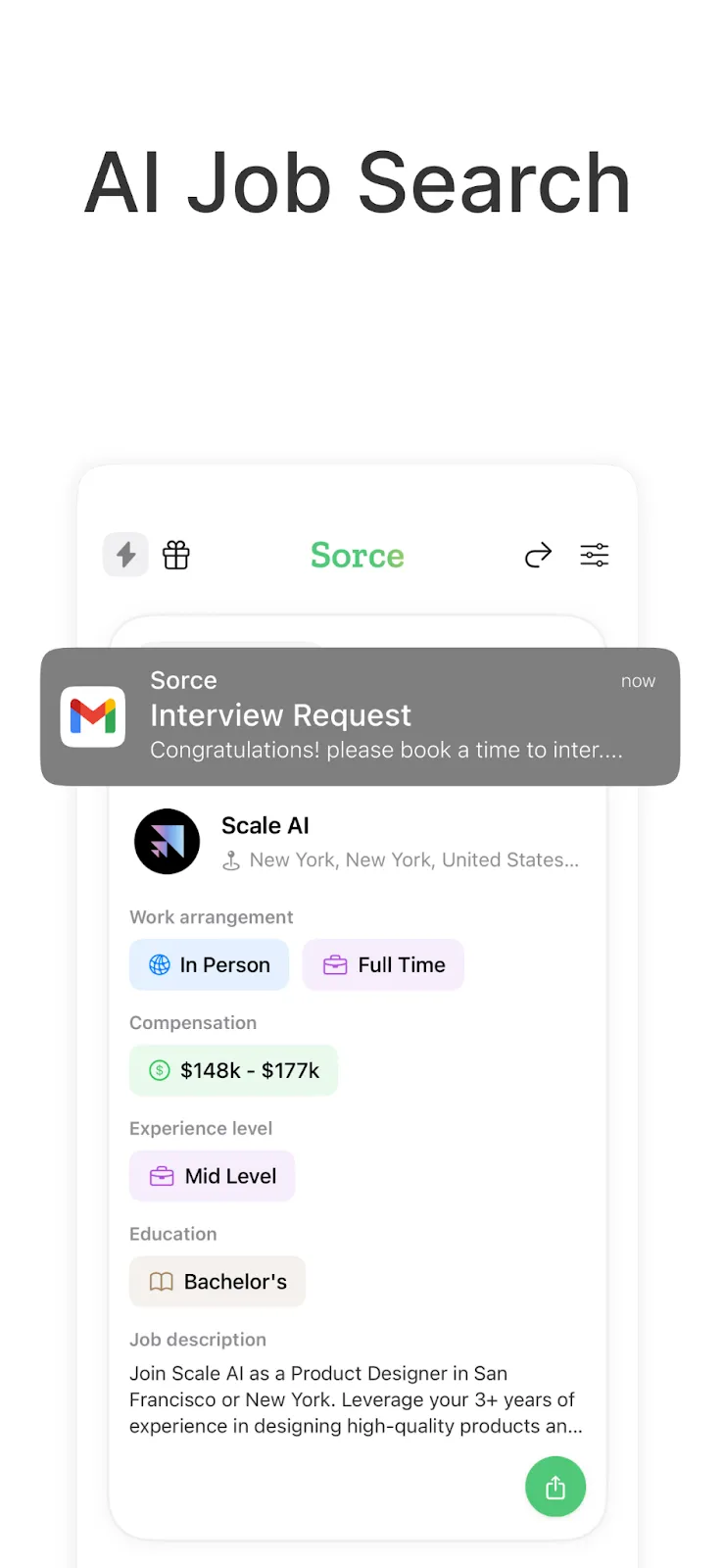
Pros of Sorce
- Extremely simple UX: swipe to apply. Great for reducing manual effort and quick applications. Designed for mobile usage, convenient on the go, modern UI.
- AI fills forms, generates cover letters, submits applications on your behalf—massively cuts time.
- You can start for free; a good concept for high-volume seekers or career switchers.
Cons of Sorce
- Because it’s newer and more experimental, there may be bugs, fewer filters, and less mature employer coverage.
- Risk of less control, errors or mis-submissions; you may not always see exactly what was submitted.
- Premium features/credits are comparatively expensive; some see value-issues.
Sorce offers a compelling alternative to traditional job-search platforms—especially for job-seekers who value speed, convenience, and mobile-first workflows. Its swipe-to-apply model and AI automation can dramatically reduce the time and effort of applying, which is a major plus for early-career professionals, career-changers or those casting a wide net. On the flip side, the model trades off some precision, control and filtering power: users may receive mismatched jobs, need to trust the AI agent’s submissions, and pay more for premium features. If you’re comfortable with a high-volume, mobile-centred job-hunt and willing to review what the AI submits on your behalf, Sorce can be a useful tool. But if you’re targeting very specific roles, industries or geographies with high selectivity and want full control over every application, you might still combine it with more traditional job-search methods.
7. Mercor
Mercor is a next-generation AI-powered talent marketplace designed to streamline and scale hiring for high-skill, global roles — particularly in fields like AI, engineering, legal, medicine, and research. Rather than being a simple job board, Mercor automates large parts of the recruitment workflow: candidates upload a resume, often complete a 20-minute AI-led interview, and then are matched via algorithmic scoring to roles. On the employer side, jobs are posted and Mercor’s AI (alongside a global talent pool) surfaces high-signal matches, onboarding and payment infrastructure included. The uniqueness lies in its end-to-end stack (sourcing → assessment → onboarding → payments) plus its focus on expert/contractor talent globally.
Read more about their founding journey here.
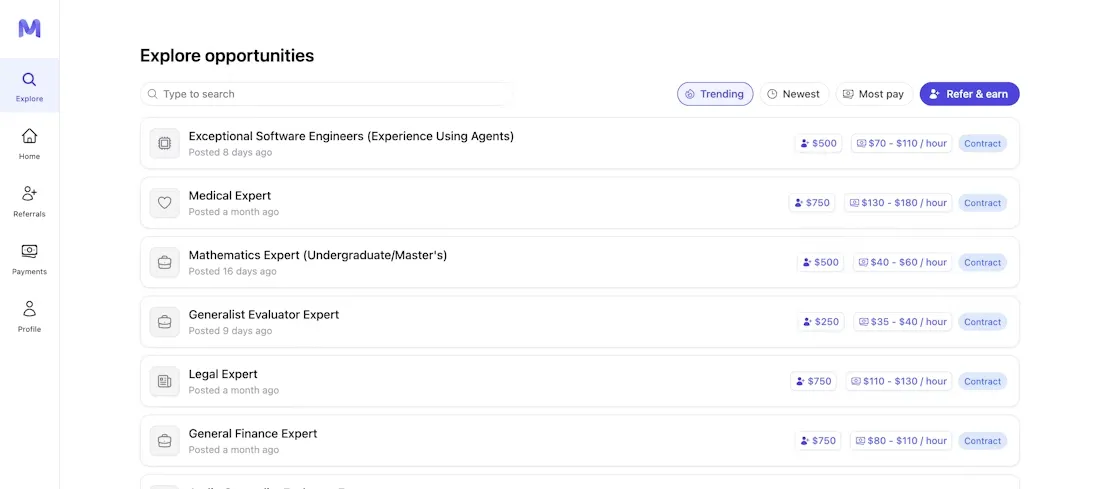
Pros of Mercor
- Automates multiple steps: AI interviewing, matching, contracting, global payments.
- For employers: high value for high-signal hires; model is aligned around successful placements.
- Access to very high-skill professionals across domains (engineers, PhDs, lawyers, etc.).
- Uses AI profiling & interviews to emphasise skills rather than purely credentials.
Cons of Mercor
- For candidates: application process may feel opaque; pricing models for employers (and by extension role types) are less public. Also feedback loops for candidates may be weak.
- AI-based assessments raise concerns: bias, transparency, candidate experience and whether metrics used really correlate with performance.
Mercor stands out as an AI-driven global hiring marketplace built for startups and companies seeking specialized, high-impact talent—especially in technical and expert domains. Its end-to-end automation, from AI-led interviews to skill-based matching and international payments, sets it apart from standard job boards. For skilled candidates open to remote or contract work, it offers a fast, data-driven path to global opportunities. However, Mercor’s focus on high-signal, expert roles means it’s less suited for conventional or local hiring. Overall, it’s a strong fit when you need to hire top talent fast and globally, but not ideal for routine or non-specialized roles.
8. Turing
Turing is a remote-engineering hiring platform that lets companies access pre-vetted, full-time software engineers from around the world. It uses an “Intelligent Talent Cloud” model: developers apply, undergo rigorous tests and interviews, then the platform matches them to roles with companies. On the employer side, you define the skills you need, and Turing delivers candidates within days, with managed onboarding, timezone overlap, and trial periods. Their focus is squarely on technical talent at scale, not generalist or local hiring.
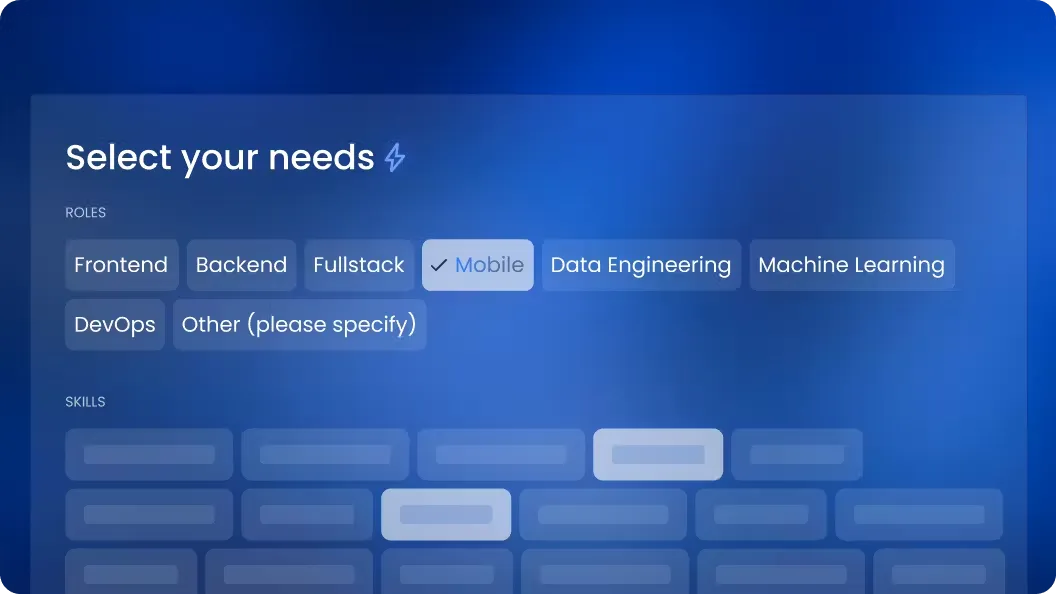
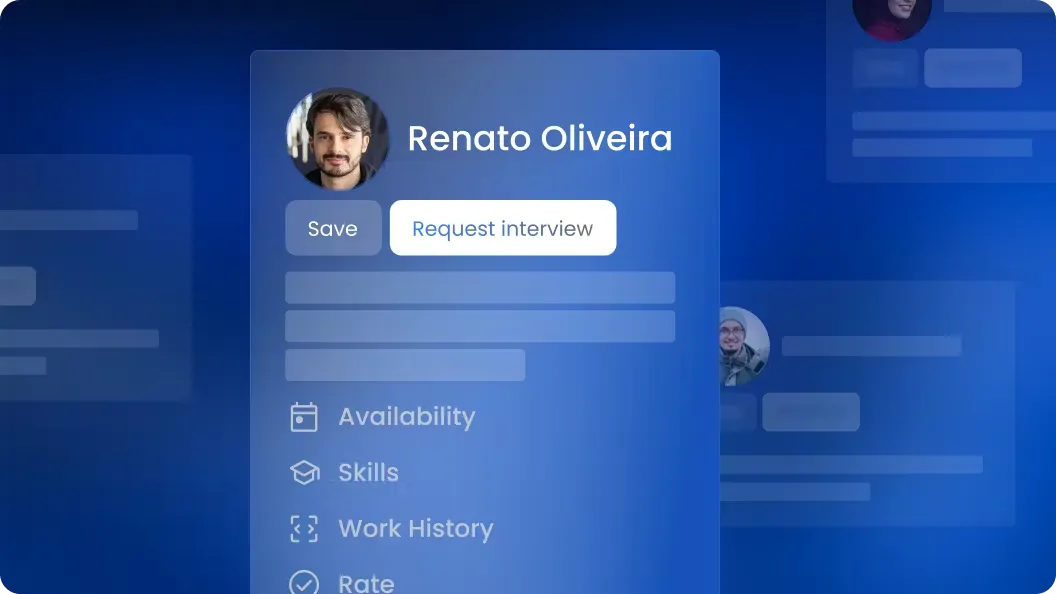
Pros of Turing
- Strong vetting: developers face multiple hours of coding/data-structure/system design tests to reach “top 1%” claims.
- Promises very fast matching for companies (roles filled in 3-5 days typical).
- Includes onboarding, remote collaboration tools, and a risk-free trial period for hires.
- Excellent for software engineering, especially roles needing senior, specialised skills.
Cons of Turing
- Less suitable for non-engineering or generalist roles (operations, admin, local hires) — the focus is heavily technical.
- For job-seekers: high barrier to entry; vetting is strict, and some candidates report scarcity of matching roles.
- Timezone overlap requirement (minimum of ~4 hours) may still create coordination challenges; cultural/communication fit may vary.
Turing stands out as a top choice when your hiring goal is to bring on remote, full-time software engineers with strong technical skills and you’re willing to use a managed, global platform. For a startup or scale-up in tech, it can dramatically reduce time-to-hire and tap into global talent that might otherwise be inaccessible.
However, if your hiring need is for non-engineering roles, or you prefer sourcing locally, part-time or traditional hire workflows, then Turing may be overkill or less suitable. For candidates looking for more flexible, less rigorous entry paths, the barrier is high. In short: powerful and efficient for tech-centric, remote-engineering hiring, but less ideal for other kinds of roles or more flexible hiring models.
9. Wellfound
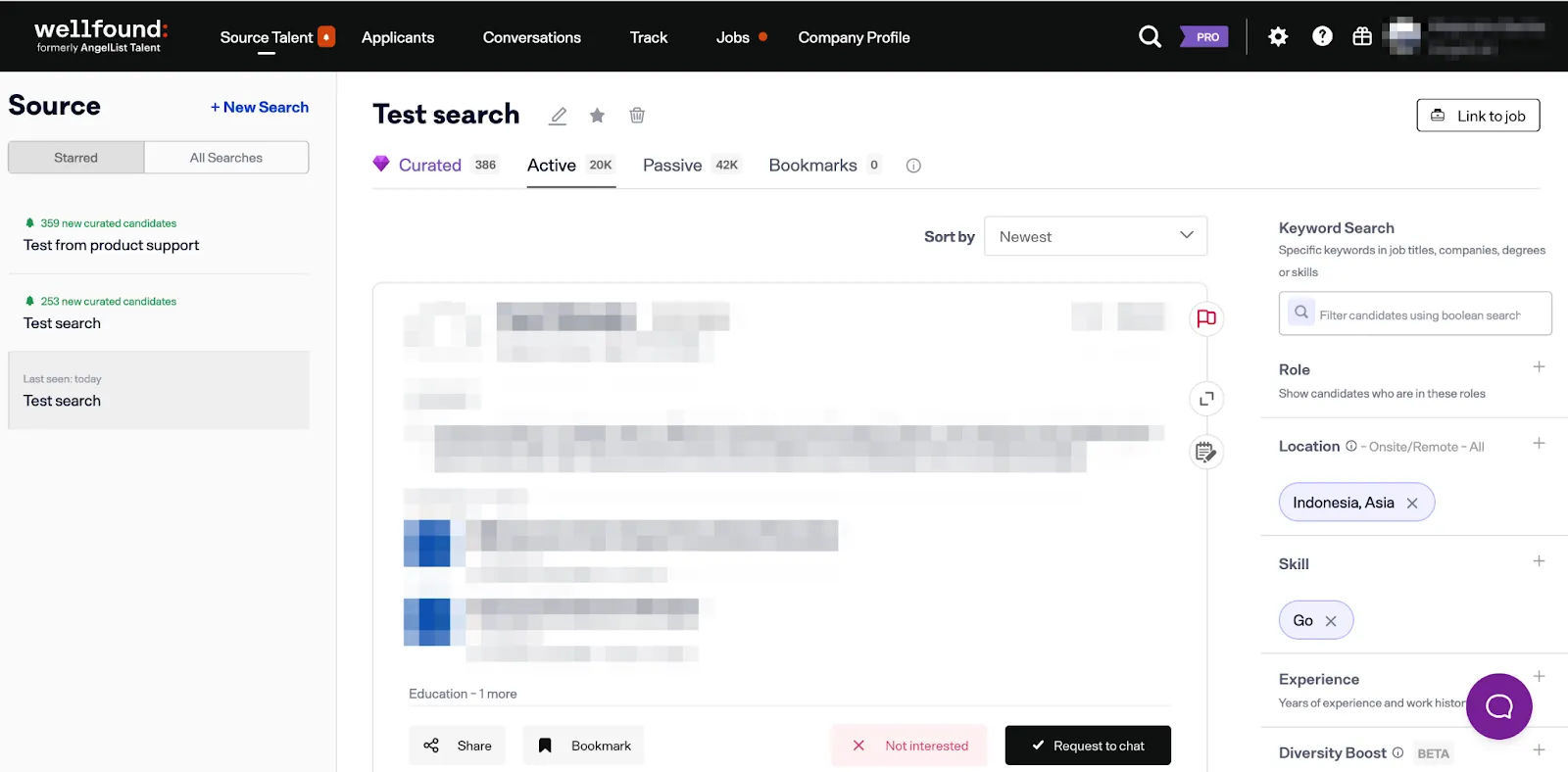
Wellfound (formerly known as AngelList Talent) is a job-platform tailored for the startup ecosystem: it connects candidates with startup-minded roles and enables companies (primarily tech startups) to post jobs, build company branding, search candidate profiles, and hire. The platform emphasises startup-specific filters (such as company stage, funding, remote vs. onsite), salary/equity transparency, and “one-click apply” flows, making it especially suited for job-seekers who are looking to join an early-stage company, and for startups that want to tap into a talent pool of people motivated by startup culture.
Pros of Wellfound
- Strongly oriented toward startup jobs: many listings from seed to Series C startups and roles that might be hard to find on generic boards.
- Allows “one-click apply” once your profile is set up. Candidates can see salary and equity information upfront, which helps with transparency.
- For job-seekers: free to use; posting jobs (for companies) has free options, making the board accessible.
- Good for startups: built-in community of “startup-ready” professionals; good fit for roles where culture/fit matters.
Cons of Wellfound
- High competition for roles (popular startup jobs) means many applications per listing; may reduce visibility.
- Despite the streamlined flow, many users report low response rates and some listings go un-reviewed.
- Because it focuses on startups, roles outside tech or non-startup culture may be under-represented.
- As a company, to get premium sourcing tools (e.g., advanced candidate search) you may need paid tiers. For job-seekers, startup risk (e.g., fewer safeguards) may be higher.
Wellfound is a go-to platform for startup-focused talent, particularly in tech, design, and product roles. It stands out for its transparency, startup-specific filters, and fast, intuitive application flow, giving both candidates and startups access to a like-minded community. However, competition is steep, response rates can be inconsistent, and it’s less suited for traditional or non-startup roles. In short, it’s ideal for those who thrive in fast-moving startup environments, but not for those seeking corporate stability.
Conclusion
In the end, choosing the right early hiring platform comes down to understanding your goals — and where you fit in the ecosystem. Founders looking to build their first core team may find value in community-driven spaces like CoffeeSpace or managed recruiting hybrids like Contrario. Recruiters and headhunters might gravitate toward platforms that blend automation with precision, such as Juicebox or Mercor. And for candidates eager to join the startup world, Wellfound and YC’s Work at a Startup remain trusted entry points with strong visibility and reach.
What’s clear is that early hiring is no longer a one-size-fits-all game. The best platforms today don’t just match résumés to roles — they align ambition with opportunity, using data, networks, and human insight to accelerate growth at the earliest stage. Whether you’re building your founding team, sourcing niche talent, or searching for your next big move, these tools reflect a broader shift in how startups find their people: faster, smarter, and more intentional than ever before.
Cofounder Tips
Debunking the Vibe Coding and the Death of the ‘Technical Founder’ Myth
October 23, 2025
The old startup script went something like this: you have a brilliant idea, you code the prototype yourself (or with a technical cofounder), you build a business, you raise money, and you scale. But today, a new dynamic is emerging. With the rise of “vibe coding” — the ability to generate functioning code, workflows or complete product scaffolding via high-level prompts and AI assistants — the idea that only someone with 10+ years of software engineering can launch the next big thing is increasingly outdated.
In this article we’ll explore how the “technical founder” myth is breaking down, how non-technical founders are leveraging vibe coding to test start up ideas and run early ventures, and how you — regardless of your background — can start your business or help someone build a business.
The Technical Founder Myth: What It Means and Why It’s Fading
For many years, the stereotypical founder was a coder-engineer who tinkered late into the night, built the MVP himself, and launched the product. That narrative reinforced a gate-keeping effect: if you weren’t fluent in JavaScript or Python, you weren’t in the “founder club”.
But research shows this assumption is no longer accurate. A piece titled 11 Non-Technical Startup Founders Who Built Great Tech Products lists numerous founders who lacked formal coding skills yet launched successful tech-driven companies. Another blog highlights non-technical founders of multi-billion dollar ventures who spotted market gaps and rallied technical talent rather than writing the stack themselves.
Why is this shift occurring? A few key drivers:
- Tools and Platforms: The rise of low-code, no-code, and now “vibe coding” platforms reduce the barrier to build. Non-technical founders can iterate quickly on start up ideas without deep engineering. For instance, a blog on non-technical founders building AI startups without a CTO describes how platforms like Streamlit or Cursor help launch MVPs.
- Changing Investor Mindset: While technical depth still helps, investors are increasingly recognizing product-market fit, founder vision, and growth-oriented execution as prime assets — not just engineering deserts.
- Distributed Tech Talent: Access to contract engineering, offshore teams, and modular APIs means non-technical founders can still assemble tech stacks without being the coder themselves.
In short: the path to build a business is no longer exclusively the code-monkey founder’s game.
What Vibe Coding Means for Founders
“Vibe coding” describes a paradigm where instead of typing every line of code, a founder or product lead describes in natural language what they want — and AI tools generate code, workflows, interfaces, or full product skeletons. The founder becomes a designer of intent rather than a hand-coder of modules.
In the context of startups, this unlocks several interesting possibilities:
- You can very quickly test start up ideas around MVPs — launch landing pages, simple apps, referral flows — without waiting for full engineering sprints.
- You can iterate on technology startup ideas at speed — adjusting features, user flows, or integrations when the market signals shift.
- You can assemble a team around your vision: you don’t need to be the tech lead; you can instead be the product + growth + vision lead, orchestrating the tech side.
However — a caveat from the field: while vibe coding helps you launch, scaling (especially for complex technical stacks, deep infrastructure or highly competitive moats) still often requires engineering depth. For example, the GitHub CEO noted that “non-technical founders will find it difficult to build a startup at scale without developers” despite the vogue around vibe coding. But for early-stage ventures, the threshold has definitely moved.
Non-Technical Founder Examples: Real Startup Stories
Example 1: Airbnb – Brian Chesky
Brian Chesky (industrial designer by training) cofounded Airbnb with a lean code base and a clear vision — he did not come from hardcore software engineering. His story underscores how spotting a gap (short-term lodging during a conference) + strong product intuition + design mindset enabled him to start a venture that became a global platform.
Example 2: Pinterest – Evan Sharp
Evan Sharp, cofounder of Pinterest, entered the startup world with an architecture/design background rather than pure software engineering. The point: vision, design, product-market fit often matter just as much or more than raw coding lines.
Example 3: Non-technical founders launching AI-driven ventures
One blog describes how non-technical founders are leveraging platforms to launch technology startup ideas without decades of engineering backgrounds. They validated the market and built early MVPs without being deep technical experts.
From these examples we can infer key lessons: vision matters; the ability to engage target users, test start up business ideas, iterate and engage is fundamental; deep technical expertise can be outsourced or paired; and your role as founder can be orchestrator rather than code-hero.
How to Launch (or Join) with the “Non-Technical Founder” Mindset
1. Pick the right start up business ideas
Your first step is to spot opportunities — gaps in user experience, underserved niches, fresh ways to use technology. Because you can lean on vibe coding and tooling, you can move fast. The process of exploring start up ideas is no longer held back by “I can’t code.”
2. Prototype with vibe tools
Use no-code platforms, low-code stacks and vibe coding assistants to build early versions. Get user feedback, iterate quick. The goal is to test your assumption: can you build a business around this idea? Can you find early traction?
3. Find a savvy tech partner or cofounder
Even if you’re not the code hero, you still need someone who understands the tech stack, drives execution, and complements your skills. Use networks — like CoffeeSpace — to meet cofounders, collaborators or technical leads. Being able to say “I have a validated MVP, users, growth metrics” is far better than “I have an idea and can’t code.”
4. Focus on growth, market, distribution
Your role as non-technical founder is often to lead strategy, go-to-market, customer acquisition, partnerships, vision. According to advice for non-technical founders, your value lies in acquiring customers, building the business, managing teams—not just writing code.
5. Use your non-technical strength as a differentiator
You might come from domain expertise (healthtech, legal, education), design, operations, marketing. Leverage that. Don’t try to pretend you are a full stack engineer. Instead, lean into your domain insight, your user's pain, your ability to see technology startup ideas and apply tools to them.
Why This Means the “Technical Founder” Myth Is Dead
- Barrier to entry has lowered: You don’t need to code everything yourself to get to MVP.
- Emphasis is increasingly on vision, growth, distribution and user needs — not just architecture.
- Fundamental shift in how startups form: cross-functional founding teams (product, design, growth) are equally viable.
- The term “technical founder” used to imply coding wizardry — now it simply means founding a tech company (regardless of who writes the code).
Yes, engineers still play a critical role especially in building defensible tech, complex stacks, tooling — but the founder role is not gate-kept by being a development virtuoso. The game is more inclusive.
Potential Pitfalls & How to Mitigate Them
While the barrier has lowered, there are still risks:
- If you rely solely on vibe coding and lack deeper tech understanding, you may run into scaling issues. The GitHub CEO warns about this.
- You may struggle to attract engineering talent if you don’t show strong execution or product sense — engineers want to build meaningful systems.
- If you pick an idea that requires deep technical innovation (e.g., new hardware, core AI research), you’ll likely need technical mastery or partnerships.
To mitigate: ensure you validate user demand early; secure a competent tech partner; build meaningful traction; use tools and platforms strategically but also plan for scale; and always keep learning about the domain, product and stack.
Summary
The narrative you must code yourself from day one is gone. With vibe coding, powerful tooling, and shifting startup dynamics, the concept of a strictly “technical founder” is no longer a barrier for launching a venture. You can still launch a startup by focusing on user problems, testing start up business ideas, writing the story of how you will build a business, iterating products and leveraging networks like CoffeeSpace to find the right technical partner.
Whether you’re exploring technology startup ideas or joining someone else’s journey, keep in mind: your job isn’t necessarily writing every line of code — it’s creating the conditions for the product to emerge, grow and scale. Use your strengths, plug into tools, connect with collaborators, and take action.
If you’re ready to explore start up ideas, help someone start your business, or partner with someone to build a business, head to CoffeeSpace now. Find a cofounder who matches your values, brings the technical complement you need, and is ready to launch alongside you.
Cofounder Tips
The Vibe Coding Economy: How “Just Describe It” Became a Startup Engine
October 22, 2025
A subtle but significant shift began in early 2025. The idea that you could simply tell software what you wanted and—without writing every line of code yourself—watch it materialize, moved from speculative demo to viable workflow. That shift is now known as vibe coding: a mode where a human becomes less of a coder and more of a director of intent, describing behavior, refining output, and letting AI agents generate structure, logic, UI, and wiring.
Several forces converged to make this real. Large language models became good enough to generate usable code across front and back ends. Development tools integrated prompt → code → run → deploy flows in one seamless environment. Economic pressures shifted—solo founders, micro-SaaS creators, and non-traditional builders realized the barrier to shipping a product was lower than ever. Culturally, vibe coding began appearing across tech blogs and accelerator stories, turning into a real movement.
The term “vibe coding” itself became popular after Andrej Karpathy described “a new kind of coding where you fully give in to the vibes—forget that the code even exists.” That phrase captured the essence of what was happening: coding not as line-by-line construction, but as intention, direction, and iteration.
Mechanics: How Vibe Coding Works
In practice, vibe coding follows a distinct workflow. A founder begins with an intent, not a spec. For example: “I want a dashboard that shows my subscription spend by category, with export to CSV.” That sentence becomes the seed.
From there, an AI engine scaffolds routes, UI components, and data models. The founder inspects the app, identifies gaps, and refines prompts: “Group by week instead of day,” “make the button red,” “add Google login.” The system regenerates or patches code. When the output feels right, deployment often happens through one-click or built-in hosting.
What sets this apart from traditional AI-assisted coding is mindset. Instead of typing code with AI filling in lines, the founder describes intent and judges whether the behavior fits. The human role shifts from syntax to orchestration. It’s less about implementation, more about direction and validation.
It doesn’t eliminate human work—but it redefines it. Less boilerplate, more iteration. Less syntax, more steering. The founder becomes a conductor, not a carpenter.
Why It’s Gaining Traction
Several factors explain vibe coding’s rise:
- Model and tool maturity: AI systems can now handle complete stacks, generate production-grade UI, and integrate with APIs.
- Speed as an advantage: Startups win when they iterate faster. Vibe coding compresses months of work into days.
- Democratization: Non-technical founders, creators, and domain experts can now build, not just ideate.
- Cultural momentum: “I just prompted it and shipped” has become the maker world’s rallying cry.
- Ecosystem support: Editors, deployers, and frameworks are adapting to prompt-driven workflows.
Together, these trends make vibe coding more than a novelty—it’s a reconfiguration of how software is built and who gets to build it.
The Startup Economy Around Vibe Coding
Lowering the Barrier to Start
Traditionally, software startups needed teams of engineers, months of work, and substantial funding. With vibe coding, the economics change.
Founders can prototype products quickly, validate user demand before hiring, and pivot without technical overhead. Startups now iterate multiple versions of an idea in the time it once took to write a first line of code. For many, this means being able to start your business with limited funding and a high-velocity feedback loop.
The result: more people experimenting with start up ideas, more micro-SaaS builders turning hobbies into revenue, and a broader base of entrepreneurs entering tech.
Evidence from Startup Activity
Recent accelerator data shows that nearly a quarter of early-stage startups now use AI to generate large portions of their MVP codebases. These aren’t experiments—they’re companies securing funding and finding customers.
Vibe coding shortens the path between idea and execution. Non-technical founders who once needed co-founders or agencies now can build their own prototypes. The bottleneck is no longer “can we code this?” but “does this solve a real problem?”
Tooling Giants of the Vibe Economy
Lovable
Sweden’s Lovable became the face of the movement by enabling anyone to build functional software through natural language. Its growth has been extraordinary—millions of users, hundreds of thousands of paying customers, and revenue milestones unheard of for a company under a year old. Its founders publicly describe Lovable as a “software creation layer for everyone,” signaling a cultural shift where a computer science degree is no longer the only path to building.
Lovable’s success validated that vibe coding isn’t a gimmick. It can scale, generate serious revenue, and expand the market of software creators beyond traditional developers.
Cursor
Cursor, created by Anysphere, takes vibe coding deeper into the developer workflow. It offers a full AI-driven code editor where natural-language commands generate, modify, and debug code. Cursor has been adopted by startups and professional teams alike, integrating prompt-to-deploy pipelines and features like conversational debugging, refactoring, and full-stack generation.
Where Lovable targets creators and entrepreneurs, Cursor enhances professional developers, making engineering itself more conversational. Together, they form the dual backbone of the vibe coding ecosystem—tools for both non-coders and coders to build faster.
Real-World Builders
From solo founders creating niche apps to small teams building sustainable SaaS products, vibe coding is already producing tangible results.
A wave of creators now describes building apps, dashboards, and automations without writing much code. These aren’t just experiments—they’re products with paying users. Each success story reinforces the perception that technology startup ideas are no longer limited to those with technical backgrounds.
The Economics and Limits
Why It Works
For startups, vibe coding’s economic advantages are massive:
- Lower cost per experiment.
- Faster validation cycles.
- Reduced dependency on technical co-founders.
- Broader access to innovation.
Startups that once required six-figure engineering budgets can now launch viable products on thousands—or even hundreds—of dollars.
Where It Struggles
But vibe coding isn’t magic. The generated code often lacks architectural depth, and without oversight, technical debt builds fast. Security vulnerabilities, scalability issues, and licensing risks remain. For high-reliability or regulated systems, traditional engineering practices still rule.
As a result, most successful startups use vibe coding as a first gear—a sprint mode for building and testing ideas—before hiring engineers to stabilize and scale.
The Hybrid Future
The next phase of the vibe coding economy won’t replace developers; it will redefine their roles. Engineers will become validators, integrators, and system architects—auditing and refining what AI generates. Founders will act as product directors, guiding the vibe, testing the feel, and iterating faster than ever before.
This hybrid approach—AI for scaffolding, humans for scaling—will dominate the coming years. It mirrors what cloud computing did a decade ago: removing friction, not replacing expertise.
We’re already seeing new roles emerge: prompt architects, AI QA leads, vibe ops specialists. These will become common as startups formalize workflows around AI-driven code generation. The “vibe stack” could soon be as foundational as the cloud stack was in 2015.
What the Future Holds
Three plausible scenarios define where vibe coding is headed:
- Hybrid Mainstream Model: AI builds, humans refine. Every dev tool will have a vibe-coding layer.
- Creator Explosion: A flood of micro-SaaS builders and solo founders use vibe tools to build profitable small products.
- Governance and Standards: As vibe-coded systems reach production, new frameworks for auditing, licensing, and security will emerge.
Whatever happens, the definition of “software development” is already changing. It’s no longer just about typing code—it’s about directing, orchestrating, and iterating.
Final Word
Vibe coding is not a fad. It’s an evolution in how we build a business, test start up business ideas, and explore technology startup ideas at unprecedented speed. It won’t eliminate the need for engineers, but it expands who can build and how fast they can start.
The startups of tomorrow may not all be written by hand. They’ll be spoken, refined, and shipped through intent.
If you’re ready to experiment, here are 50 vibe coding tools you can explore to start your journey.
Sorry - there were no result for your search - try again :)